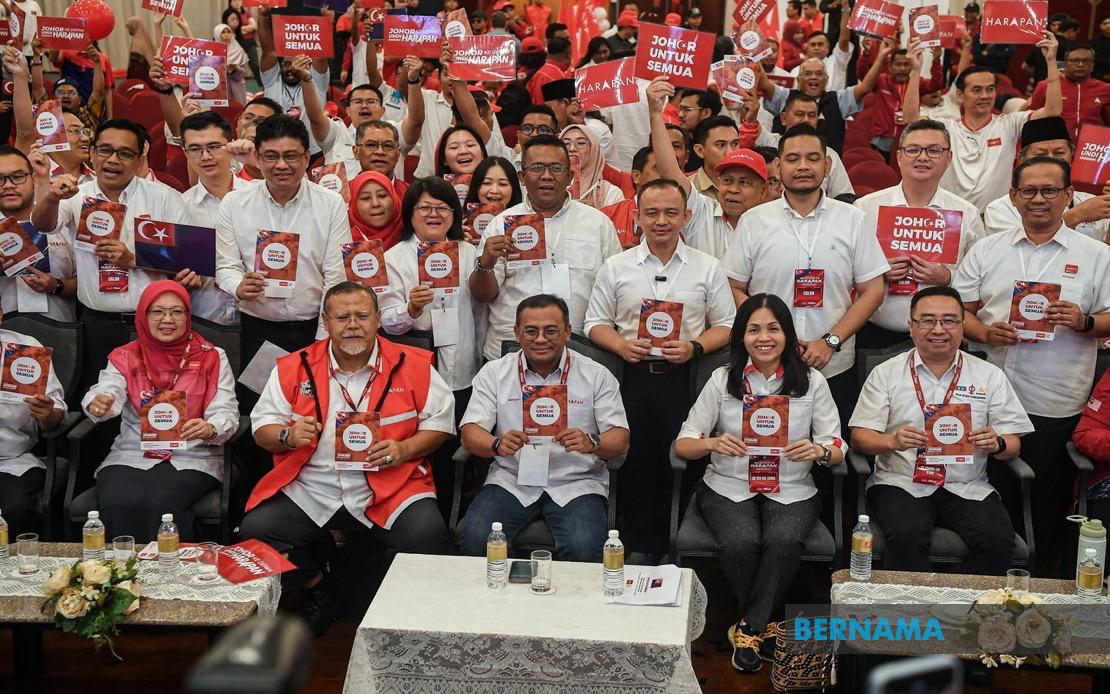
Pakatan Harapan launched its Johor Untuk Semua manifesto in Johor Bahru today, positioning the coalition's vision as a practical response to the state's immediate challenges rather than aspirational campaigning divorced from reality. According to Johor DAP chairman Teo Nie Ching, the 10-point platform reflects genuine consultation with constituents and careful assessment of what Johor's economy can sustain. The manifesto will be tested at the ballot box on July 11, with early voting scheduled for July 7.
Teo, who serves as Deputy Communications Minister, stressed that the promises contained in the manifesto are deliverable rather than rhetorical flourishes. This claim carries particular weight given the coalition's recent track record in government and the specific benchmarks against which voters will measure performance. She indicated that realising the manifesto's commitments depends critically on coordination between the state administration and federal agencies, suggesting that governance will function as an integrated system rather than operating in silos—a recognition of how state-level policies increasingly intersect with federal infrastructure and resources.
Among the manifesto's centrepiece proposals is the Johor Health Scheme, which addresses healthcare accessibility across the state's diverse geography and income levels. Rather than present this as an entirely novel concept, Teo explicitly referenced Selangor's existing health scheme as a working template. This comparative approach provides voters with concrete evidence that the model functions in a neighbouring state with similar demographic diversity and economic challenges. Selangor's experience demonstrates not merely that such schemes are theoretically possible but that they operate successfully within the Malaysian federal system, where states balance healthcare provision with fiscal constraints.
Education emerges as a second priority within the manifesto, reflecting ongoing public concern about schooling quality, access, and outcomes across Johor's urban and rural areas. This focus aligns with broader Malaysian anxiety about educational standards and competitiveness. By positioning education as a core campaign commitment, PH signals awareness that parents across social classes prioritise their children's learning prospects and are willing to support policies that promise tangible improvements in this domain.
The manifesto's proposal to reduce waiting times at the Johor-Singapore border crossings by half represents a recognition that cross-border efficiency directly affects commerce, employment patterns, and daily quality of life for residents in the state's northern districts. Hundreds of thousands of Malaysians commute to Singapore for work, and congestion at land borders generates substantial economic drag and personal frustration. Teo's confidence in achieving this target rests partly on better coordination with the Home Ministry, indicating that state-level governance cannot solve border challenges unilaterally. This implicit acknowledgement of jurisdictional complexity reflects the genuine constraints facing any administration seeking to deliver on logistics promises.
Another major plank involves financial assistance for first-time homebuyers, addressing Malaysia's acute housing affordability crisis that affects young professionals and families establishing themselves independently. With property prices in Johor having risen substantially, particularly in Iskandar Puteri and other developed corridors, down-payment assistance targets a constituency struggling with accumulating deposits while managing living costs. This policy speaks to aspirational Malaysians seeking to transition from rental accommodation to ownership.
The manifesto allocates RM500 million specifically toward youth development initiatives, a commitment signalling recognition that young Johoreans face distinct employment prospects, skills gaps, and pathways into economic participation. Whether through vocational training, entrepreneurship support, or job creation schemes, this funding stream represents substantial resource allocation to an age group that increasingly influences electoral outcomes and demands substantive engagement rather than symbolic gestures.
Teo's characterisation of the manifesto as "balanced" suggests deliberate effort to construct a platform appealing across demographic lines—addressing youth without neglecting mothers and children, tackling economic infrastructure without ignoring social welfare. This balancing act reflects the political mathematics of diverse constituencies within Johor, where urban professionals, rural agricultural workers, and manufacturing sector employees hold different priorities.
The coalition's emphasis on the Bangsa Johor concept—a notion of shared Johor identity transcending communal divisions—frames these policy commitments as unified rather than segmented. By rooting the manifesto in collective Johor interests rather than targeting specific ethnic or religious groups, PH attempts to construct an inclusive narrative around state development. The success of this framing will depend significantly on whether voters perceive the policies as genuinely addressing universal needs or whether they view the manifesto as masking particularistic preferences through universal language.
The July 11 election represents a critical juncture for both Pakatan Harapan and Johor's political trajectory. The state's history of strong-man politics and traditional power structures means that manifestos must overcome established patronage networks and voter habits. Teo's assertions about deliverability carry implicit pressure: should PH secure electoral mandate and subsequently struggle to implement these commitments, the credibility gap between campaign promises and governance performance could reshape voter attitudes toward the coalition heading into subsequent federal and state contests.
For Malaysian observers beyond Johor, this election provides a window into how opposition coalitions construct platforms in complex, economically significant states where performance is measurable against concrete benchmarks. The health scheme, border efficiency targets, and housing assistance are not abstract commitments but will generate visible results or obvious shortfalls within months of implementation. This specificity distinguishes the Johor Untuk Semua manifesto from campaigns built primarily on symbolism or anti-incumbent sentiment.

