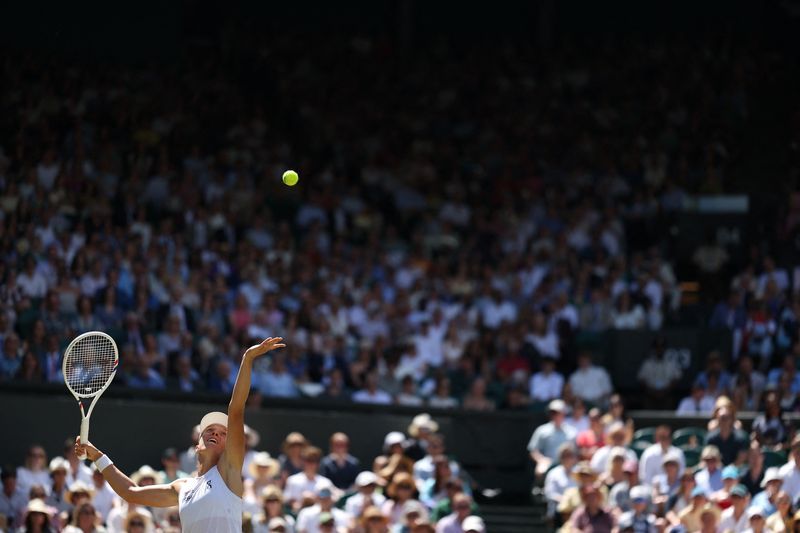
Alexandra Eala has announced herself as one of tennis's most exciting emerging talents after producing a commanding performance to eliminate defending Wimbledon champion Iga Swiatek on Saturday. The rising Filipino player dismantled the Polish third seed 7–6(9) 6–2 in a Centre Court thriller that showcased Eala's technical prowess and mental composure under intense pressure. The victory marks a watershed moment in the 20-year-old's career, confirming that her breakthrough moments at other tournaments were no flash in the pan but rather the foundation of a genuine title contender.
Swiatek's title defence unravelled on the very surface that had long tormented her reputation. The 25-year-old had arrived at the All England Club on the back of mixed form, having suffered an unexpected early exit at Bad Homburg in her final grass-court preparation event. Despite securing commanding victories against Taylor Townsend and Karolina Pliskova in earlier rounds, Swiatek carried into the encounter a lingering sense of vulnerability that Eala exploited ruthlessly. Her struggles with consistency on grass have historically been pronounced; last year's triumph represented a watershed moment precisely because it laid to rest the persistent narrative that she could not perform at the sport's fastest and most unforgiving surface.
The pair shared intriguing recent history that added narrative texture to their collision. Eala had upset Swiatek in Miami earlier in the year, demonstrating that the Polish champion could be beaten by the younger generation. However, Swiatek had reclaimed psychological advantage by securing revenge when they met again on the clay courts of Madrid, suggesting a rivalry in its infancy with momentum potentially in flux. Those prior encounters provided Swiatek with some confidence, yet they could not have prepared her for the intensity and precision that Eala brought to Saturday's encounter.
The opening set exemplified the brutality of grass-court tennis at the highest level, with both competitors engaging in a high-octane affair where neither player was prepared to surrender ground. Eala's powerful baseline game, particularly her commanding forehand strokes, created immediate problems for Swiatek, who found herself wrestling for control from the outset. The set ultimately required a tiebreak to determine a winner, with Eala prevailing 9–7 in what proved a dress rehearsal for the psychological battles that would define the match.
Swiatek's composure visibly fractured as the opening set concluded. The Pole initially acknowledged the loss with a smile, a gesture of sportsmanship quickly replaced by visible frustration directed toward her coaching team in the player's box. She subsequently unleashed her racket onto a chair, a sign of the mounting pressure she felt slipping away. Meanwhile, Eala fed off the palpable momentum, absorbing thunderous applause from an All England Club crowd that had been thoroughly captivated by the quality and intensity of the contest.
The second set became a one-sided affair as Eala seized the psychological upper hand. Breaking Swiatek's serve twice in rapid succession established a commanding 3–0 lead, with the younger player demonstrating the clinical finishing ability that distinguishes championship contenders. Her aggressive court positioning, combined with willingness to attack second serves, prevented Swiatek from establishing the rhythm required to mount a comeback on the fast surface. For Malaysian and Southeast Asian tennis supporters, this performance carries particular significance as evidence that Asian players can compete at the sport's highest echelon across all surface types.
Swiatek attempted to engineer a recovery, retrieving one break of serve as she began to reassert pressure on Eala's delivery. The Polish champion's superior experience and tactical awareness momentarily surfaced, suggesting that veteran resilience might yet prove decisive. However, Eala remained unmoved by these late pressure plays, demonstrating maturity that belied her youth and relative inexperience at this level. She immediately re-established her break advantage and subsequently delivered the coup de grâce with a powerful forehand winner, cementing her advance to the fourth round.
Eala's breakthrough carries implications extending beyond personal achievement. As a Southeast Asian player succeeding on the grass courts of Wimbledon, she provides inspiration to the broader regional tennis community and demonstrates that geographical location need not be an impediment to elite-level performance. Her success also suggests that the traditional dominance of European and North American players in tennis may gradually erode as aspiring professionals from underrepresented regions invest in development and access improved coaching infrastructure.
With this victory, Eala advances to a fascinating fourth-round encounter against Italy's Jasmine Paolini, the 2024 Wimbledon runner-up who demonstrated her own elite pedigree by reaching the final just months prior. This matchup represents another step up in competition for Eala but also an opportunity to announce her arrival as a genuine contender for silverware at tennis's most prestigious tournaments. Paolini's experience navigating Wimbledon's demands will prove formidable, yet Eala's performance against Swiatek suggests the Philippine star possesses the weaponry and temperament to compete with any opponent on grass. Her continued progress through the draw will keep global audiences invested in monitoring one of the sport's most compelling emerging narratives.

