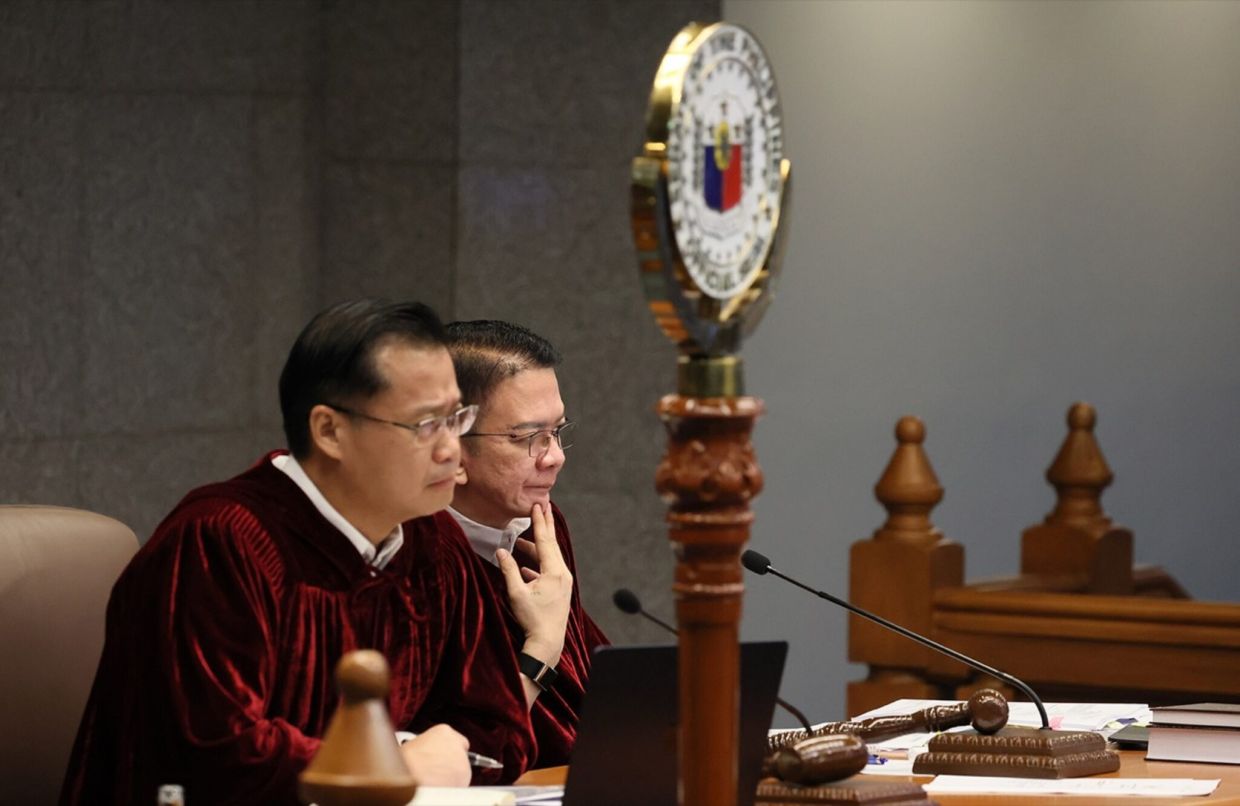
The Philippine Senate impeachment court faces a decisive vote this week on whether to compel Vice President Sara Duterte to disclose her financial records—a ruling that could fundamentally shape the trajectory of her trial and the broader question of accountability for the nation's highest officials. House prosecutors have signalled confidence that senator-judges will grant their request to subpoena Duterte's bank accounts, tax documentation, and records held by the Anti-Money Laundering Council, along with similar documents belonging to her husband, lawyer Manases Carpio. The vote is scheduled for Monday afternoon and represents what many legal observers view as one of the most consequential procedural moments in the week-old trial.
Prosecutors argue that access to Duterte's financial records is fundamental to establishing whether she accumulated wealth disproportionate to her legitimate income while serving as a public official—a central allegation in Article II of the impeachment articles against her. The prosecution contends that the documents would reveal the truth about her financial activities spanning her tenures as Davao City vice mayor and mayor through her current position as vice president. House prosecutors have emphasized that their case does not depend solely on these financial records, but that their inclusion would substantially strengthen the evidentiary foundation supporting charges of betrayal of public trust and misuse of office.
The legal argument hinges partly on precedent and statutory interpretation. Prosecutors point to the 2012 impeachment trial of then-Chief Justice Renato Corona, when the Senate successfully compelled production of bank records despite Philippine banking secrecy protections. The key legal basis cited by the prosecution is Republic Act No. 1405, the nation's bank secrecy law, which explicitly exempts impeachment proceedings from confidentiality restrictions. House prosecutors maintain this exception is clear and unambiguous—that impeachment trials, as constitutionally mandated proceedings, supersede ordinary privacy protections when evidence of official misconduct is at stake.
Prosecutor Chel Diokno has specifically highlighted financial activity exceeding three billion Philippine pesos documented in an Anti-Money Laundering Council report covering the period from 2007 to 2013, a span that encompasses Duterte's progression through municipal and city offices. Diokno argues that financial records predating her vice presidency remain relevant because the impeachment complaint alleges she systematically accumulated unexplained wealth while occupying various public positions over nearly two decades. The prosecution further contends that the Senate's authority as an impeachment court derives directly from the Constitution, enabling it to compel disclosure of otherwise confidential records essential to determining whether an elected official breached the public trust.
The defense has mounted a spirited counter-argument centered on due process protections and the scope of impeachable conduct. Lead counsel Michael Poa characterizes the prosecution's request as an impermissible "fishing expedition"—a search for financial evidence pursued only after impeachment charges had already been filed, rather than evidence that prompted the charges. The defense argues that the subpoena is unreasonably broad, reaching back nearly two decades to encompass periods when Duterte held positions arguably outside impeachment jurisdiction, particularly her earlier role as Davao vice mayor. Poa invokes a 2025 Supreme Court ruling in Duterte v. House of Representatives establishing that impeachable offenses must have been committed while occupying an impeachable office, which would exclude her conduct as a municipal official from legitimate scrutiny.
A secondary defense argument challenges the procedural mechanism itself. While acknowledging that the bank secrecy law recognizes an impeachment exception, Poa contends that automatic disclosure is not mandated—rather, any subpoena must still satisfy fundamental due process requirements. The defense further notes that the Anti-Money Laundering Act and the National Internal Revenue Code contain no explicit impeachment exception for AMLC reports or tax records, suggesting that these documents occupy a different legal category than bank records. Additionally, the defense objects to the inclusion of Manases Carpio's financial records, arguing that because Carpio is not himself an impeachable official, his records fall outside the legitimate scope of an impeachment investigation regardless of his marital relationship to the vice president.
Civil society organizations have forcefully urged the Senate to grant the prosecution's request, invoking both historical precedent and broader principles of government accountability. The August Twenty-One Movement has specifically warned senator-judges against repeating what it characterizes as the "second envelope" controversy from former President Joseph Estrada's 2001 impeachment trial, when disputes over evidence withholding ultimately galvanized public anger and contributed to political upheaval. The organization has framed the vote as a test of whether the Senate will prioritize "what is right, what is true, and what is just," while suggesting that if Duterte is genuinely innocent of wealth accumulation charges, financial disclosure would vindicate her. The faith-based coalition Kingdom Keepers has similarly emphasized that public officials operate under heightened accountability obligations regarding their finances, and that transparency serves justice rather than threatening it.
The Kingdom Keepers and its constituent members, including activist priest Fr. Robert Reyes and social anthropologist Dr. Melba Padilla Maggay, have articulated a broader principle: that elected officials cannot invoke personal privacy rights to shield themselves from scrutiny when allegations of corruption or illegitimate enrichment arise. Their statement that Duterte "cannot hide behind the skirt of privacy and confidentiality" reflects a philosophy gaining traction in the region that official status necessarily constrains individual privacy claims when public funds and public trust are implicated. These organizations have posed a rhetorical challenge to the defense: if Duterte genuinely refrained from amassing ill-gotten wealth during her terms as mayor or vice mayor, what legitimate reason exists to resist disclosure of financial records from those periods.
The timing and implications of this vote extend beyond the immediate impeachment trial. For Malaysia and other Southeast Asian democracies, the Philippine Senate's decision will signal how judicial bodies approach the tension between official accountability and financial privacy protections when investigating elected officials. The outcome may influence how future anti-corruption efforts are conducted across the region, particularly regarding the accessibility of bank records and anti-money laundering intelligence during impeachment or removal proceedings. The precedent established could affect how other governments balance citizens' expectations of official integrity against statutory protections designed originally to guard individual financial privacy from unreasonable state intrusion.
Duterte confronts four articles of impeachment encompassing allegations of misuse of confidential and intelligence funds, accumulation of unexplained wealth, and threatening remarks directed toward President Ferdinand Marcos, First Lady Liza Araneta-Marcos, and former Speaker Martin Romualdez. Conviction on these charges would result in her automatic removal from the vice presidency and permanent disqualification from holding any future elected or appointed public office. The financial records vote thus carries significant personal and political consequences for Duterte, but also broader institutional implications regarding the authority and procedures of the Senate sitting as an impeachment court.
The prosecution indicated that National Bureau of Investigation Director Melvin Matibag is expected to testify on Tuesday, providing investigative findings regarding Duterte's alleged threats against the President. According to prosecutors, the NBI investigation concluded that these remarks were not spontaneous utterances but rather reflected a coordinated plan, a characterization that could substantially impact the credibility and severity of charges under the impeachment articles. This testimony, combined with whatever financial evidence the Senate ultimately permits, will shape the evidentiary landscape within which senator-judges must ultimately decide whether to convict and remove the vice president from office.
The impeachment trial of Vice President Sara Duterte has already generated substantial regional attention as a test case for executive accountability in Southeast Asia. The Senate's handling of procedural questions such as evidence disclosure will demonstrate whether Philippine democratic institutions possess the institutional independence and political will to pursue accountability investigations against sitting officials at the highest levels of government, regardless of their political power or connections. As senator-judges prepare to vote, they face pressure from reform advocates arguing that transparency and accountability must supersede privacy claims, while the defense insists that constitutional protections cannot simply dissolve in impeachment proceedings. The vote's outcome will signal the Senate's answer to fundamental questions about the limits of official power and the scope of public accountability in democratic government.

