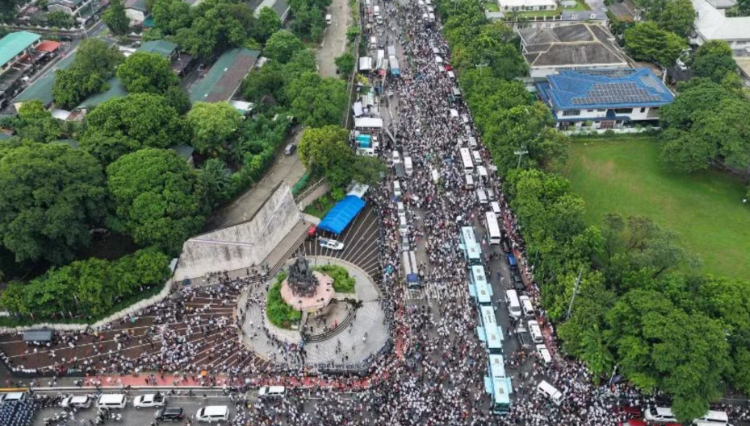
Thousands of devotees belonging to one of the Philippines' most influential religious organisations descended on Manila's streets on Tuesday, triggering extensive traffic disruptions across the capital as they mobilised against the anticipated arrest of a senior politician and church member. The demonstration highlighted the Iglesia Ni Cristo's continued relevance as a formidable political force in the archipelago, capable of mobilising constituencies at short notice and projecting power at critical constitutional moments.
The rally materialised following announcements that Senator Rodante Marcoleta, both a congregant of the Iglesia Ni Cristo and a prominent supporter of impeached Vice President Sara Duterte, faced imminent charges stemming from alleged irregularities in his campaign finances. The ombudsman's office, under Jesus Remulla, outlined that Marcoleta stood accused of failing to disclose approximately 75 million pesos—equivalent to roughly $1.2 million—representing unused contributions earmarked for his electoral campaign. This allegation formed part of a broader pattern of legal proceedings targeting political figures aligned with the Duterte faction.
The timing of the demonstration proved strategically significant given the constitutional calendar. Duterte's impeachment trial, formally commencing on July 6, requires a supermajority of 16 votes from the 24-member Senate to remove her from office and impose permanent electoral disqualification. Marcoleta represents a pivotal vote, with political analysts regarding his position as virtually certain opposition to conviction, thereby enhancing the Vice President's prospects of surviving the proceeding. The church's public intervention underscores the calculus surrounding institutional support networks in Philippine high-stakes constitutional proceedings.
Police estimates suggested the gathering numbered approximately 8,000 participants during morning hours, with expectations that the assemblage would expand throughout daylight hours. The concentration of demonstrators along EDSA, Manila's primary thoroughfare, created cascading transportation disruptions, restricting movement to dedicated bus lanes whilst stranding thousands of commuters attempting routine journeys to workplaces and educational institutions. The disruption illustrated how religious mobilisation can impose tangible costs on civilian populations whilst amplifying political messages through sheer disruptive capacity.
Church spokesman Edwil Zabala articulated the organisation's grievances through a recorded statement distributed via social media platforms, framing the protest as a demand for governmental accountability and procedural integrity. Zabala's rhetoric emphasised notions of selective justice and institutional bias, contending that imprisonment of Marcoleta would constitute an abuse of legal mechanisms. This framing transformed what might otherwise appear as sectional interest advocacy into a broader critique of judicial impartiality, thereby appealing to constituencies beyond the church's immediate membership who harboured doubts regarding the fairness of proceedings against Duterte loyalists.
The trajectory of legal actions against Duterte-aligned figures revealed a widening pattern of prosecutorial attention. Senator Jose Estrada faced separate graft allegations connected to a substantial corruption scheme involving fraudulent flood management infrastructure projects, proceedings that ignited considerable public outrage across the nation. Simultaneously, Senator Ronald Dela Rosa remained in flight following near-apprehension on an International Criminal Court warrant relating to his involvement in the controversial drug war prosecuted by former president Rodrigo Duterte, the Vice President's father. These simultaneous legal developments created an impression of systematic dismantling of the previous administration's support structures.
The Iglesia Ni Cristo had previously demonstrated its organisational capacity through enormous mobilisations on politically consequential matters. In November, the church orchestrated a gathering encompassing hundreds of thousands of adherents protesting a massive flood control scandal that implicated government officials and lawmakers. That demonstration had explicitly blamed President Ferdinand Marcos for the crisis, signalling the organisation's willingness to challenge the sitting chief executive when church interests appeared threatened. Such precedents established the Iglesia Ni Cristo as an autonomous political actor capable of constraining governmental action through coordinated mass mobilisation.
Most dramatically, in January 2025, the church convened a substantial Manila rally explicitly opposing the contemplated impeachment of Vice President Duterte, reflecting the profound estrangement between Duterte and Marcos following their earlier alliance. Although the Supreme Court subsequently reversed that initial impeachment proceeding, the House of Representatives mounted a fresh impeachment initiative last month, culminating in the forthcoming trial. The church's consistent intervention in these constitutional struggles indicated that religious institutional interests had become thoroughly enmeshed with the political trajectory of the Duterte dynasty.
President Marcos's decision to cancel a scheduled engagement with international journalists in order to monitor the emerging situation underscored official concern regarding the rally's implications. The cancellation signalled that governmental authorities perceived the gathering as sufficiently significant to warrant chief executive attention, albeit implicitly rather than through direct public statement. This measured response reflected constitutional sensitivity surrounding religious mobilisation, given Philippines' constitutional protections for religious freedom and historical patterns wherein excessive governmental reaction to faith-based activism courts accusation of persecution.
The broader context encompasses escalating institutional conflict between competing political networks within the Philippine system. Duterte's spectacular rupture with Marcos, notwithstanding their earlier collaboration, had fractionalised the political establishment into incompatible camps competing for constitutional advantage. The simultaneous prosecution of multiple Duterte allies suggested systematic efforts to weaken the former president's network at the precise moment when her daughter faced removal through impeachment. Religious institutional intervention through the Iglesia Ni Cristo represented an organised counterweight to these prosecutorial initiatives, employing the church's demonstrated capacity for rapid mobilisation to signal political costs for pursuing such legal strategies.
Looking forward, the trial's outcome will substantially depend upon senatorial votes that cannot be compelled through constitutional process. The Iglesia Ni Cristo's public intervention amplified implicit pressure on wavering senators who might face institutional disapprobation from powerful religious constituencies should they vote for conviction. In Philippine political contexts where religious identification remains significantly consequential for electoral prospects and social standing, such demonstrations functionally operate as warnings regarding potential organised opposition to particular senatorial positions, thereby constraining the formally unconstrained judgment senators theoretically possess regarding impeachment proceedings.

