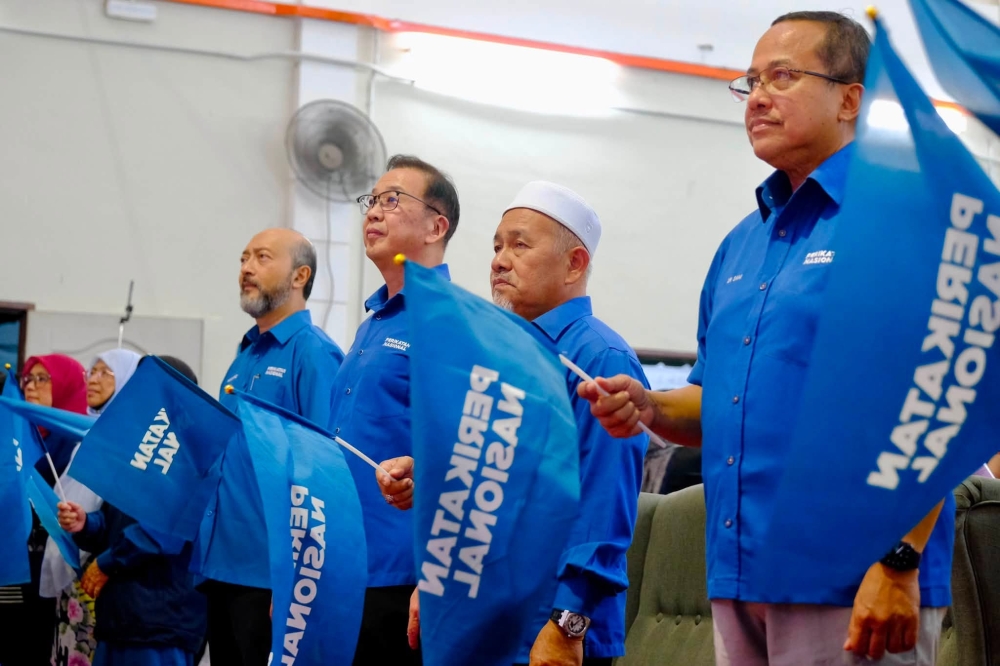
Perikatan Nasional chairman Datuk Seri Ahmad Samsuri Mokhtar has indicated that the coalition arrangement between PN and Barisan Nasional could potentially extend into the 16th general election, provided their partnership at state level in Negeri Sembilan proves sufficiently durable and productive. The signal reflects growing confidence within PN that cooperation with BN might form a stable basis for federal-level cooperation beyond the current electoral cycle, marking a significant shift in Malaysian coalition politics following years of acrimony between the two blocs.
The prospect of a sustained PN-BN partnership would reshape the Malaysian political landscape considerably. For nearly two decades, the two coalitions represented opposing camps in Malaysian politics, with BN's dominance followed by opposition from PN and its predecessor alliances. The current collaboration, forged through necessity rather than ideological alignment, suggests both coalitions recognise the electoral mathematics of contemporary Malaysian politics increasingly favour larger, more inclusive formations rather than narrow, faction-based arrangements.
Ahmad Samsuri's comments carry particular weight given PN's role as a relative newcomer to national-level governance. Perikatan Nasional was formally constituted in 2018 as a coalition of PAS, PPBM, Amanah, and Warisan, though its political footprint expanded significantly after the 2022 general election when it secured substantial parliamentary representation. The chairman's willingness to publicly discuss a potential long-term alliance with BN suggests PN leadership has begun viewing itself as a permanent fixture in Malaysian politics rather than a transitional phenomenon.
The Negeri Sembilan arrangement functions as a crucial testing ground for the broader PN-BN relationship. The state has served historically as a bellwether for national political trends, and its diverse demographic composition—balancing urban and rural constituencies—provides a microcosm of challenges facing both coalitions at the federal level. Success in managing the state government jointly would demonstrate their capacity to navigate competing interests, resource allocation disputes, and ideological differences that have traditionally plagued Malaysian coalition arrangements. Conversely, any significant fracture in the state government would likely signal fundamental incompatibility at the national level.
The timing of Ahmad Samsuri's remarks reflects the current political cycle's expectations. The 16th general election remains several years distant, yet Malaysian politics operates within compressed timeframes where alliances can crystallise or collapse with surprising speed. By articulating the potential for continued partnership now, PN leadership aims to telegraph stability to both coalition partners and the broader electorate, countering perceptions of temporary convenience arrangements that characterise much contemporary Malaysian politics.
For Barisan Nasional, the proposition presents both opportunities and constraints. BN's electoral dominance has eroded substantially since the 2018 watershed, with UMNO-led coalitions losing traditional bastions to both opposition and emerging alternatives. A formalised, extended partnership with PN could restore BN's claim to represent a majority-building coalition capable of delivering stable governance. However, such an arrangement requires BN to accept reduced dominance within a larger framework, a concession that historically has proven difficult for the coalition's leadership to navigate gracefully.
The broader implications for Malaysian democracy merit consideration. Coalition politics, while necessary in Malaysia's multi-ethnic, multi-party environment, has occasionally produced outcomes where electoral mandates become obscured through post-election realignments and negotiations conducted beyond public scrutiny. A commitment to a longer-term PN-BN framework before the next election could enhance democratic transparency by allowing voters to evaluate the partnership on its merits rather than encountering it as a surprise outcome. Such advance signalling of coalition intentions has become increasingly common in Southeast Asian democracies and reflects maturing expectations around electoral accountability.
The Negeri Sembilan test case also carries implications for state-level politics across Malaysia. If PN and BN demonstrate competent joint governance in the state, other state administrations where both coalitions hold representation might explore similar arrangements, gradually transforming the federal political landscape from the ground up. Conversely, should the state arrangement deteriorate, it would validate arguments that coalition partnerships remain fundamentally unstable in Malaysian politics and serve primarily short-term survival needs rather than genuine policy alignment.
Regional observers will note this development as part of a broader pattern across Southeast Asia where political coalitions have become more flexible and pragmatic. Thailand, Indonesia, and the Philippines have all witnessed shifts toward larger, more inclusive coalitions in recent elections. Malaysia's experience with PN-BN cooperation, if sustained, would align with regional trends toward governance models that prioritise stability and executive capacity over ideological purity. This transformation, though incremental, represents a meaningful departure from earlier cycles dominated by bipolar competition between clearly defined opposing blocs.
For Malaysian business and investment communities, the prospect of a longer-term PN-BN arrangement offers potential advantages. Extended coalitions typically produce more predictable policy environments and reduce the uncertainty associated with frequent leadership transitions or sudden political realignments. Investors evaluating Malaysia's medium-term prospects may view a PN-BN partnership extending into GE16 as an indicator of greater governmental continuity, though actual policy implementation remains contingent on the quality of leadership and institutional capacity within the coalition.
Ahmad Samsuri's careful articulation of this possibility—contingent on Negeri Sembilan's success—demonstrates sophisticated coalition management. Rather than committing unequivocally to a long-term partnership that might prove electorally damaging if the state-level arrangement fails, PN's leadership has created a pathway for either continuation or graceful separation. This flexibility, paradoxically, may strengthen the coalition's immediate prospects by reducing anxiety among partners who fear irreversible commitment to arrangements that might not serve their interests.
The coming months will prove instructive in assessing the viability of PN-BN cooperation. Negeri Sembilan's governance challenges—including economic development, intra-coalition resource distribution, and constituent service delivery—will test whether both coalitions can subordinate competitive instincts to collaborative governance. Should this experiment succeed, Ahmad Samsuri's tentative suggestion of extended partnership may crystallise into formal coalition architecture well before GE16, reshaping Malaysian politics for a generation.

