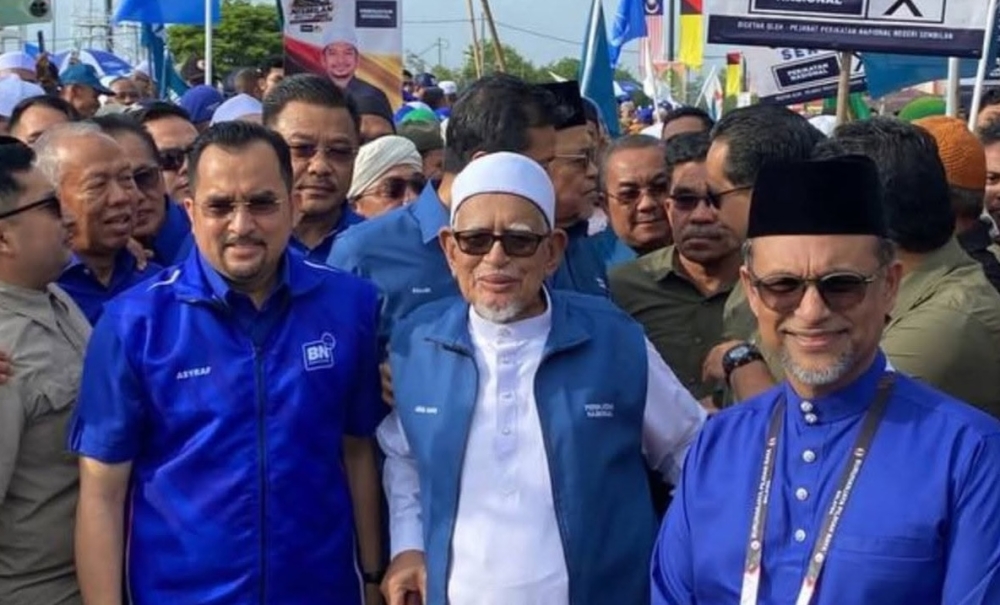
PAS president Tan Sri Abdul Hadi Awang has announced that Perikatan Nasional and Barisan Nasional will jointly campaign for one another's candidates in the forthcoming Negeri Sembilan state election, underscoring the strengthening alliance between the two major political groupings. The commitment represents a significant show of unity at the state level, with both coalitions pledging reciprocal support to enhance their combined electoral prospects in what is shaping up to be a closely contested battle for control of the Negeri Sembilan state assembly.
The cooperation framework signals a tactical shift in how Malaysia's two largest political blocs are approaching regional contests. Rather than competing as completely separate entities, the arrangement allows candidates from both Perikatan Nasional and Barisan Nasional to benefit from an expanded campaign apparatus and voter mobilisation networks. This arrangement is particularly notable given the historical tensions between these coalitions, which have competed fiercely for political dominance since Perikatan Nasional's formation in 2020. The willingness to coordinate campaign efforts suggests both groups recognise the electoral advantages of presenting a united front against opposition parties, particularly in a state where political fortunes have shifted considerably in recent years.
Negeri Sembilan's political landscape has undergone substantial transformation, with voter preferences demonstrating volatility across recent electoral cycles. The state has served as a bellwether of broader national sentiment, making it strategically important for both Perikatan Nasional and Barisan Nasional as they position themselves ahead of the anticipated 15th general election. The coordinated campaign approach provides each coalition with access to fresh constituencies and previously untapped supporter networks, multiplying the reach of their political messaging without requiring formal merger or structural reorganisation.
The announcement comes at a time when Malaysia's political environment remains fluid, with multiple state elections anticipated in the coming months and national polls likely within the next two years. Both coalitions have been pursuing various cooperation arrangements, though this level of explicit, reciprocal campaign support is noteworthy. The strategy reflects pragmatic recognition that electoral mathematics at the state level often demand cooperation between larger blocs to prevent opposition parties from capitalising on a fragmented anti-PN or anti-BN vote.
For Barisan Nasional, which has undergone significant organisational restructuring and reassessment following its 2018 general election defeat, the joint campaign framework offers opportunities to rebuild grassroots presence and demonstrate continued electoral viability to party members and supporters. The coalition has been working methodically to restore its standing across various states, and Negeri Sembilan represents an important testing ground for its renewed strategies and leadership approaches. The collaboration with Perikatan Nasional provides additional resources and volunteer capacity that could prove decisive in closely contested state assembly seats.
Perikatan Nasional, which swept to power in several states following the Sheraton Move and subsequent political realignments, also stands to benefit from the arrangement. The coalition gains access to Barisan Nasional's extensive party machinery, particularly at the local level where both the MIC and MCA maintain significant membership networks. This grassroots infrastructure, built over decades of electoral competition, can be instrumental in converting voter support into actual ballot box results, particularly in mixed communities where these parties maintain traditional strongholds.
The implications for Malaysian voters extend beyond Negeri Sembilan's borders. The campaign coordination sets a precedent for how Perikatan Nasional and Barisan Nasional might cooperate in other state elections, potentially reshaping the competitive dynamics across peninsular Malaysia. Opposition parties will likely scrutinise this arrangement closely, assessing whether it represents a prelude to broader national cooperation or remains limited to specific state contests where electoral mathematics favour such alliances.
PAS, as the dominant party within Perikatan Nasional and the party whose president made this announcement, underscores its growing centrality to Malaysian political configurations. The party's ability to negotiate such arrangements reflects its strengthened position following recent electoral performances and its expanded presence across multiple states and federal territories. For PAS, the Negeri Sembilan campaign provides an opportunity to showcase its organisational capacity and mobilisation capability while building relationships with Barisan Nasional partners that could prove valuable in future national negotiations.
For Southeast Asian observers monitoring Malaysian political developments, this cooperation arrangement illustrates broader trends of coalition fluidity and strategic realignment that characterise the region's democracies. Rather than static, permanently opposed political camps, Malaysia's major blocs demonstrate willingness to cooperate when strategic interests align, creating complex political configurations that resist simple left-right or pro-reform versus conservative categorisations. The Negeri Sembilan campaign will provide valuable data points about whether such cooperation translates into enhanced electoral performance or whether fundamental differences between the coalitions ultimately constrain their ability to translate joint campaigns into sustained political partnerships.

