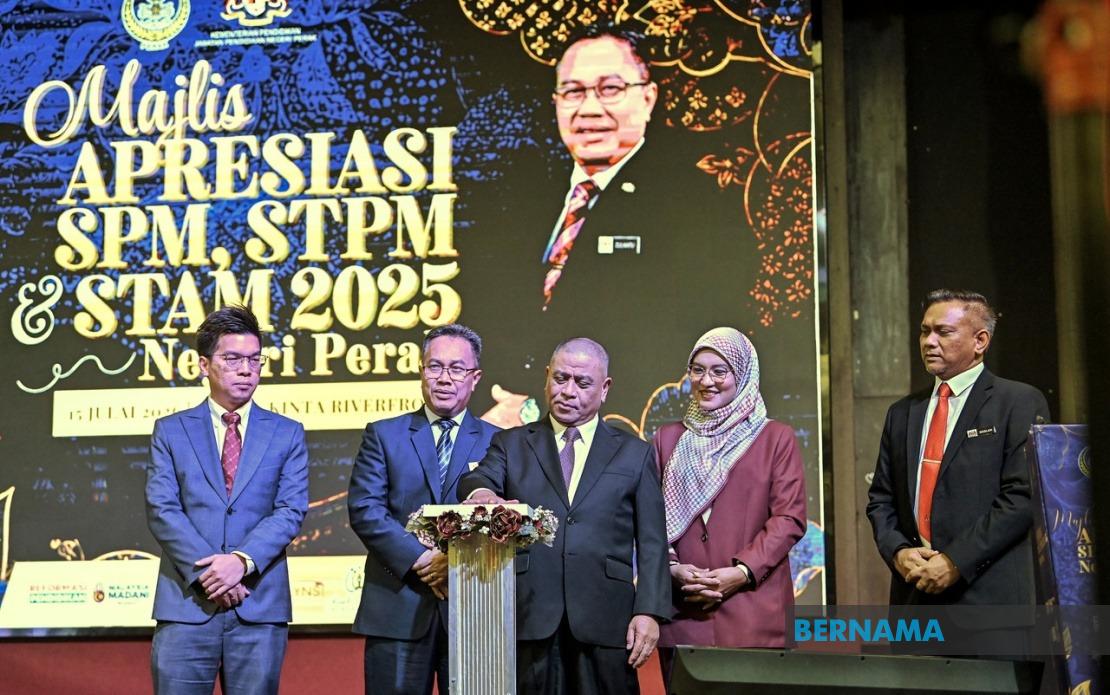
The Perak state government's Menteri Besar Scholarship continues to serve as a meaningful lifeline for students pursuing secondary and tertiary education, addressing a critical gap in educational financing that affects many middle and lower-income households across the state. During a state-level appreciation ceremony held in Ipoh on July 15 for students who completed their Sijil Pelajaran Malaysia (SPM), Sijil Tinggi Persekolahan Malaysia (STPM), and Sijil Tinggi Agama Malaysia (STAM) examinations in 2025, education officials and scholarship recipients underscored how the financial assistance directly translates into improved academic performance and expanded opportunities for university admission.
Yoong Lam, a 20-year-old recipient from Sekolah Menengah Kebangsaan Sultan Yussuff, exemplifies the programme's tangible benefits. She secured a perfect 4.00 Overall Grade Point Average in her STPM examinations and receives RM1,200 per semester through the scholarship. Rather than hoarding the funds, she deploys them strategically—paying examination fees, acquiring necessary reference materials, and accessing tuition support that proved instrumental in achieving top grades. As the eldest of two children and the primary financial support alongside her self-employed father, Yoong Lam's experience demonstrates how educational assistance penetrates beyond the individual student to stabilise household finances more broadly.
Muhammad Haziq Hafit, 19, from Al-Ulum Al-Syar'Iyyah Religious Secondary School in Bagan Datuk, received RM1,000 in assistance after excelling in STAM examinations. He plans to study education at the University of Malaya and views the scholarship as essential seed funding for transitional costs associated with university life—accommodation, materials, and initial living expenses that often derail promising students from modest backgrounds. Similarly, Muhammad Taufiq Ikwan Mohammad Asri, also 19 and from the same religious school, is using his RM1,000 scholarship allocation to prepare for further studies in Egypt, highlighting how the programme's benefits extend beyond Malaysia's borders and support students pursuing international educational pathways.
What distinguishes these individual stories is the scholarship's modest but strategic amount. While recipients acknowledge that RM1,000 to RM1,200 per semester may seem comparatively small against scholarships offered by private institutions or corporate sponsors, they emphasise its psychological and practical significance for middle-income families navigating the precarious space between ineligibility for needs-based assistance and insufficient household resources for unsubsidised education. Taufiq explicitly noted that though the sum is not as substantial as competing scholarships, its meaning resonates deeply with students whose families occupy that vulnerable economic stratum where educational advancement requires careful financial planning.
The timing of this scholarship initiative aligns with demonstrable improvements in Perak's educational outcomes. Menteri Besar Datuk Seri Saarani Mohamad announced that the state achieved a Grade Point Average of 4.49 for the 2025 SPM results—the highest performance recorded over the preceding thirteen years. This achievement followed consecutive years of improved performance, suggesting systemic gains rather than isolated statistical fluctuation. More significantly, the performance gap between urban and rural examination candidates compressed to merely 0.04 points, indicating that educational quality and opportunities are increasingly distributed equitably across geographical divides within the state.
This reduction in the achievement gap carries profound implications for a state historically characterised by resource disparities between developed urban centres like Ipoh and remote rural districts. When rural students perform at near-parity with urban counterparts, it signals that complementary interventions—including financial assistance, curriculum support, and teaching improvements—are successfully counteracting structural disadvantages. The scholarship programme, operating in conjunction with other state initiatives, appears to be narrowing the pathway into higher education for students regardless of their postcode or family income.
Beyond direct financial aid, state officials highlighted the Tuisyen Cikgu Saarani (TCS) Programme as a critical complementary intervention. Perak Education Director Zulkafli Mohamed Mokhtar credited the programme's additional SPM reference books with materially contributing to improved 2025 examination performance. These materials, developed collaboratively by experienced teachers and Yayasan Perak in partnership with the State Education Department, represent a pedagogically sophisticated approach to addressing student needs. Rather than generic textbooks, they target identified gaps in conceptual mastery and examination technique based on systematic analysis of Perak student performance data.
The scope of the TCS reference book initiative demonstrates substantial operational commitment. Over 63,567 copies have been distributed to daily school students throughout Perak, with particular targeting of students identified as potential examination passers who require structured supplementary guidance. The programme now extends its reach to approximately 25,000 SPM candidates anticipated for the 2026 examination cycle. Notably, this year marks the first expansion to students in Sekolah Menengah Tahfiz Darul Ridzuan and Sekolah Menengah Agama Rakyat institutions, demonstrating that the state is deliberately extending equity initiatives across religious education sectors that sometimes operate outside mainstream resource distribution networks.
This expansion into tahfiz and religious schools reflects nuanced understanding of Perak's educational landscape. Religious secondary institutions often serve student populations from distinct socioeconomic and geographical communities, and their historical separation from mainstream support programmes can perpetuate achievement gaps. By integrating these schools into the reference book initiative under supervision of the Perak Islamic Religious Department, officials acknowledge that educational equity requires targeted engagement with diverse institutional types rather than one-size-fits-all approaches.
For Malaysian policymakers and educators across the region, Perak's integrated approach—combining direct financial assistance, supplementary learning materials, and institutional expansion—offers instructive lessons. The state has avoided positioning the scholarship in isolation, instead embedding it within a broader ecosystem of academic support. The recognition that middle-income families face distinctive challenges, neither qualifying for poverty-targeted programmes nor possessing resources for premium tuition services, directly addresses a gap often overlooked in education policy frameworks that bifurcate students into either disadvantaged or adequately-resourced categories.
The challenge moving forward involves sustaining momentum and scaling successful interventions as education needs evolve. Perak's thirteen-year performance peak and consecutive yearly improvements suggest that sustained commitment yields measurable returns, but these gains remain vulnerable to resource fluctuations, curriculum changes, or implementation inconsistencies. The scholarship programme's expansion and the TCS initiative's scaling both signal institutional willingness to invest, yet questions about long-term funding sustainability and potential resource constraints warrant ongoing scrutiny.
Moreover, the success metrics should extend beyond examination scores. While the 4.49 GPA achievement and rural-urban convergence are genuinely significant, stakeholders should track whether scholarship recipients persist through tertiary education, whether they face barriers to university completion, and whether educational advancement translates into meaningful employment outcomes. Yoong Lam's aspiration to university and Muhammad Haziq's planned studies at the University of Malaya represent important intermediate steps, but their actual trajectories will ultimately determine whether the scholarship investment fulfils its transformative promise.
As Malaysia navigates broader conversations about education quality and equity, Perak's model warrants attention from other states and federal policymakers. The combination of targeted financial support, pedagogically informed supplementary materials, and deliberate institutional inclusion demonstrates that meaningful educational advancement need not require massive budgetary outlays if interventions are strategically designed and comprehensively coordinated. For families like Yoong Lam's, where parental self-employment generates income uncertainty, and for students like Muhammad Taufiq pursuing international education pathways, such support catalyses trajectories that might otherwise remain unrealised.

