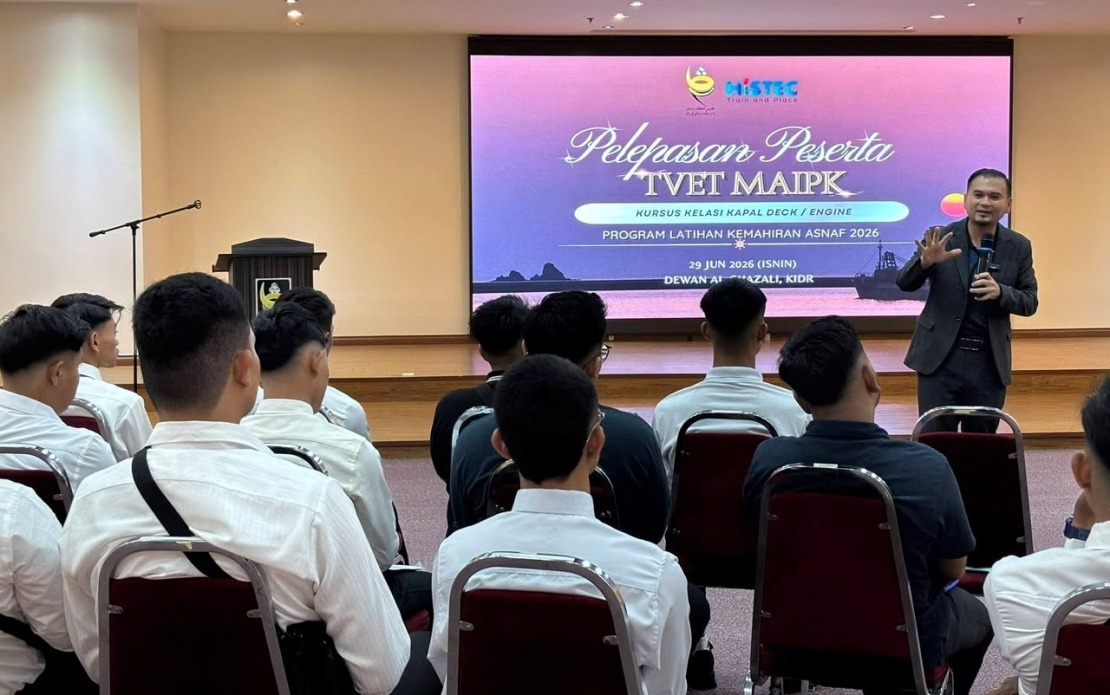
The Perak Islamic Religious and Malay Customs Council (MAIPk) is making a significant investment in vocational training by channelling RM470,000 towards maritime education for underprivileged youth. The initiative will sponsor 25 asnaf participants in a specialized ship crew course focusing on deck and engine operations, marking an expansion of the council's efforts to align with Malaysia's broader TVET agenda and industry workforce development priorities.
At RM18,800 per participant, the funding allocation demonstrates MAIPk's strategic commitment to bridging the skills gap in the maritime sector while simultaneously addressing socio-economic disparities within the asnaf community. This cost-per-student investment reflects a calculated approach to capacity building, where professional credentials and practical expertise form the foundation for long-term employment stability and income growth among vulnerable populations.
The three-month training programme will be delivered at the Ranaco Education and Training Institute in Chukai, Terengganu, a centre chosen for its maritime specialization and proximity to operational shipping hubs. Participants will engage in a comprehensive curriculum combining classroom instruction with hands-on practical modules, culminating in professional certification and a seaman's licence—the critical credential required for formal entry into maritime employment across regional and international shipping companies.
MAIPk's positioning of TVET as a socio-economic transformation tool reflects a growing understanding among religious and community institutions that vocational pathways offer faster and more direct routes to sustainable livelihoods than traditional educational tracks. For the asnaf demographic, particularly those from lower-income households, maritime training represents a gateway to stable, internationally recognized employment with competitive wage structures and prospects for career progression within a vital economic sector.
The programme design incorporates immediate post-training job placement, addressing a critical gap often seen in skills development initiatives where graduates struggle to transition from classroom to workplace. By securing employment commitments before participants complete their studies, MAIPk removes uncertainty and enables trainees to begin earning within weeks of certification, reducing the financial vulnerability that typically follows training periods.
Malaysia's maritime industry faces persistent labour shortages in technical crew positions, particularly as regional shipping and offshore activity expand. The introduction of locally-trained personnel reduces reliance on foreign maritime workers while building a domestic talent pipeline that strengthens the country's strategic position in regional shipping networks and port operations. This initiative thus serves both immediate beneficiary needs and broader sectoral development objectives.
The involvement of religious councils in TVET sponsorship underscores how Malaysian institutions are diversifying their social welfare approaches beyond traditional charitable frameworks. By targeting skill acquisition rather than subsistence support alone, MAIPk demonstrates how philanthropic resources can catalyze structural economic participation and enable communities to transition from aid dependency towards productive contribution in growth sectors.
The send-off ceremony, officiated by MAIPk Asnaf Empowerment Division General Manager Amirudin Osman at Kompleks Islam Darul Ridzuan in Ipoh, signals institutional endorsement and formal recognition of participant cohort status. Such ceremonial acknowledgment often carries psychological and social significance for beneficiaries, framing their entry into vocational training as a valued pathway rather than remedial intervention, thereby strengthening motivation and completion rates.
For broader policy consideration, this MAIPk initiative exemplifies how targeted sectoral training can simultaneously address labour market needs, income inequality, and skills gaps. The maritime sector's particular relevance to Malaysia—as a major shipping hub and offshore resource manager—makes workforce development in this domain a strategic priority. Scaling similar programmes across other critical sectors could yield substantial returns in productivity, unemployment reduction, and income distribution improvements.
The programme's three-month duration reflects the efficiency expectations of modern vocational training, where concentrated, industry-aligned curricula produce job-ready graduates faster than extended academic programmes. This timeline also considers the financial constraints of asnaf participants, allowing them to earn wages within a shortened dependency period and reducing family stress that often disrupts training completion.
Looking forward, the success metrics of this initiative—completion rates, employment placement percentages, wage progression trajectories, and long-term industry retention—will offer valuable data for other Malaysian institutions considering similar ventures. Regional economies facing similar skills shortages and demographic challenges may find the MAIPk model instructive for mobilizing religious and community-based financing towards vocational pathways that generate both social equity gains and sectoral competitiveness improvements.

