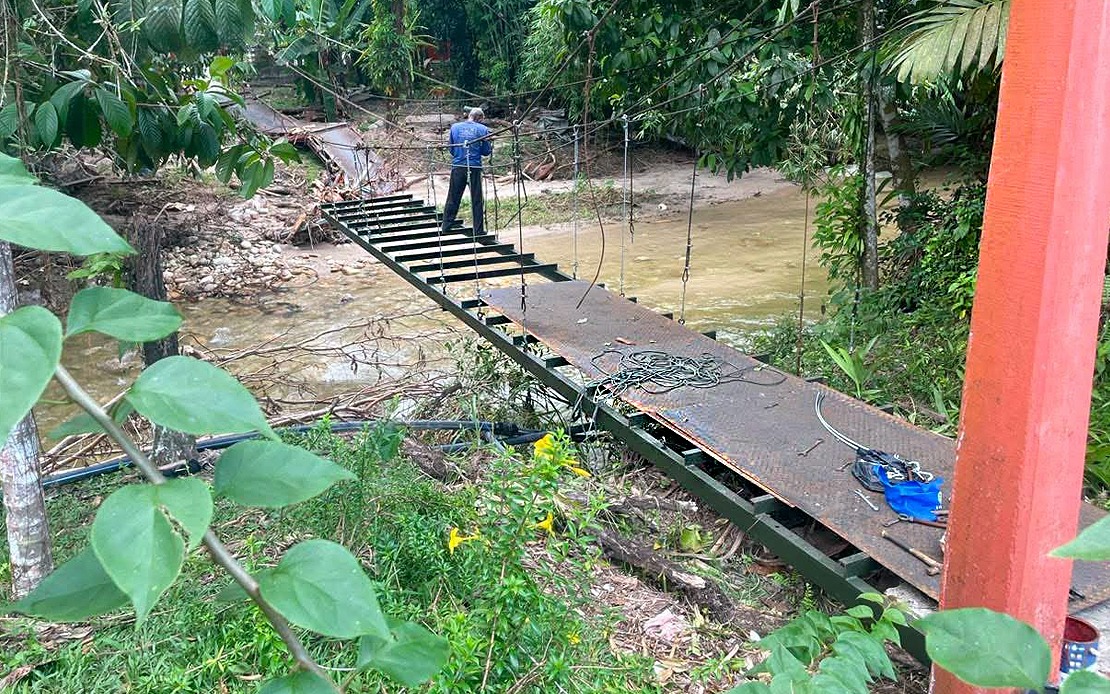
The Perak state government has moved swiftly to reconstruct critical infrastructure in Kampung Ulu Geruntum, Gopeng, after a devastating water surge obliterated the village's primary bridge access on June 19, leaving the community isolated and vulnerable. An allocation of RM500,000 has been approved for the construction of a new concrete bridge, marking the state's commitment to providing a robust long-term solution that will withstand future natural disasters and ensure permanent connectivity to this rural enclave.
The decision reflects the urgency with which state authorities are addressing the aftermath of the flooding incident that forced more than 50 residents to evacuate to emergency shelter at Gopeng Town Hall. The destruction of the main bridge effectively severed the only practical access route for villagers, preventing the movement of people, goods, and emergency services in and out of the settlement. This isolation underscored how dependent rural communities remain on single points of infrastructure connection, a vulnerability that development planners across Southeast Asia must increasingly factor into their assessment of village infrastructure adequacy.
Sandrea Ng Shy Ching, the State Housing and Local Government Committee chairman and Teja assemblyman, announced the funding arrangement and expressed determination to accelerate recovery efforts. She acknowledged the tireless work of multiple agencies and field personnel engaged in rescue, relief, and rehabilitation operations, recognising that such coordinated responses require sustained commitment from government bodies, emergency services, and local administrators working in tandem to restore normalcy to affected communities.
Beyond the primary bridge reconstruction, the state government has implemented a multi-layered recovery strategy to address both immediate and medium-term needs. A temporary suspension bridge with a construction budget of RM150,000 is already under way and is targeted for completion by mid-July, providing a crucial interim crossing that will reconnect the isolated area while permanent works progress. This phased infrastructure approach allows residents to resume movement between the village and surrounding areas, restoring access to markets, medical facilities, schools, and other essential services that many rural dwellers depend upon.
Water supply restoration has emerged as another critical priority. The initial flooding and bridge collapse compromised the pipe network servicing the community, compounding the immediate hardship faced by residents. Sandrea utilised RM45,000 from her constituency allocation to finance the repair of damaged pipes and reinstatement of water distribution, addressing one of the most fundamental human needs that the disaster had disrupted. Access to clean drinking water remains a basic service challenge in several Malaysian rural areas, and infrastructure damage from natural disasters frequently exacerbates existing supply vulnerabilities.
The incident itself illustrates the growing climate-related risks facing communities situated in flood-prone regions. The water surge that struck on June 19 demonstrated the destructive potential of rapid, concentrated flows in areas where drainage and water management infrastructure may be inadequate or where natural topography concentrates runoff. As extreme weather patterns become more frequent across Southeast Asia, such singular catastrophic events are increasingly shaping the calculus of infrastructure investment and village resilience planning in Malaysia's rural hinterlands.
The response timeline is noteworthy. Within approximately two weeks of the bridge collapse, the state government had already approved substantial funding, mobilised resources for temporary access, and initiated design and construction processes for permanent replacement infrastructure. This relatively rapid decision-making contrasts with the often protracted bureaucratic processes that characterise major infrastructure projects in many jurisdictions, suggesting that disaster recovery situations can sometimes catalyse more agile governance responses than routine development planning typically permits.
For Kampung Ulu Geruntum residents, the approved funding represents more than financial allocation; it signals institutional acknowledgement that their community's isolation was unacceptable and that reconnection is an immediate priority. The layered approach—temporary suspension bridge, permanent concrete structure, water infrastructure repairs, and ongoing remedial work—demonstrates a commitment to comprehensive recovery rather than piecemeal repairs. This integrated methodology, while resource-intensive, addresses multiple dimensions of disruption simultaneously and reduces the likelihood of cascading secondary crises stemming from incomplete rehabilitation.
The broader implications extend to how state governments across Malaysia balance rural infrastructure development with disaster resilience. Communities in hilly or flood-prone regions often lack redundant access routes, making them vulnerable to isolation if primary bridges or roads are compromised. The Kampung Ulu Geruntum incident serves as a case study for planners considering whether secondary access routes, elevated or reinforced bridge designs, or diversified transport connections might merit investment as preventive measures. Such forward-looking infrastructure decisions could substantially reduce the human and economic costs of future water surges or similar natural disasters affecting geographically isolated settlements.

