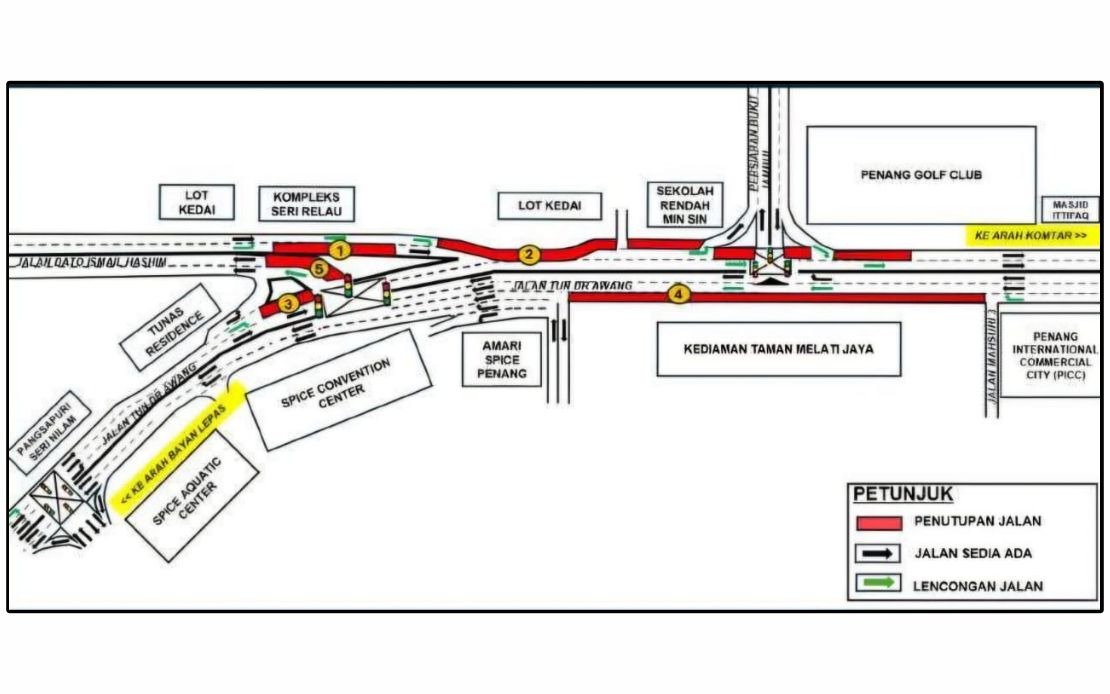
Commuters and businesses in George Town, Penang, will need to navigate revised traffic arrangements from late August through the end of October as Malaysia Rapid Transit Corporation Sdn Bhd (MRT Corp) undertakes preparatory works for the Mutiara Line Light Rail Transit project. The corporation has announced periodic partial lane closures spanning a 72-day period along Jalan Tun Dr Awang and Jalan Dato Ismail Hashim between Sri Relau Complex and Penang Golf Club, beginning August 20 and concluding October 31.
The construction phase represents a critical preliminary stage for the Mutiara Line, one of Penang's ambitious transit infrastructure initiatives designed to alleviate congestion in the northern corridor. The affected section falls under Package CMC1 of the larger project, which aims to modernise public transportation connectivity across the state. Rather than implementing full road closures that would paralyse traffic flow, MRT Corp has opted for a managed approach featuring staggered lane restrictions during daylight working hours, from 8:30 am to 4:30 pm each day. This strategy seeks to balance construction imperatives with maintaining reasonable traffic circulation, particularly important given that these routes serve as primary thoroughfares linking residential areas, commercial zones, and the Komtar shopping complex.
The specific lane configurations affected by the closure regime demonstrate the complexity of urban infrastructure projects in densely settled areas. On Jalan Dato Ismail Hashim directly in front of Sri Relau Complex, the right lane heading towards Komtar will be sealed off to accommodate drainage infrastructure and earthworks. Further along the same road, from the vicinity of shop lots near SJK (C) Min Sin extending to Penang Golf Club, the left lane in the Komtar direction will similarly become unavailable. At the traffic light intersection where Jalan Dato Ismail Hashim meets Jalan Tun Dr Awang, the left turning lane towards Komtar is scheduled for closure, while on Jalan Tun Dr Awang proper, the leftmost lane near Taman Melati Jaya residential area progressing towards Bayan Lepas will be sequestered for project works. Throughout these restrictions, MRT Corp has committed to maintaining at least one functioning lane in each direction to prevent complete gridlock.
The underlying construction activities centre on essential groundwork components prerequisite to actual transit infrastructure installation. Drainage system redesign represents a significant element, as modern LRT systems require sophisticated water management to protect underground and elevated structures from seasonal flooding—a critical consideration for a tropical region like Penang prone to heavy monsoon downpours. Concurrent road widening initiatives suggest that current carriageway dimensions prove insufficient for the integrated transportation network envisioned by planners. These preliminary works, though unglamorous compared to the eventual rail infrastructure, establish the physical and hydrological foundations upon which reliable transit service depends.
For the broader Malaysian context, the Mutiara Line project exemplifies how regional transport authorities are tackling metropolitan mobility challenges intensifying as populations concentrate in urban areas. Penang, as a major commercial and manufacturing hub, has witnessed consistent demographic growth that existing road infrastructure struggles to accommodate efficiently. The LRT expansion programme reflects a policy orientation favouring rail-based transit over further road expansion—a position increasingly adopted across Southeast Asian cities confronting congestion and air quality deterioration. However, such transitions impose considerable short-term disruption, and the manner in which authorities communicate and manage these inconveniences significantly influences public acceptance of long-term infrastructure investments.
MRT Corp has instituted several measures designed to minimise commuter frustration during the closure window. Traffic control infrastructure including signboards, traffic cones, and on-site flagmen will guide motorists through modified traffic patterns. The positioning of personnel at closure points aims to enhance real-time navigation and prevent confusion-related accidents. Nevertheless, the corporation acknowledges implicitly that disruptions are inevitable and has positioned itself as responsive to public concerns. The Mutiara Line Careline (1-800-88-6782) and dedicated email channel ([email protected]) provide mechanisms for residents and businesses to lodge complaints, request clarifications, or report unexpected problems during the construction phase.
For businesses along the affected corridors, the three-month closure period presents manageable though quantifiable challenges. Retailers, particularly those fronting Sri Relau Complex and nearby shop lots, may experience reduced customer foot traffic during peak construction hours. Delivery logistics become complicated when standard access routes are compromised, potentially increasing operational costs. However, the phased, time-limited nature of closures—confined to business hours with weekends presumably unrestricted—suggests that impacts remain circumscribed compared to catastrophic scenarios of total road closure. Businesses dependent on customer accessibility would be well-advised to implement contingency marketing and operational strategies anticipating reduced patronage and adjusted delivery schedules during the August-to-October window.
The Mutiara Line represents significant capital commitment by Malaysia's transport authorities, reflecting confidence that rail infrastructure constitutes essential backbone for Penang's economic vitality and livability in coming decades. The preliminary works now commencing pave the way for actual transit line construction, which will ultimately reshape commuting patterns and land-use dynamics across George Town and surrounding districts. By establishing drainage systems and widened roadbeds in advance, MRT Corp aims to streamline subsequent construction phases and minimise aggregate disruption spread across several years. This sequenced approach, though generating immediate inconvenience, potentially reduces cumulative community impact relative to concentrated intensive construction.
Motoring public should anticipate modified travel times and exercise heightened caution throughout the closure zones, particularly during peak morning and evening rush periods when congestion potential peaks. Alternative routes, while available, may themselves become congested as diverted traffic seeks passage, potentially cascading delays throughout George Town's transport network. Public transportation alternatives, if available, may offer preferable options for regular commuters, though Penang's existing bus network capacity may struggle absorbing sudden route diversions. The closure period thus constitutes a transitional moment wherein transport planning assumptions become temporarily invalidated, and commuters must develop novel travel strategies responsive to revised infrastructure availability.
As Penang progresses with its transport modernisation agenda, the Mutiara Line represents a tangible commitment to reducing congestion and improving connectivity across the state. The preliminary works commencing August 20 mark the visible commencement of this transformation, though results remain several years distant. For residents and workers navigating George Town during the closure period, temporary inconvenience represents the proximate cost of long-term urban improvement. MRT Corp's communication channels and traffic management protocols aim to contain disruption within acceptable parameters, though inevitably some adjustment costs will be borne by the affected community.

