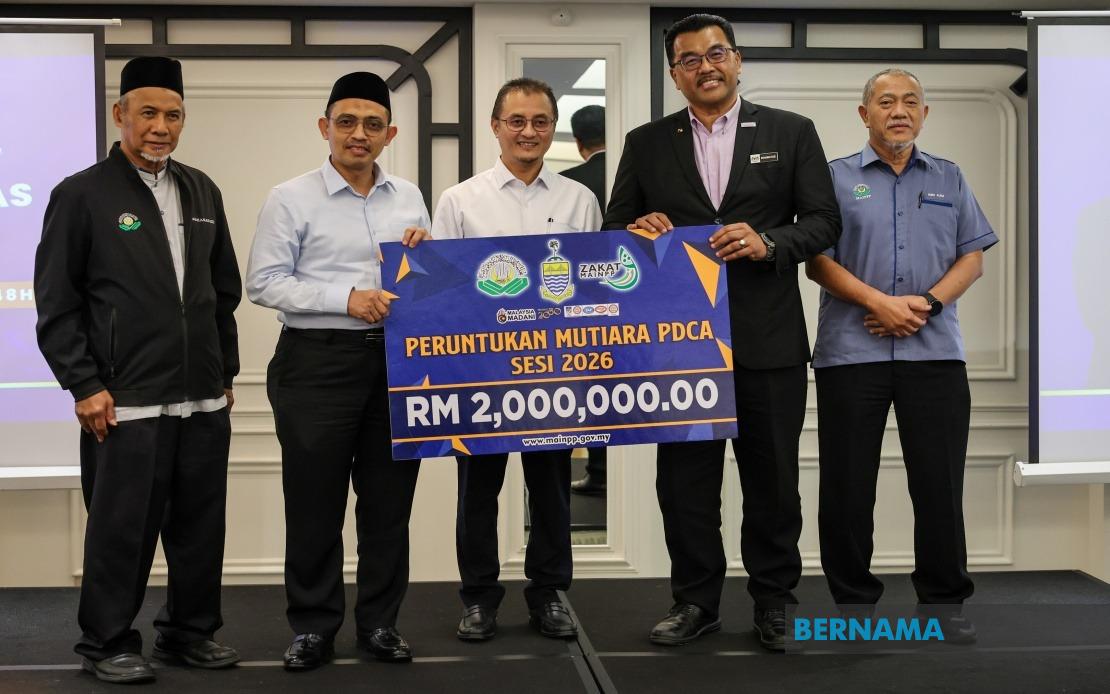
The Penang State Islamic Religious Council (MAINPP) has channelled RM2 million into its flagship education programme this year, supporting over 7,400 Bumiputera students seeking to strengthen their academic foundations. Penang Deputy Chief Minister I Datuk Dr Mohamad Abdul Hamid announced the allocation at a briefing for coordinating teachers, emphasising the council's ongoing commitment to expanding educational access among the state's Bumiputera population.
The Mutiara Didik Cemerlang Akademik (MPDCA) programme, which began in 2006, represents a collaborative effort spanning MAINPP, the Penang State Education Department (JPNPP), the Penang Bumiputera Participation Coordination Division under Prime Minister's Department Implementation Coordination Unit, and the Penang Regional Development Authority (PERDA). This multi-agency structure allows the initiative to draw on diverse resources and expertise, positioning it as one of the state's most comprehensively supported educational schemes targeting disadvantaged Bumiputera learners.
The 2026 iteration involves 698 coordinating teachers deployed across 71 primary schools and 38 secondary schools throughout Penang. This extensive teacher network reflects the programme's grassroots reach and its capacity to deliver personalised academic support in settings where students learn. Participating teachers receive specific training in programme methodology and serve as bridges between home study and classroom instruction, helping students consolidate learning across different contexts.
For primary students, the programme concentrates on four foundational subjects: Bahasa Melayu, English, Mathematics and Science. This focused approach recognises that mastery of core competencies at primary level significantly influences secondary academic trajectories. The tuition classes complement formal schooling rather than replace it, using systematically developed learning modules that educators report have improved student comprehension and retention.
Students preparing for the Sijil Pelajaran Malaysia (SPM) examination access instruction across 13 subjects, creating pathways for diverse academic interests and career aspirations. Alongside mainstream subjects including Bahasa Melayu, History, English, Mathematics and Sciences, the programme includes Arabic and Integrated Dini Curriculum subjects such as Dini-Lughatul Arabiyyah Mu'asirah (LAM), Dini-As Syariah and Dini-Usuluddin. This breadth enables students from government-aided religious schools to receive integrated academic preparation aligned with their institutional framework.
Beyond tuition classes, the RM2 million allocation supports learning modules, academic seminars and examination technique workshops designed to build student confidence and strategic test-taking skills. These components address not merely content knowledge but metacognitive abilities—teaching students how to approach examinations systematically and manage exam-related anxiety. Teachers report that quiz-based activities embedded within updated modules have particularly enhanced student engagement and classroom participation.
Testimonies from participating educators underscore the programme's tangible impact on learning outcomes. Hartina Arjan, a Bahasa Melayu teacher at Sekolah Kebangsaan Permai Indah in Bukit Minyak, noted that the systematically designed modules have strengthened students' mastery across speaking, reading and writing skills, preparing them effectively for Classroom-Based Assessment (PBD) and year-end examinations. Sadiah Roslan from Sekolah Rendah Islam Al-Masriyah Halimatun in Bukit Mertajam highlighted particular benefits for students from low-income households unable to access private tuition, democratising access to supplementary academic support.
The allocation sits within MAINPP's broader educational investment framework. Beyond the RM2 million for MPDCA, the council has committed RM22.36 million for Higher Education Bursaries, RM6.3 million for the Permulaan IPT (Permulaan Institut Pendidikan Tinggi) Scheme supporting entry into tertiary education, RM3 million for Early Schooling Aid and RM3 million for School Uniform Aid. Combined, these initiatives total approximately RM36.66 million, representing substantial financial commitment to human capital development across educational stages.
This integrated approach reflects a developmental philosophy spanning early childhood through higher education. By removing financial barriers to uniform provision and school entry, enabling supplementary tuition at critical junctures, and facilitating tertiary access, MAINPP addresses structural inequalities affecting Bumiputera learner progression. The timing of support—strengthening foundation skills in primary years, consolidating secondary performance, and enabling tertiary transitions—follows evidence-based patterns of educational vulnerability.
The programme's two-decade track record provides compelling validation of its approach. Since introduction in 2006, JPNPP data demonstrates measurable improvements in academic performance and achievement among participating students. This longitudinal success distinguishes MPDCA from temporary interventions, suggesting that sustained, institutionalised support embedded within education systems produces more durable outcomes than ad-hoc initiatives.
For Malaysian policymakers, the Penang model offers instructive lessons regarding integrated support systems. Rather than treating tutoring, materials provision and teacher training as separate interventions, MPDCA weaves them into coordinated provision. The involvement of state-level education authorities alongside religious and development agencies suggests institutional arrangements that blend bureaucratic capacity with community legitimacy, potentially applicable to other states seeking to improve Bumiputera academic outcomes.
The programme also illustrates how state-level actors can implement targeted educational policies reinforcing national equity commitments. Bumiputera educational access remains politically significant across Malaysia, and state governments able to demonstrate measurable impacts on this objective strengthen their political legitimacy while advancing genuine educational inclusion. Penang's sustained RM2 million annual allocation indicates political will to institutionalise such initiatives beyond electoral cycles.

