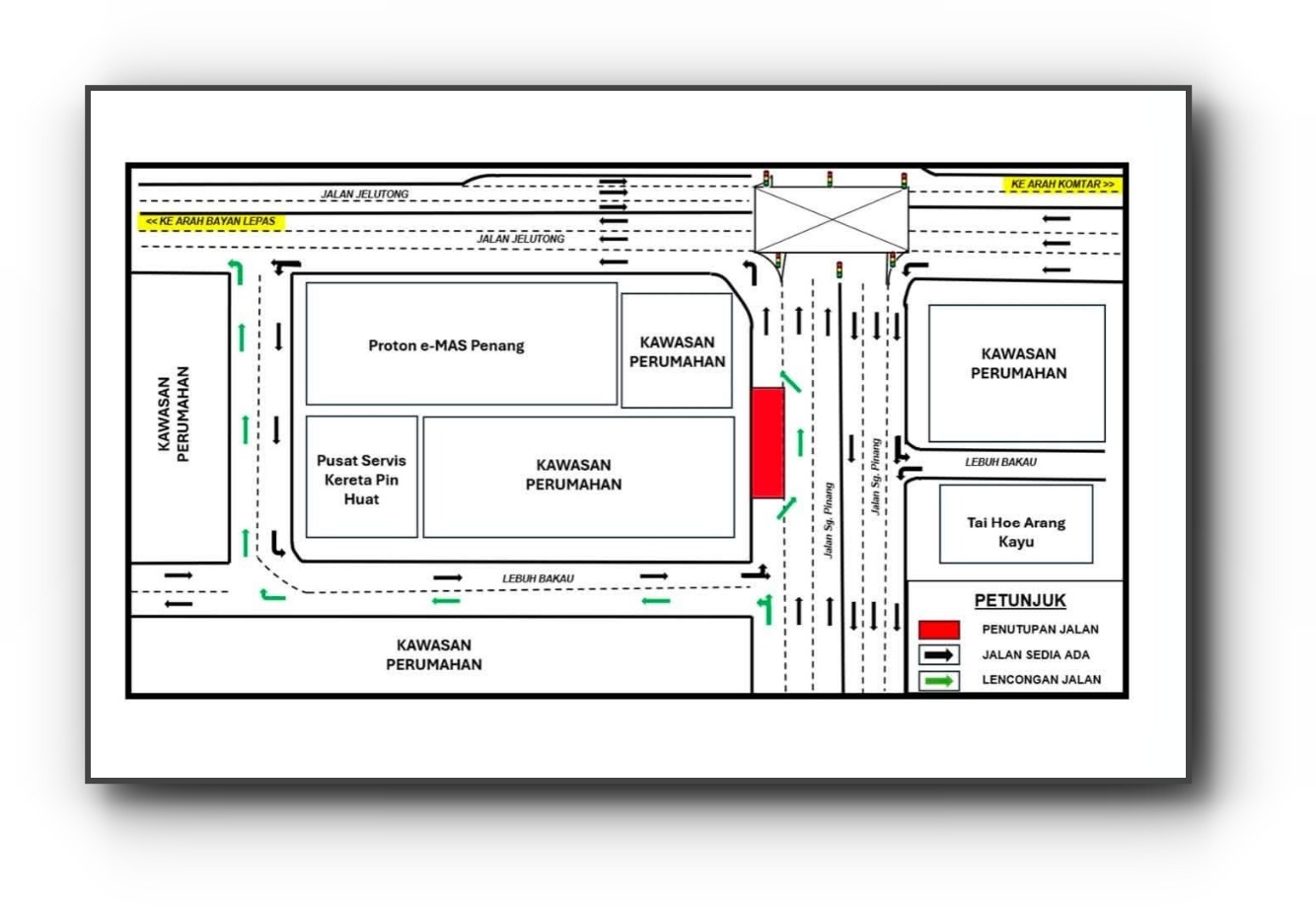
The George Town municipality will implement a 10-day partial closure on Jalan Sungai Pinang beginning tomorrow, with work scheduled to run continuously through September 6. The restriction affects only the leftmost lane along the stretch connecting Lebuh Bakau junction to the traffic light intersection where Jalan Sungai Pinang meets Jalan Jelutong, creating a carefully managed bottleneck to accommodate essential infrastructure maintenance by national utility provider Tenaga Nasional Bhd.
Sungai Pinang state assemblywoman Lim Siew Khim announced the closure schedule in a Facebook post this evening, confirming that the 24-hour work commences at 9 am on August 28 and concludes at 11:59 pm on September 6. Her announcement signals the authorities' commitment to transparent communication with the public ahead of potential traffic disruptions in one of George Town's major thoroughfares. The timing and duration suggest that TNB has coordinated extensively with the state government to minimise community impact while completing necessary utility relocation tasks.
The utility relocation project reflects ongoing infrastructure modernisation efforts across Penang's road network. Such works typically involve relocating underground power cables, conduits, or related equipment to accommodate road widening, maintenance, or urban development initiatives. While the specific reason for this relocation was not detailed in the announcement, these projects are generally part of broader public works planning to improve service reliability and accommodate growing urban demands in the George Town corridor.
To mitigate traffic congestion, authorities have identified Lebuh Bakau as the primary alternative route for motorists heading towards Jalan Jelutong during the closure period. This diversion strategy suggests that Lebuh Bakau possesses sufficient capacity to absorb the displaced traffic volume, though commuters should anticipate slower movement during peak hours. Other lanes on Jalan Sungai Pinang will remain operational, meaning vehicles proceeding in other directions or using the middle and right lanes can continue unimpeded.
Lim, who also chairs the state's Social Development, Welfare and Non-Islamic Religious Affairs Committee, has emphasised the importance of exercising caution throughout the affected zone. Her multi-portfolio role underscores the state government's integrated approach to managing public services, with transport planning linked to broader community welfare concerns. The assemblywoman's direct public communication reflects contemporary best practices in constituency management, where elected representatives proactively inform residents of disruptions affecting their daily routines.
The authorities have deployed comprehensive traffic management infrastructure to ensure safe passage through the work zone. Safety signboards will alert approaching drivers to the lane closure well in advance, allowing adequate reaction time for navigation decisions. Traffic cones will physically demarcate the closed lane and guide vehicles toward open alternatives, creating visible boundaries that reduce driver confusion. Flagmen positioned throughout the corridor will provide real-time traffic direction and respond to emerging congestion or safety hazards, adding a human element to mechanical traffic control systems.
This closure demonstrates the ongoing tension between essential infrastructure maintenance and the demands of urban mobility in a congested metropolitan area. For Malaysian commuters familiar with Penang's notoriously busy roads, any lane restriction typically triggers anxiety about travel times and disrupted schedules. However, the 10-day timeframe is relatively contained, suggesting that TNB has scheduled this work during a window deemed manageable by traffic planners rather than extending indefinitely.
The relocation of utilities by a state-controlled entity like TNB often involves coordinating multiple government agencies and contractors. The seamless execution of such projects depends on prior coordination between TNB, the state Works Department, traffic management authorities, and local councils. The announcement's specificity regarding exact start and end times indicates that detailed planning has preceded this public notice, reducing the likelihood of unexpected delays or extensions that frequently frustrate motorists.
Commuters using this route regularly should prepare for alternative transportation strategies during the closure window. While Lebuh Bakau offers the designated detour, experienced drivers often explore secondary routes to avoid concentration of diverted traffic on any single alternative. Residents might consider adjusting travel times by leaving earlier or using app-based navigation to identify least-congested paths through George Town's complex street network.
The project also carries broader implications for Penang's infrastructure resilience and service continuity. Utility relocations often precede significant road improvements or urban renewal projects, suggesting that this area may experience subsequent development. For property owners and businesses along the corridor, such infrastructure work typically signals medium-term planning by the government for area-wide improvements, potentially affecting property values and commercial viability.
Utility companies and state governments across Southeast Asia face increasing pressure to balance essential maintenance with minimal public disruption. This Penang closure exemplifies the coordination required to deliver necessary services without forcing wholesale traffic chaos. The structured approach—defined timeframes, designated alternative routes, visible safety measures, and advance communication—reflects mature project management practices that other Malaysian states might emulate when managing similar situations.
Mottorists should also note that safety near construction sites demands heightened vigilance. Flagmen, despite their best efforts, cannot prevent all incidents, and the concentrated presence of heavy machinery and workers increases accident risks. Reducing speeds, avoiding sudden lane changes, and maintaining heightened attention remain essential even when official safety measures are comprehensively deployed.

