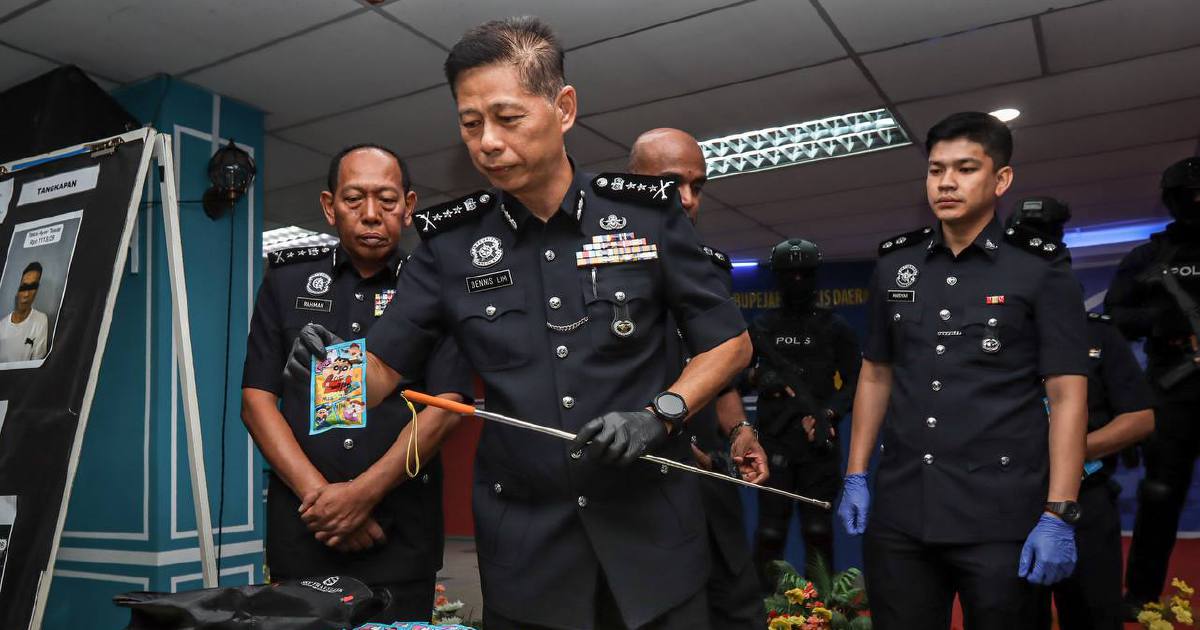
In a significant crackdown on drug trafficking in the northern region, Penang police successfully conducted an enforcement operation that resulted in the seizure of a large quantity of illicit substances and the arrest of a suspect involved in narcotics distribution. The raid, executed on Sunday at a location in Teluk Air Tawar, uncovered 3.1 kilograms of MDMA—commonly known as ecstasy—which authorities valued at approximately RM470,000 on the illegal market.
The operation represents part of ongoing efforts by the Penang state police force to combat the circulation of dangerous synthetic drugs that have become increasingly prevalent throughout Malaysia's urban centres. MDMA, a controlled substance classified under Malaysia's Dangerous Drugs Act 1952, continues to pose significant public health and social challenges, particularly among younger demographics and within entertainment venues. The interception of this substantial cache prevents these substances from reaching end consumers and disrupts established distribution networks operating within the state.
The Teluk Air Tawar area, situated in George Town, has been an area of concern for law enforcement due to its proximity to residential communities and commercial zones. Police operations in such locations require careful coordination to ensure public safety while maximising the effectiveness of enforcement activities. The successful execution of this raid underscores the importance of intelligence gathering and community vigilance in identifying locations where drug-related activities may be concentrated or organised.
These enforcement actions form a critical component of Malaysia's broader anti-narcotics strategy, which has intensified significantly over recent years. The country faces persistent challenges from both international drug trafficking organisations and domestic syndicates that exploit regional vulnerabilities to move controlled substances through supply chains. Penang, as a major commercial and tourism hub with significant port infrastructure, remains an attractive target for traffickers seeking to distribute drugs throughout Malaysia and the broader Southeast Asian region.
The value attributed to the seized MDMA reflects market realities in Southeast Asia, where synthetic drugs command premium prices due to supply constraints and enforcement risks. The RM470,000 valuation suggests this operation may have targeted mid-level distribution networks rather than street-level dealers, indicating a more strategic approach to dismantling the supply chain rather than simply arresting end users. This distinction is meaningful, as disrupting higher-level operations creates more significant disruption to criminal enterprises than isolated arrests of lower-tier participants.
Malaysian authorities have consistently emphasised that combating drug trafficking requires multi-agency coordination involving police narcotics divisions, customs agencies, and international law enforcement partners. The seizure of such quantities typically prompts follow-up investigations to identify upstream suppliers and downstream distribution networks connected to the arrested individual. These secondary investigations often yield additional arrests and further confiscations as enforcement chains expand to encompass broader criminal organisations.
Penang's geographic position as a gateway to Malaysia makes drug enforcement operations there particularly consequential for national security and public health objectives. The state's status as a major tourist destination and business centre creates environment where synthetic drugs can find readily accessible markets among various demographic groups. Police operations targeting wholesale quantities of MDMA address the supply side of this equation, attempting to constrain availability even as demand management through education and rehabilitation services must continue in parallel.
The arrest and charge procedures following such operations involve custody management, investigation protocols, and eventual prosecution through Malaysia's specialised drug courts. Individuals charged with possession of quantities exceeding certain thresholds face mandatory presumptions of trafficking rather than simple possession, resulting in significantly enhanced penalties under existing legislation. The severity of these potential consequences reflects the government's commitment to treating large-scale narcotics operations as serious criminal matters deserving of proportionate legal responses.
This successful operation contributes to an expanding enforcement record across Malaysia's primary police jurisdictions and reflects resource allocation priorities that increasingly emphasise drug interdiction. Regional cooperation through mechanisms such as ASEAN frameworks for law enforcement coordination enables information sharing and joint operations that amplify the impact of individual state-level enforcement activities. The Penang seizure thus carries implications beyond immediate local security, potentially disrupting supply patterns affecting neighbouring states and regional drug markets more broadly.
Community awareness regarding drug trafficking routes and patterns remains essential for sustaining effective enforcement outcomes. Public cooperation through confidential tip-offs to authorities frequently provides the intelligence foundation enabling operations such as the Teluk Air Tawar raid. Authorities continue to encourage residents to report suspicious activities while emphasising that protective measures exist for informants supplying information regarding narcotics operations.

