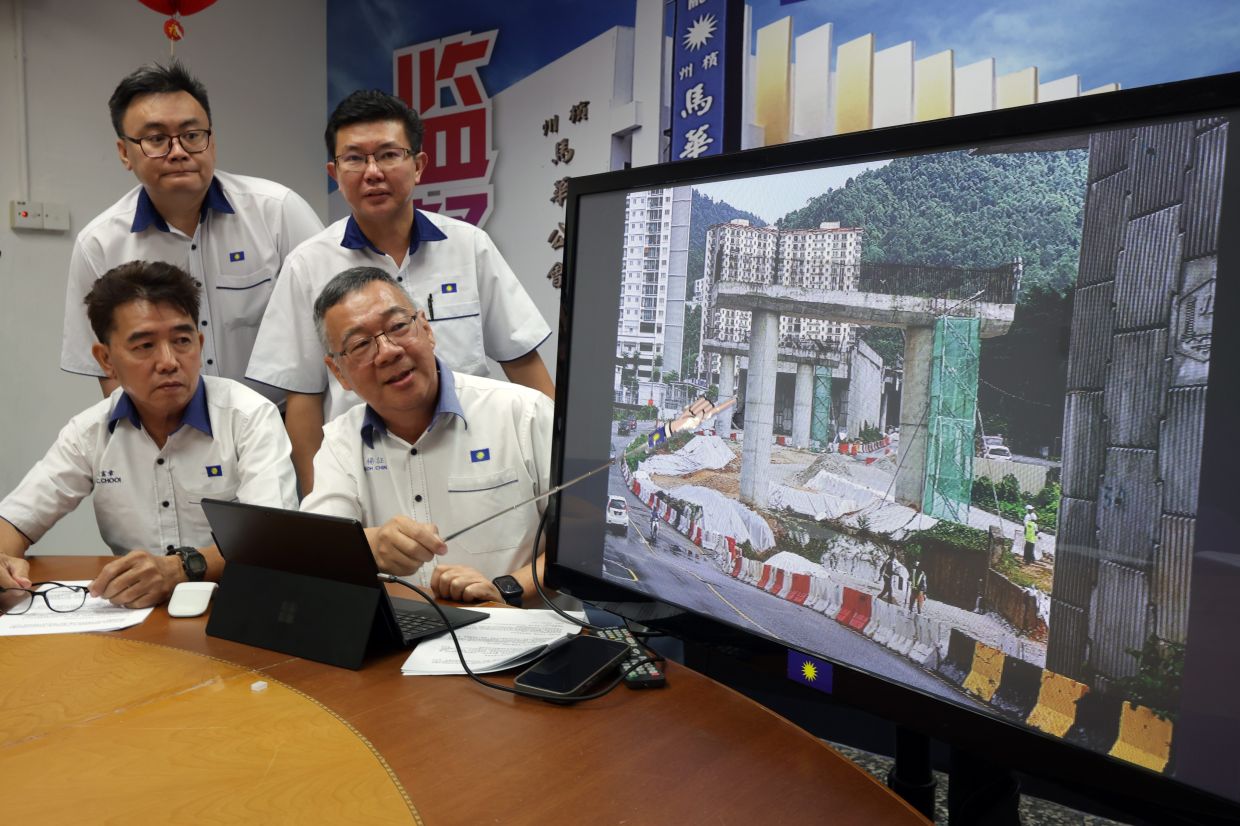
The Penang MCA has escalated its scrutiny of the Air Itam-Tun Dr Lim Chong Eu Expressway bypass project, moving beyond complaints about delays to demand comprehensive transparency from the state government on a infrastructure initiative that has become emblematic of project management challenges in Malaysia's northern corridor. Party secretary Yeoh Chin Kah framed the dispute as fundamentally about restoring public confidence rather than merely explaining construction setbacks, signalling that political pressure on the issue will intensify regardless of official progress reassurances.
The core dispute centres on the credibility of completion percentages being reported by authorities. Yeoh pointed out that claimed progress jumped from 80 percent in May to 89 percent in December, a 9-percentage-point advance in seven months that he argues is inconsistent with observable conditions on site. When MCA representatives conducted their own inspection on July 1, they documented extensive work still outstanding across multiple sections including Valley Road, Changkat Tembaga and Jalan Thean Teik. According to their assessment, bridge piers had been erected but bridge beams and deck structures remained absent, while surfacing, guardrails, noise barriers, electrical systems and connecting roads were incomplete in numerous locations.
This discrepancy between reported metrics and ground-level reality points to a broader issue affecting major infrastructure projects across Malaysia: the reliability of progress reporting mechanisms and whether completion percentages accurately reflect work done or merely represent contractual milestones achieved. The gap between 89 percent completion as stated by the state government and the visible scope of outstanding work suggests either the measurement methodology itself requires clarification or the categories being counted as "complete" warrant examination by independent parties.
Penang MCA has set a seven-day deadline for the state government to release payment records, consultant certification reports and project assessment documents—essentially demanding the evidentiary basis for the completion claims. Should these documents not materialise, the party has indicated it will escalate matters to the National Audit Department and the Malaysian Anti-Corruption Commission, moves that would trigger formal investigative processes and potentially create political complications for state leadership heading toward election cycles.
The 6-kilometre toll-free bypass forms the second phase of the broader Penang undersea tunnel and three paired roads infrastructure initiative. It is designed to create a direct arterial connection between Lebuhraya Thean Teik in Bandar Baru Air Itam and the Tun Dr Lim Chong Eu Expressway via elevated viaducts, subterranean sections and ground-level routes. The project was originally scheduled for 2024 completion but has received two time extensions, with the current target now April 12, 2027—a pattern of deadline slippages that has eroded public confidence in official timelines.
When completed, the bypass is projected to benefit approximately 300,000 residents concentrated in Air Itam, Bandar Baru Air Itam and Paya Terubong, making it strategically important for the wider metropolitan region's traffic management and economic development. However, repeated delays have meant that anticipated congestion relief has been deferred multiple times, affecting commuter planning and regional economic assessments that depend on improved transport infrastructure.
In response to MCA's challenges, Paya Terubong assemblyman Wong Hon Wai provided an updated completion figure of 91 percent and confirmed that contractor assurances point toward the April 12, 2027 deadline being maintained. Wong's account included specifics about ongoing work schedules: twelve bridge beams are scheduled for launch between the current period and August on the Gelugor side, with six additional beams targeted for fourth-quarter installation. All bridge beams on the Bandar Baru Air Itam side have already been launched, though Wong clarified that opening to public traffic would not occur immediately upon structural completion.
The timeline between structural completion and public opening will involve additional procedural steps: government agencies will conduct Road Safety Audits, following which the Public Works Department will determine the actual opening date based on audit findings. This final approval mechanism means that even if construction concludes on schedule, actual traffic flow could be delayed by weeks or months pending regulatory sign-off. Such procedural requirements, while appropriate for safety assurance, introduce uncertainty into public-facing promises about operational commencement.
The dispute between Penang MCA and state authorities reflects deeper governance questions that resonate across Southeast Asian infrastructure development. Malaysia, like regional peers, faces structural challenges in project delivery: cost overruns, schedule extensions, and accountability mechanisms that do not always align with public expectations. The demand for documentary evidence—payment records, consultant reports, assessment documents—represents an insistence on verifiable accountability rather than reliance on official proclamations alone.
For Malaysian readers and regional observers, this impasse illustrates why infrastructure transparency matters beyond mere project management efficiency. When governments cannot readily produce documentation supporting publicly stated completion claims, or when ground realities diverge significantly from reported metrics, broader questions emerge about financial control, contractor performance monitoring and the institutional capacity to oversee large-scale development. Such concerns are not unique to Penang but appear across Malaysian state-level infrastructure portfolios.
The seven-day ultimatum represents a potential inflection point. If the state government produces comprehensive, credible documentation supporting its progress claims, public confidence may stabilise. Conversely, if disclosure is delayed, contested or incomplete, the escalation to anti-corruption and audit authorities becomes more likely, potentially triggering investigations that extend beyond this single project to examine systemic practices in state infrastructure governance. Either outcome will have implications for how Malaysian state governments approach transparency in large-scale public works going forward.

