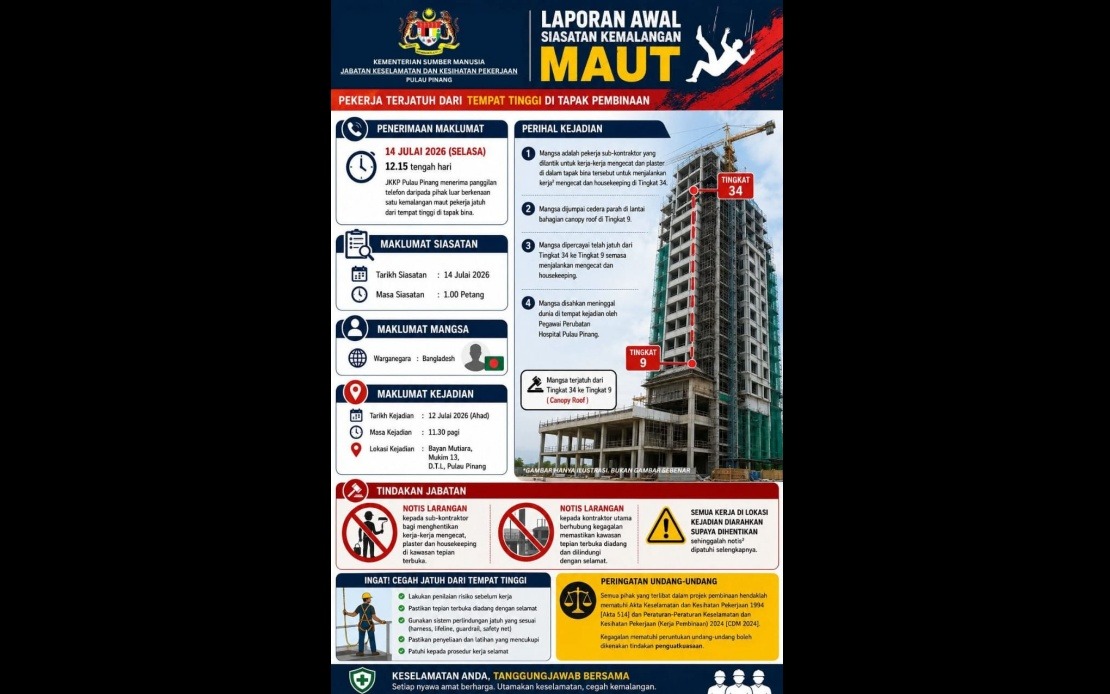
Malaysia's construction sector faced renewed scrutiny over worker safety this week following the death of a Bangladeshi labourer in Penang, with regulatory authorities moving swiftly to halt operations and examine compliance failures at the troubled site. The incident, which occurred at a residential tower under development in the Bayan Mutiara district, has prompted the Department of Occupational Safety and Health (DOSH) to launch a full investigation into how such a fatal accident could have occurred during routine building work.
The tragedy unfolded on July 14 when the unidentified worker, employed through a subcontracting arrangement, plummeted from the 34th storey of the building where he had been engaged in painting, plastering, and housekeeping duties. He landed on a canopy structure at the ninth-floor level, sustaining injuries so severe that medical personnel from Penang Hospital pronounced him deceased at the scene. The discovery came several hours after the incident when external parties notified authorities, with DOSH receiving the alarm at 12:15 pm and dispatching investigative teams within minutes.
According to Penang DOSH director Hairozie Asri, the preliminary assessment reveals that the victim was part of a subcontracting workforce rather than direct employees of the main contractor. This tiered employment arrangement, common across Malaysia's construction industry, often creates ambiguity in accountability chains and raises questions about supervision standards and safety protocol enforcement. The fact that a worker could fall from such a height—spanning 25 floors of vertical space—suggests potential gaps in fall-prevention measures that should be mandatory at elevated work locations.
The regulatory response has been forceful, with DOSH issuing comprehensive prohibition notices to both the subcontractor responsible for the specific work activities and the principal contractor overseeing the entire project. These orders specifically prohibit all painting, plastering, and housekeeping operations in areas with open edges, effectively halting a significant portion of the construction work. Additionally, all activities connected to the accident location have been suspended indefinitely until the contractors fully satisfy every requirement outlined in the prohibition notices.
This incident underscores persistent vulnerabilities in Malaysia's construction safety framework, particularly regarding foreign workers who comprise a substantial portion of the sector's labour force. Bangladeshi nationals, along with workers from Nepal, Myanmar, and Indonesia, form a critical backbone of Malaysia's building industry, yet they often face language barriers, limited safety awareness, and insufficient protective equipment. The reliance on subcontracting arrangements means that responsibility for safety training and equipment provision frequently becomes diffused, with workers sometimes unaware of hazards or their rights.
Penang, as a rapidly developing state with numerous high-rise residential and commercial projects, has witnessed increased construction activity over recent years. The Bayan Mutiara area itself represents significant urban development, hosting multiple towers at various stages of completion. Each project represents both economic opportunity and potential risk—particularly when contractors prioritise speed and cost efficiency over meticulous safety protocols. Fatal or serious accidents carry not only human tragedy but also reputational consequences for developers and regulatory implications for authorities.
The investigation into this tragedy will likely examine whether proper scaffolding, safety harnesses, guardrails, and warning systems were in place on the 34th floor. Malaysian construction standards, harmonised with international best practices, mandate specific fall-protection measures for work at heights exceeding two metres. The scale of the fall here—from the 34th to approximately the ninth storey—suggests fundamental breakdowns in basic safety architecture. Questions will centre on whether the worker received adequate safety briefings, whether his employer verified his competency for high-altitude work, and whether supervision was sufficient.
For Malaysian construction workers and employers alike, this incident serves as a harsh reminder of regulatory vigilance. DOSH maintains authority to issue substantial fines and criminal charges in cases where negligence contributes to worker deaths, and these cases often result in prosecutions against contractors, site managers, and occasionally company directors. The issuance of prohibition notices is typically followed by detailed forensic investigation and, in cases involving fatalities, potential referral to law enforcement authorities for criminal investigation.
The broader context matters here: Malaysia has committed to improving workplace safety through its ratification of International Labour Organization conventions and its National Occupational Safety and Health Master Plan. However, enforcement remains inconsistent, with smaller subcontractors sometimes operating with minimal oversight. The employment of foreign workers without proper documentation or verification compounds these challenges, as does the competitive pressure within the construction sector that incentivises corners to be cut.
For multinational firms and major developers operating in Malaysia, this incident reinforces the business case for rigorous safety investments. Insurance premiums, project delays stemming from investigations, reputational damage, and potential criminal liability far outweigh the savings gained through safety shortcutting. Smaller contractors, however, often lack the resources or sophistication to implement comprehensive safety programmes, creating a two-tier system where larger firms maintain better standards while smaller players struggle with compliance.
The coming weeks will reveal more details about the victim's background, his length of service, and his qualifications for the work assigned to him. DOSH's investigation will likely produce a detailed report examining the causal factors, systemic failures, and recommendations for preventing similar incidents. Depending on those findings, prosecutions may follow, settlements may be negotiated with the victim's family, and the contractor may face substantial reputational and financial consequences.
This death represents a preventable tragedy—a reminder that construction work remains inherently dangerous, particularly in tropical climates where weather conditions, heat stress, and fatigue compound the baseline hazards. For Malaysia's construction sector, continuous investment in safety culture, worker education, and regulatory compliance remains essential to protect the thousands of workers, many of them migrants, who build the nation's future.

