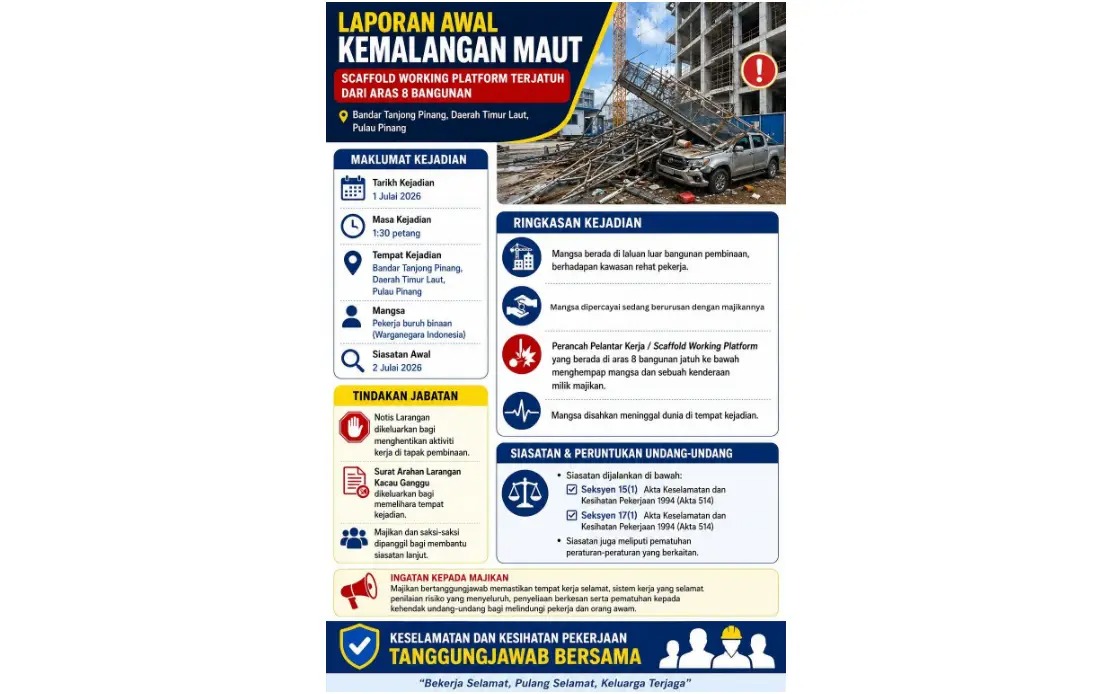
The Department of Occupational Safety and Health (DOSH) Penang has implemented an immediate work suspension at a building site in Bandar Tanjong Pinang after a fatal construction accident claimed the life of an Indonesian worker on July 1. The decision reflects the regulator's commitment to investigating workplace safety breaches that resulted in loss of life and signals a tough stance on construction industry compliance ahead of potential enforcement action.
The tragedy unfolded on the afternoon of July 1 when a scaffolding working platform detached from the eighth floor of the building under construction. The falling structure struck the worker who was positioned at ground level on an external walkway adjacent to the workers' rest area. Evidence suggests the victim was engaged in discussion with his employer at the moment of impact, with the force of the collapse also damaging a vehicle belonging to the employer at the site.
DOSH Penang's response has been swift and comprehensive. Beyond the stop-work order prohibiting all related construction activities, the authority has imposed a non-disturbance directive to preserve the accident scene in its original state. This preservation is essential for investigative teams to reconstruct the sequence of events and identify contributing factors that led to the platform's structural failure. The dual approach—halting operations while maintaining scene integrity—demonstrates standard occupational safety protocol in serious incidents.
The investigation now underway will focus on whether the employer, developer, and main contractor fulfilled their statutory obligations. Specifically, DOSH is examining compliance with Sections 15(1) and 17(1) of the Occupational Safety and Health Act 1994 (Act 514), which establish the fundamental duties employers must observe to protect workers from hazards. These sections typically require employers to provide and maintain safe work systems, conduct risk assessments, and ensure proper supervision and training. Any deviation from these requirements could result in formal enforcement action including fines or criminal prosecution.
Calls have been placed for employers and eyewitnesses to participate in the investigation process. Their testimonies and statements will help clarify the circumstances surrounding the incident, including whether proper maintenance protocols were followed, whether safety certifications for the scaffolding were current and valid, and whether workers received adequate safety briefings before work commenced. The involvement of multiple parties in the inquiry reflects the complexity of construction site management where multiple contractors and subcontractors operate simultaneously.
This incident arrives amid broader concerns about occupational safety standards in Malaysia's construction sector. The industry has long struggled with inconsistent adherence to safety regulations, particularly on sites where foreign workers constitute a significant portion of the workforce. The fatality in Bandar Tanjong Pinang underscores vulnerabilities in the oversight system, even in developed areas of Penang where regulatory presence is stronger than in other regions.
DOSH Penang has used this incident as an opportunity to remind all industry participants of their legal and moral obligations. The statement issued by the authority emphasizes that workplace accidents resulting in fatalities demand serious response and cannot be treated as mere operational setbacks. The emphasis on proper planning and safe execution of work activities serves as both a warning to negligent operators and reassurance to workers that regulatory authorities will investigate thoroughly when incidents occur.
For employers, developers, main contractors, and subcontractors operating across Penang and the broader Southeast Asian region, this case illustrates the tangible consequences of safety non-compliance. Construction sites are inherently hazardous environments where falls from height represent one of the most common causes of fatal injuries. The eighth-floor origin point of the fallen platform in this incident demonstrates how risk exposure compounds with building height, making proper safety systems non-negotiable rather than optional.
The presence of an Indonesian worker on this Malaysian site reflects the regional dynamics of construction labor markets. Many Southeast Asian countries rely heavily on migrant workers who may face language barriers, limited familiarity with local safety standards, and sometimes reduced legal protection compared to citizens. This vulnerability underscores the importance of employers and contractors implementing safety measures that transcend linguistic and cultural boundaries, using visual safety signage, practical demonstrations, and multilingual briefings.
As investigations progress, the findings will likely inform future guidance from DOSH regarding scaffolding inspection protocols, maintenance schedules, and worker positioning during construction operations. Any violations uncovered will set precedent for how aggressively regulators enforce safety standards in subsequent cases. This enforcement approach ultimately determines whether the construction industry treats occupational safety as a genuine priority or merely as a compliance checkbox.
The stop-work order will remain in place until DOSH concludes its investigation and determines that conditions are safe for resumption. Project delays and financial losses will result for the developer and contractors involved, but regulatory authorities have signaled that business continuity considerations are secondary to ensuring that similar incidents do not recur at the site or elsewhere. For the Malaysian construction sector and its regional peers, this incident serves as a sobering reminder that proper safety investment yields returns measured in lives saved.

