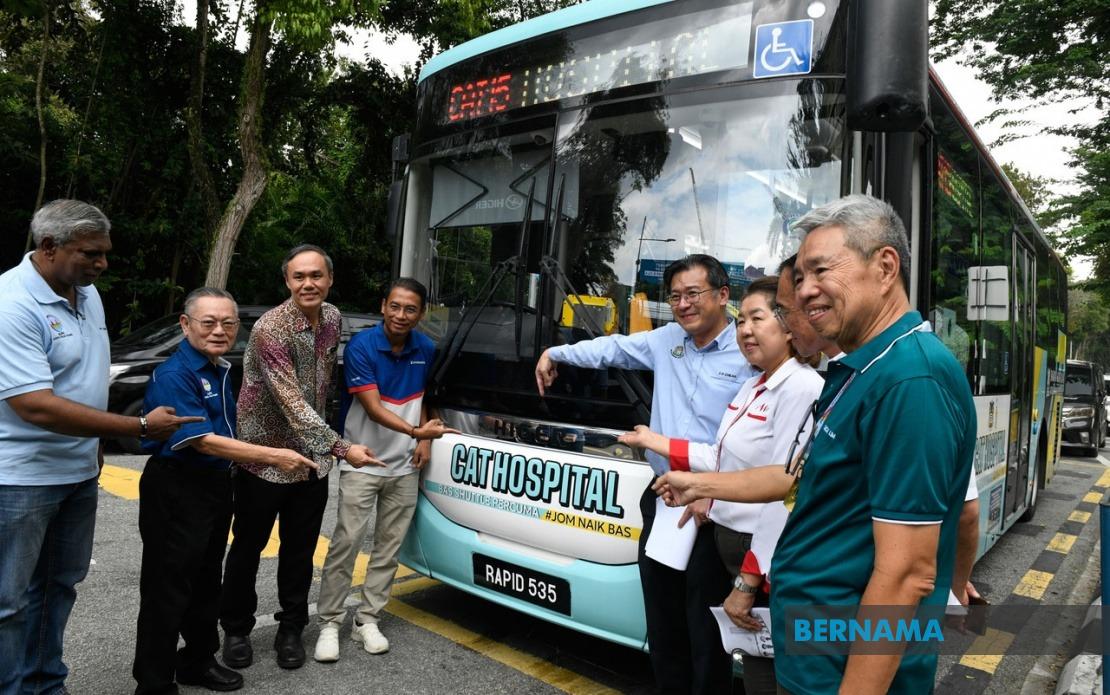
The Penang Island City Council (MBPP) has committed substantial resources to improving public access to healthcare facilities in the city centre, allocating RM900,000 each year to operate a free shuttle bus service that links the central business district with Penang Hospital and other medical institutions. The Central Area Transit (CAT) service, which formally launched on January 1, represents a strategic intervention by local authorities to address persistent transportation challenges that have plagued the hospital precinct as demand for medical services has grown.
The initiative emerged from careful planning by MBPP following a comprehensive survey undertaken after Penang Hospital completed a major expansion programme. Officials identified that the enlarged facility faced significant pressures from increased patient volumes, with parking availability becoming a critical constraint that affected both access and the surrounding urban environment. Rather than focusing solely on expanding parking infrastructure, the council determined that introducing reliable free public transport would offer a more sustainable solution while delivering broader benefits to the community.
Operationally, the service covers an eight-kilometre corridor and benefits from a dedicated fleet of three Rapid Penang buses that operate throughout the day from 6 am until 8 pm. These vehicles maintain a consistent schedule with departures every 20 minutes, completing 36 journeys daily across the network. The route encompasses Komtar, the administrative hub, along with Penang Hospital itself and three private healthcare providers, ensuring that the service functions as a comprehensive transport solution for the entire medical cluster rather than a single-institution shuttle.
The response from residents and patients has exceeded initial expectations. When the service commenced operations at the beginning of the year, daily passenger volumes hovered around 300 individuals. Within months, ridership climbed to approximately 600 daily commuters, representing a near-doubling of utilisation rates. This growth trajectory indicates strong community acceptance and suggests that the barriers to using public transport for hospital visits have been substantially lowered by offering the service free of charge.
MBPP Engineering Director Cheah Chin Kooi articulated the dual strategic objectives underpinning the investment. Beyond facilitating hospital access, the scheme aims to cultivate broader behavioural shifts toward public transport usage and away from dependence on private vehicles. In an urban context where congestion and parking scarcity plague central areas, normalising bus travel for routine journeys represents a modest but meaningful contribution to traffic management and air quality improvements. The hospital environment itself becomes a proving ground where commuters experience reliable, convenient transit without cost barriers.
The service has been deliberately designed with vulnerable user groups in mind. Patients recovering from medical procedures, elderly individuals managing chronic conditions, and family members serving as caregivers benefit from the elimination of parking stress and the simplified journey to healthcare. For seniors particularly, the provision of direct access without requiring navigation of complex transportation arrangements or expenditure reduces barriers that might otherwise delay or prevent medical consultation. This equity dimension reflects recognition that healthcare access encompasses not merely clinical provision but the practical ability to reach treatment.
Infrastructure improvements complement the bus service itself. Penang Hospital has upgraded the pedestrian walkway running along Jalan Residensi to create safer passage for foot traffic connecting arriving passengers to the main facility. Concurrent works are advancing the refurbishment of the main entrance fronting Jalan Utama, improving visual access and wayfinding to ensure arriving passengers can easily identify the bus stop and hospital access points. These physical enhancements demonstrate that sustainable transport integration requires coordination between transit operators and destination facilities.
From a broader Malaysian policy perspective, the Penang initiative offers a model worth consideration by other major urban centres grappling with hospital congestion and traffic management. As healthcare infrastructure expands to meet growing demand, particularly in ageing populations and during health crises, securing reliable patient access becomes essential. Free or heavily subsidised public transport options represent a cost-effective infrastructure investment compared to expanded parking or new road capacity, while delivering co-benefits including reduced emissions and improved urban livability.
The annual expenditure of RM900,000 positions this not as a pilot or experimental programme but as a sustained commitment embedded in municipal budgets. This signals confidence that the service addresses a genuine transportation need and delivers value sufficient to justify ongoing public investment. For Southeast Asian cities examining how to integrate healthcare facilities within sustainable urban mobility frameworks, Penang's approach demonstrates that innovative solutions need not require complex technology or infrastructure but rather strategic allocation of existing transport capacity combined with institutional coordination.
The involvement of Rapid Penang, the state transport operator, underscores how municipal vision requires partnership with transport authorities. Similarly, the participation of Penang Hospital's medical leadership and the Penang Women's Development Corporation indicates that healthcare access sits at the intersection of transportation, urban development, and social policy. This collaborative model suggests that solving mobility challenges for vulnerable populations demands engagement across professional and administrative boundaries rather than siloed departmental responses.

