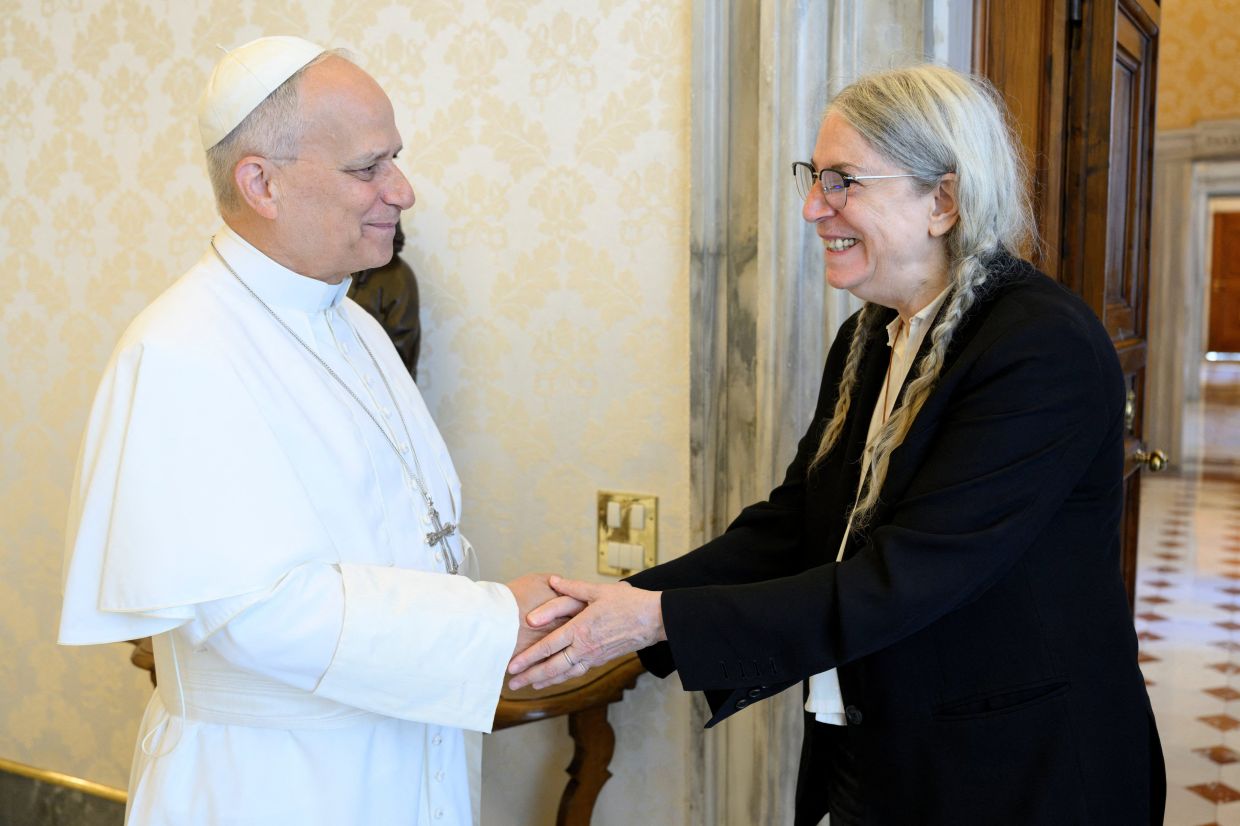
American rock icon Patti Smith experienced a moment of quiet reverence on Friday when she sat across from Pope Leo XIV at his desk in the Apostolic Palace, the two finding an unexpected kinship that transcended the formal protocol typically associated with papal audiences. The Grammy Award-winning artist, dressed simply in her characteristic braids and a crucifix necklace, exchanged pleasantries with the pontiff in what observers described as a surprisingly intimate conversation between two figures separated by vastly different worlds yet connected through faith, creativity, and humanity.
Smith's growing relationship with the Vatican stems largely from her friendship with Rev Antonio Spadaro, who serves as undersecretary in the Vatican's culture ministry. This connection has opened doors for the singer to participate in significant religious and cultural moments at the Holy See, gradually positioning her as an unusual but welcome presence within Vatican circles. Her involvement signals a broader embrace by the contemporary Church of artists and cultural figures as ambassadors of spiritual values to global audiences.
While Smith has been candid about her position outside the Catholic faith, she has described a deep emotional and philosophical affinity for Pope Francis and his approach to spirituality. She articulated her admiration for his "gentle, open, and steadfast sense of humanity," qualities she saw reflected in his papal ministry. This distinction matters: Smith's appreciation is not rooted in doctrinal alignment but in recognising a kindred spirit devoted to compassion and human dignity.
The meeting on Friday reportedly lasted approximately forty minutes, far longer than ceremonial papal audiences typically allow. According to Spadaro, who attended the encounter, the interaction resembled "a conversation between two people discovering they were old friends, sharing memories woven from words and music, dreams, visions, and hopes—both from yesterday and for today." This characterisation suggests a genuine dialogue rather than a formal state visit, revealing a Pope willing to engage substantively with artists about shared concerns.
Smith's relationship with the Vatican deepened notably in May when she performed during the inauguration of the Holy See's pavilion at the Venice Biennale, the world's foremost contemporary art exhibition. That May 8 date held particular significance, coinciding with the anniversary of Pope Leo XIV's election to the papacy. The Vatican's decision to feature Smith at such a prominent cultural venue demonstrated institutional recognition of her status as a living legend whose work transcends secular boundaries.
The pontiff demonstrated familiarity with Smith's artistic catalogue during their exchange, indicating he or his advisors had prepared for the meeting. When Smith referenced her 1979 composition, Leo responded appreciatively, calling it "marvelous." This moment crystallised the conversation's essence: two creative minds acknowledging each other's contributions to human expression and spiritual reflection across decades and disciplines.
Smith's personal journey with the Church extended back further than her current Vatican connections. She met Pope Francis in 2013 and performed for him the following year, developing a relationship she treasured deeply. When Francis died on April 21, 2025, Smith channeled her grief into poetry, composing an elegiac tribute on social media that compared the pontiff to a dandelion—"humble yet strong." Her words, "Nature and poetry and the suffering shall miss their champion," captured both her genuine affection for Francis and her belief that his papacy represented something rare in institutional religion: authentic engagement with the marginalised and the creative.
The Friday audience with Pope Leo XIV carries weight beyond the merely ceremonial, suggesting continuity in how the contemporary papacy approaches culture and the arts. For Malaysian and Southeast Asian readers, Smith's presence at the Vatican underscores an important evolution within global Catholicism—a Church increasingly willing to dialogue with secular artists and intellectuals rather than maintain rigid boundaries. This shift has implications for how the Church positions itself in pluralistic societies where religious authority must compete for attention and respect.
Smith's latest Vatican encounter also represents a broader pattern of Pope Leo XIV's engagement with cultural and musical figures. Just days before meeting Smith, the pontiff attended a concert honouring him performed by world-renowned tenor Andrea Bocelli on July 29. This sequence of events reveals a papacy strategically using high-profile cultural encounters to enhance its global image and demonstrate openness to artistic expression as a vehicle for spiritual meaning.
For American audiences familiar with both Smith's legendary status in rock music and her role as a poet and cultural commentator, the Vatican meetings represent validation of her long-standing artistic and spiritual integrity. Smith never abandoned her creative independence or ideological commitments to join any institution, yet she found in the contemporary Church a willingness to engage her on terms of mutual respect. Her presence at the Vatican signals that spiritual authenticity and artistic freedom need not be contradictory in the modern world.
The encounter between Smith and Leo XIV also speaks to the Vatican's sophisticated understanding of soft power in the twenty-first century. By welcoming artists like Smith and Bocelli into papal audiences, the Church demonstrates that it remains relevant to cultural conversations and capable of bridging divides between the secular and sacred. For a pontiff navigating complex global challenges, such moments of cultural connection project an image of a Church willing to listen and engage with diverse perspectives.
As Smith has aged into a revered elder statesman of rock music, her spiritual journey has become more public and reflective. Rather than retreating into nostalgia, she has positioned herself as a bridge between generations and between worlds—proving that one need not be Catholic to find meaning in dialogue with the Church's leadership. Her Friday conversation with Pope Leo XIV exemplifies this possibility, offering both the Vatican and the artist something neither could obtain alone: credibility and reach within audiences that might otherwise remain disconnected.

