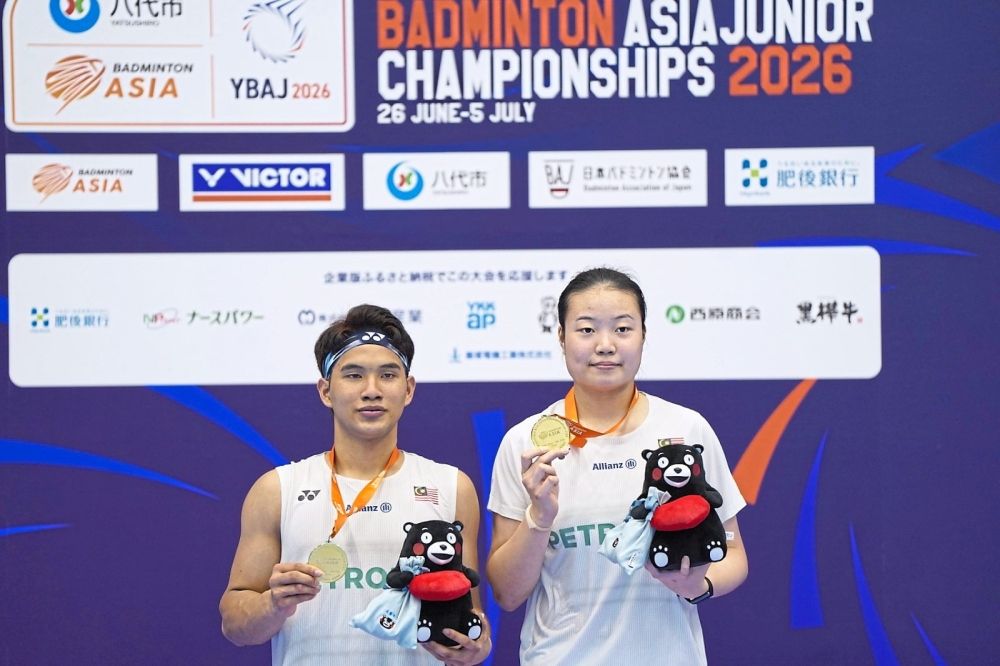
Malaysia's badminton fortunes received a significant boost yesterday when Ahmad Redzuan Zulwaqqarizal and Low Zi Yu captured the mixed doubles crown at the Asian Junior Championships in Yatsushiro, Japan, delivering the nation's first title in the category since 2007. The victory breaks a prolonged absence that has lasted nearly two decades, marking a turning point in the country's junior badminton programme and signalling renewed competitiveness in a discipline that once saw Malaysian players dominate regional and international stages.
The final proved to be a tightly contested affair against China's Zheng Weigang and Li Menghan, with the Malaysian pairing required to demonstrate both technical proficiency and mental fortitude. Across 43 minutes of play, Redzuan and Zi Yu navigated a challenging second game where they found themselves within touching distance of victory, holding a two-point advantage only to watch their opponents mount a spirited comeback that dragged the match into a deciding third game. The ability to reset mentally and execute crucial shots under pressure ultimately separated the two teams, with the Malaysians prevailing 21-15, 22-20 in a contest that reflected the high quality of junior badminton across Asia.
The significance of this championship extends beyond the immediate joy of winning gold. The previous Malaysian mixed doubles champions at this level were Tan Wee Kiong and Woon Khe Wei, who secured their title during the 2007 edition held in Kuala Lumpur. The 18-year gap underscores the challenges Malaysian badminton has faced in maintaining consistency and excellence across multiple age groups and disciplines, a concern that has occupied administrators and coaches seeking to replenish the player pipeline from which senior national representatives emerge.
For Zi Yu, who at just 15 years old has already displayed maturity beyond her years, the mixed doubles triumph represents vindication of her approach to competing in multiple events simultaneously. She managed the physical and mental demands of juggling both mixed doubles and girls' doubles competitions, though the latter endeavour yielded a bronze medal after she and partner Genevie Lim fell short in their semi-final against Japan's second-seeded pairing of Aoi Banno and Yuzu Ueno. Rather than viewing the girls' doubles loss as a setback, Zi Yu demonstrated the perspective of a developing athlete who understands that strength of character and resilience often prove as valuable as technical skill in the competitive badminton environment.
Zi Yu attributed much of her success in the mixed doubles final to the psychological dimension of the contest, highlighting how composure and focus separated the two teams when the outcome hung in balance. Her observation about the importance of maintaining concentration during the crucial 20-20 juncture in the second game illustrates the mental chess that characterises elite junior badminton, where technical margins between opponents are often razor-thin. The encouragement from Malaysian teammates who had already concluded their own tournaments created an intangible support system that bolstered the finalists' morale, demonstrating how team cohesion extends beyond individual medal pursuits.
Redzuan's journey to this breakthrough moment carried particular poignancy given his previous disappointments across three consecutive Asian Junior Championships editions. Making his debut in 2023 at the Yogyakarta championships, the Terengganu-born shuttler encountered early eliminations in both his boys' doubles and mixed doubles entries. Rather than providing a foundation for subsequent success, however, those early attempts saw him repeat the pattern of premature exits when the championships returned to Yogyakarta in 2024 and subsequently moved to Surakarta in 2025. The trajectory from repeated disappointment to championship success within the span of two years suggests either a significant improvement in playing standard or a maturation in approach that has finally unlocked his potential.
Redzuan himself acknowledged the progression represented by this title while maintaining realistic expectations about the demands ahead. His comment that he successfully executed the tactical and technical elements refined through dedicated training sessions reveals a competitor focused on controllable variables rather than outcomes. Simultaneously, his assertion that further improvement remains essential betrays the mindset of an athlete who understands that capturing a junior title, whilst validating past efforts, represents merely a stepping stone toward senior competition where the margins for error narrow considerably and the quality of opposition intensifies substantially.
The pair's victory arrives amid a broader context of competitive intensity within Asian junior badminton, where China continues to demonstrate formidable strength across multiple categories. The Chinese competitors Redzuan and Zi Yu defeated in the final, along with the other Chinese gold medallists who emerged from these championships in the singles events, illustrate the sustained investment and development programmes that neighbouring nations maintain. For Malaysian badminton, the challenge remains not merely achieving occasional breakthrough victories but rather building sustainable systems that produce consistent medal winners across age groups and disciplines.
The composition of Malaysian success at this championships, anchored by younger players still in their teenage years, suggests that the talent identification and development mechanisms currently operational may finally be yielding results after years of relative scarcity. Low Zi Yu's ability to operate effectively in both mixed doubles and girls' doubles competition indicates a player with the technical versatility and adaptability increasingly demanded in modern badminton. Similar observations apply to Redzuan, who has persisted through multiple disappointments to finally break through, behaviour that coaches and selectors often regard as indicative of player character and potential longevity at elite level.
The championship results across other categories reveal patterns that may inform future Malaysian strategic decisions regarding talent development. Chinese competitors claimed both singles titles, demonstrating the continued strength of the Middle Kingdom in individual events, whilst Japanese and Taiwanese pairings secured victories in the doubles disciplines. This distribution of success across different Asian nations suggests that whilst no single country maintains overwhelming dominance, the depth and consistency of stronger programmes remain evident, creating benchmarks against which Malaysian progress must be measured.

