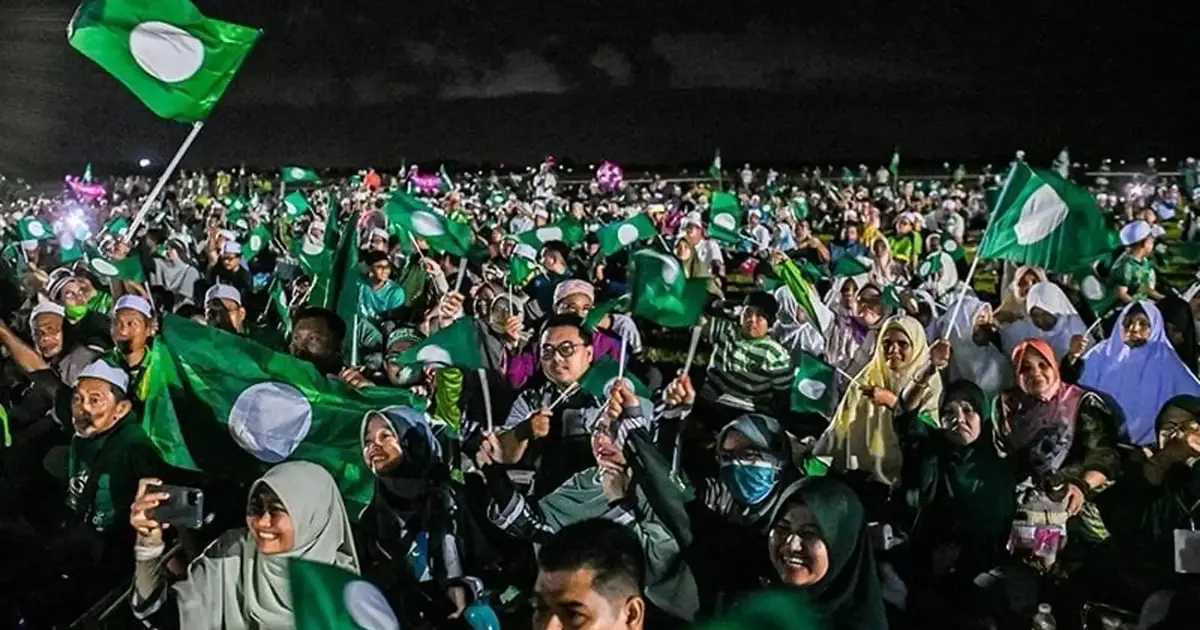
PAS president Hadi Awang has levelled accusations that the opposition coalition Pakatan Harapan, particularly the Democratic Action Party, deliberately exploited religious anxieties to mobilise voters against his party, framing such tactics as a calculated strategy rooted in Islamophobia. In characterising these efforts, Hadi argues that the repeated invocation of phrases like "green wave"—a reference often applied to PAS's electoral campaigns—functioned as a tool to reinforce negative stereotypes about Islamic political movements and Muslims more broadly.
The allegation highlights a deepening fault line in Malaysian electoral politics where religious identity and sectarian messaging have become increasingly central to campaign narratives. Hadi's contention is that opposition parties deliberately conflated support for PAS with a broader threat narrative designed to unsettle non-Muslim and secular-minded voters, effectively weaponising religious identity as a political dividing line. This framing suggests that opponents used fear-based appeals rather than substantive policy critiques to erode PAS's electoral appeal.
The deployment of the "green wave" label requires contextual understanding for Malaysian readers unfamiliar with recent electoral discourse. Green, a colour traditionally associated with Islam, became shorthand in opposition messaging for what they portrayed as a surge of religious conservatism that would allegedly threaten Malaysia's secular constitutional framework and pluralistic governance model. By consistently linking PAS electoral advances to this charged terminology, critics implicitly suggested that voting for the Islamist party represented a fundamental departure from Malaysia's established political culture.
Hadi's pushback against this framing reflects PAS's longstanding struggle with perception management in Malaysia's religiously diverse society. The party has attempted to rebrand itself as a mainstream political force capable of governing effectively across communities, yet its Islamist ideological roots create persistent concerns among non-Muslim constituencies and secular-oriented voters. This tension between PAS's actual electoral performance and the anxiety its rise generates reveals deeper sociological divisions within the Malaysian electorate.
The accusation also raises questions about the boundaries of legitimate political discourse in multiracial democracies. While opposition parties possess the right to critique PAS's governance agenda and religious policy positions, Hadi suggests that opponents crossed into territories of explicit religious prejudice rather than engaging in conventional policy-based opposition. This distinction—between attacking a party's platform versus attacking Muslims as a group—speaks to broader concerns about how religious identity becomes mobilised in electoral campaigns across Southeast Asia.
Packatan Harapan's coalition composition makes Hadi's critique particularly pointed, given the alliance includes the Chinese-dominated DAP alongside Malay-majority secular and Islamic parties. The inclusion of DAP creates a ready-made narrative for Hadi to suggest that non-Muslim parties specifically exploited religious anxieties to contain PAS influence. Whether such framing reflects actual coordinated strategy or represents Hadi's interpretation of organic political opposition remains contested, but the allegation underscores how coalition politics in Malaysia continues to be mediated through communal and religious lenses.
For Malaysian voters and observers, understanding this dynamic requires recognising how electoral competition has increasingly organised itself around religious identity rather than purely economic or developmental considerations. While PAS's electoral gains in the 2022 general elections demonstrated genuine voter appeal in certain constituencies, the subsequent controversy around religious policy implementation at state level—particularly in Kelantan and Terengganu—reignited broader national anxieties about the pace and scope of religious law expansion that extends beyond simple partisan competition.
The timing of Hadi's remarks also warrants consideration within Malaysia's current political trajectory. As general election speculation intensifies and coalitions recalibrate their positioning, claims about opposition tactics become part of a broader narrative competition for voter sympathy. PAS has an interest in portraying itself as unfairly targeted by religious prejudice, a frame that resonates with supporters who feel their Islamic identity has been delegitimised in mainstream political discourse. Conversely, coalition partners maintain that substantive concerns about PAS governance and religious policy implementation constitute legitimate democratic critique rather than Islamophobic scaremongering.
Regionally, Malaysia's experience with religiously-inflected electoral politics carries implications for neighbouring democracies navigating similar tensions. Thailand, Indonesia, and the Philippines all grapple with questions about how religious identity should function in electoral competition without devolving into communal polarisation. The Malaysian case demonstrates how even established democracies struggle to maintain boundaries between religious freedom and anti-religious discrimination when political stakes increase.
Moving forward, Hadi's complaints highlight a governance challenge that extends beyond partisan politics: how can Malaysia conduct electoral competition in ways that neither suppress legitimate religious political expression nor permit the mobilisation of religious prejudice as campaign strategy? This question lacks easy resolution, particularly in a society where religious identity, ethnic community, and political affiliation remain tightly interwoven. The sustainability of Malaysia's democratic system may ultimately depend less on which parties win elections than on whether all major political forces commit to norms preventing the deliberate exploitation of religious anxiety as a mobilisation tool.

