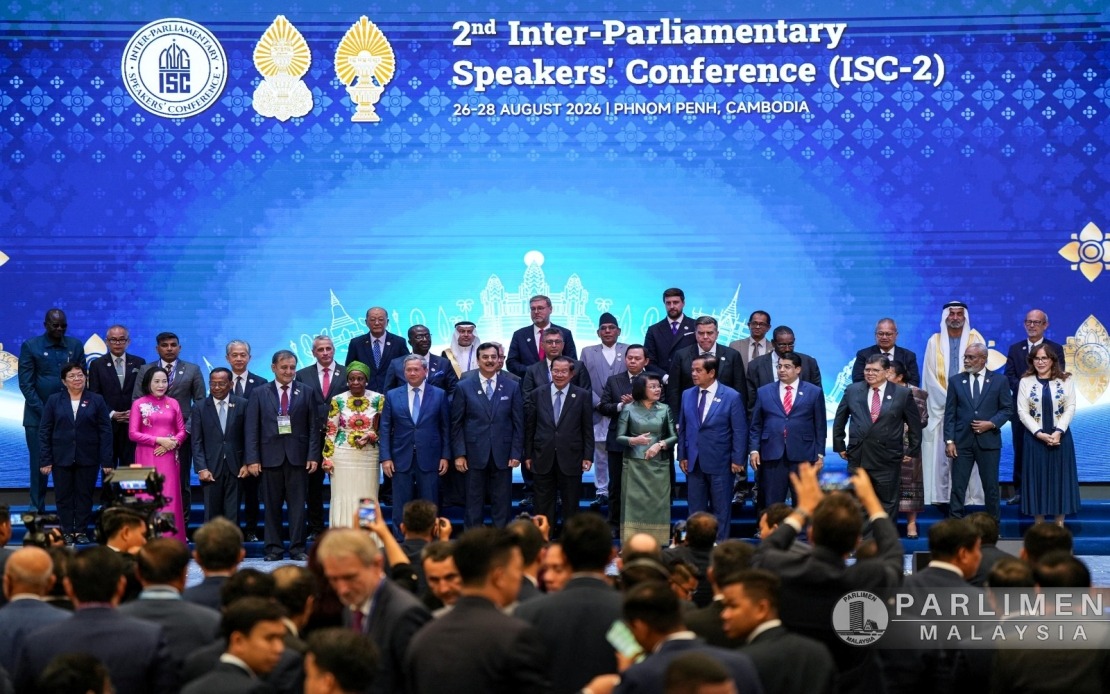
Tan Sri Dr Johari Abdul, Speaker of the Dewan Rakyat, has made a compelling case for legislatures to assume greater responsibility in addressing the world's most pressing challenges, from armed conflicts to geopolitical fractures and climate crises. Speaking at the Second Inter-Parliamentary Speakers' Conference in Phnom Penh, the Malaysian parliamentary leader contended that resolving such matters cannot rest solely with executive governments, but demands meaningful involvement from elected representatives who answer directly to their constituents.
The conference, jointly convened by Cambodia's National Assembly and Senate from August 26 to 28, brought together parliamentary leaders under the banner of "Solidarity for Peace and Shared Prosperity: Strengthening International Law and Resolving Conflicts Peacefully." Johari's intervention signals Malaysia's commitment to strengthening legislative diplomacy as a stabilising force in an increasingly volatile geopolitical environment. His remarks reflect growing recognition among regional lawmakers that traditional executive-dominated approaches to conflict resolution often overlook the grassroots perspectives that only elected bodies can provide.
Johari emphasised that the Inter-Parliamentary Speakers' Conference represents a crucial forum where legislative bodies can collectively mobilise to tackle transnational challenges that devastate ordinary citizens and communities. In an era where geopolitical tensions and climate-related disasters disproportionately harm vulnerable populations, parliamentary platforms offer mechanisms for addressing root causes rather than merely managing symptoms. The human dimension of conflict—displaced families, interrupted education, shattered communities—demands attention from institutions directly connected to affected populations, he argued.
The Malaysian speaker articulated a nuanced division of labour between executive and legislative branches. While governments necessarily operate within formal diplomatic and strategic frameworks, parliaments often possess a broader, more comprehensive understanding of ground-level realities. Executives, by contrast, frequently approach such matters through narrower political calculus. When these two institutions work in concert rather than parallel, Johari suggested, societies gain access to more holistic problem-solving capacity. This complementary arrangement, he reasoned, strengthens the prospects for durable, legitimate solutions that command public support.
A particularly innovative dimension of Johari's argument concerns parliamentary diplomacy's capacity to maintain dialogue channels when official relations deteriorate. When governmental relations become strained or overtly hostile, parliaments can continue conversations across political and national boundaries. This informal track creates valuable space for understanding and trust-building between institutions, even when formal diplomatic ties fray. By engaging at the parliamentary level, nations demonstrate that disagreement need not inevitably escalate to confrontation, preserving pathways toward eventual reconciliation.
Malaysia's own position reflects deep commitment to principles undergirding regional stability. Johari reiterated his nation's conviction that durable peace must be grounded in respect for national sovereignty, territorial integrity, adherence to international law, and peaceful dispute resolution mechanisms. These commitments carry particular resonance in Southeast Asia, where the Association of Southeast Asian Nations was explicitly founded on dialogue, consultation, and the principle that regional peace requires constant, deliberate cultivation rather than passive maintenance.
The Malaysian speaker highlighted ASEAN's distinctive role in providing constructive engagement platforms whenever tensions emerge among member states. When differences surface regionally, ASEAN mechanisms must remain functional and respected, serving as neutral ground for pursuing dialogue. Parliamentary institutions, working through their respective national jurisdictions, can amplify these efforts by deepening mutual understanding among Southeast Asian peoples and championing solutions rooted in international law, reciprocal respect, and regional stability. This layered approach—combining governmental, regional organisational, and parliamentary efforts—creates multiple reinforcing mechanisms for peace.
Johari's intervention arrives at a moment of considerable global turbulence. Conflicts have grown demonstrably more complex in character, geopolitical divisions are deepening with alarming speed, and traditional international institutions face unprecedented stress. The multilateral order established during the post-World War II era, designed to prevent large-scale conflict and promote international security, is being tested as never before. This context renders parliamentary voices increasingly vital, as they represent constituencies whose lives depend directly on rational, inclusive approaches to global governance.
The conference series itself represents an institutional innovation of growing importance. Indonesia will host the third iteration next year, following Pakistan's inaugural hosting in 2025. This rotating arrangement demonstrates expanding commitment among parliamentary leaders to formalise cross-legislative cooperation on matters traditionally reserved for executive decision-making. By establishing regular, structured forums for parliamentary engagement on global issues, nations create persistent mechanisms for maintaining dialogue and building coalitions around shared principles.
For Malaysia specifically, active participation in such platforms reinforces the nation's diplomatic strategy. As a developing nation navigating complex regional geopolitics and committed to ASEAN solidarity, Malaysia benefits from elevating parliamentary voices in international discourse. Enhanced legislative engagement complements Malaysia's existing diplomatic initiatives while providing additional channels through which Malaysian interests and values circulate globally. The emphasis on international law and peaceful dispute resolution aligns particularly well with Malaysia's diplomatic tradition and regional leadership aspirations.
The broader implications extend across Southeast Asia and the Global South. Developing nations often possess less institutional capacity for sustained bilateral and multilateral diplomacy than wealthy countries. Parliamentary conferences offer cost-effective, accessible mechanisms for smaller nations to participate meaningfully in global governance conversations. By empowering legislatures, countries enhance their diplomatic voice while simultaneously strengthening domestic democratic institutions and ensuring that constituent concerns inform international negotiations.
Johari's call ultimately invites reimagining how the modern world addresses collective challenges. The speaker's argument suggests that sustainable solutions to conflict, climate crisis, and geopolitical instability require engagement from multiple institutional levels and perspectives. When parliaments assume greater responsibility for these matters, when they complement executive efforts rather than serving merely as rubber-stamp bodies, nations gain access to richer, more legitimate decision-making processes. In an age of digital transparency and heightened citizen awareness, governance approaches that remain divorced from popular consent face mounting credibility deficits. Parliamentary involvement in addressing global crises thus represents not merely an institutional preference but a pragmatic necessity for building durable international peace.

