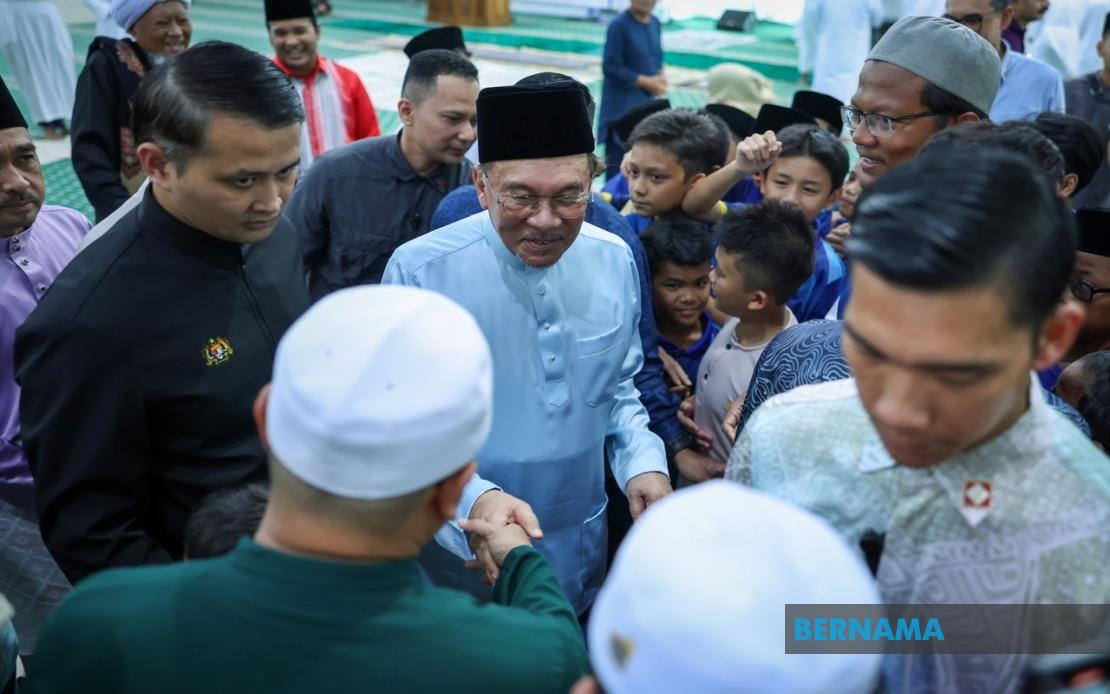
Prime Minister Datuk Seri Anwar Ibrahim has drawn a clear distinction between constituency allocations and the personal entitlements of elected representatives, emphasising that public funds distributed to parliamentary constituencies exist exclusively for the benefit of the communities they serve. Speaking after Friday prayers in Alor Gajah, Anwar stressed that the funds represent a public trust that must be deployed to improve living standards across the constituency, rather than functioning as discretionary resources available to individual Members of Parliament.
The Prime Minister outlined the intended purpose of such allocations with specific examples, noting that constituency funds should be channelled towards tangible community improvements including school facilities, religious institutions, mosque construction or renovation, and essential infrastructure maintenance such as drainage systems. His clarification comes in response to escalating tensions between government and opposition lawmakers, with several MPs from the latter group claiming the administration has deliberately withheld funding from their constituencies. By establishing that funds flow to the people rather than to elected officials, Anwar has effectively reframed the debate around resource distribution as one of governance principle rather than political arithmetic.
Anwar indicated that this interpretive framework for constituency allocations has operated as longstanding government policy, one that sitting MPs from previous administrations would have understood and accepted during their tenure in office. The articulation of this principle appears designed to insulate the government from accusations of political vindictiveness, repositioning fund channelling decisions as procedurally neutral applications of established guidelines rather than punitive measures against opposition-held constituencies. This rhetorical manoeuvre seeks to depoliticise what has become an increasingly fraught issue affecting parliamentary relations and constituent services across Malaysia's diverse political landscape.
When pressed on recent complaints from opposition MPs regarding withheld allocations, Anwar addressed the contentious scenario directly: should a Member of Parliament occupy a seat on the opposition benches, the government maintains its commitment to ensuring that designated funds still reach the constituents through direct distribution mechanisms rather than intermediation through the elected representative. This position effectively circumvents the traditional role of MPs as gatekeepers and distributors of development resources within their constituencies, a function that has historically granted parliamentarians considerable leverage in their local political positioning. The shift represents a significant departure from conventional practice in Malaysian politics, where constituency development allocations have traditionally flowed through MPs and served as instrumental to their political machinery.
The clarification carries particular significance for the current political environment in Malaysia, where coalition boundaries remain fluid and numerous MPs face questions about their continued party affiliations or government alignment. By establishing that constituency funds will continue reaching communities regardless of an MP's political affiliation or status, the government theoretically neutralises one mechanism through which opposition gains electoral advantage or suffers disadvantage. However, the practical implementation of this policy requires robust oversight to ensure that direct fund distribution genuinely reaches intended beneficiaries without becoming tangled in bureaucratic complexity or vulnerable to partisan interpretation at implementation levels.
Anwar's remarks also encompassed a brief update regarding his daughter and Deputy President of the People's Justice Party (PKR), Nurul Izzah, who recently requested a temporary step-down from her party position to pursue alternative commitments. The Prime Minister characterised this development as a straightforward accommodation of her request, emphasising that her absence from formal party machinery represents a temporary arrangement rather than any fundamental shift in her status or influence within PKR structures. By referring to unspecified "special programmes" requiring her attention, Anwar declined to elaborate on the nature of these commitments, though he affirmed that Nurul Izzah remains engaged with party activities despite her formal role suspension.
The handling of his daughter's position adjustment demonstrates Anwar's effort to maintain organisational clarity while accommodating personal circumstances within the party hierarchy. The public framing of this matter as entirely routine and administratively uncomplicated suggests the Prime Minister wishes to prevent any perception that his daughter's withdrawal signals internal PKR instability or reflects broader governance challenges. By contextualising her move as a temporary and expected adjustment rather than a crisis development, Anwar seeks to maintain confidence in the party's leadership structure and his own capacity to manage organisational affairs alongside prime ministerial responsibilities.
These statements collectively address two separate but interconnected concerns within Malaysia's political apparatus: the appropriate relationship between elected representatives and the resources entrusted to them, and the management of party hierarchies during periods of domestic restructuring. The emphasis on constituency allocations as public resources rather than MP perquisites could reshape how development funding flows through constituencies going forward, particularly in political environments where parliament comprises members from multiple coalition arrangements or independent representatives. Implementation of this principle, however, will require careful coordination between federal ministries, state governments, and local authorities to ensure that genuine constituent benefits emerge from this reframing of allocation procedures.

