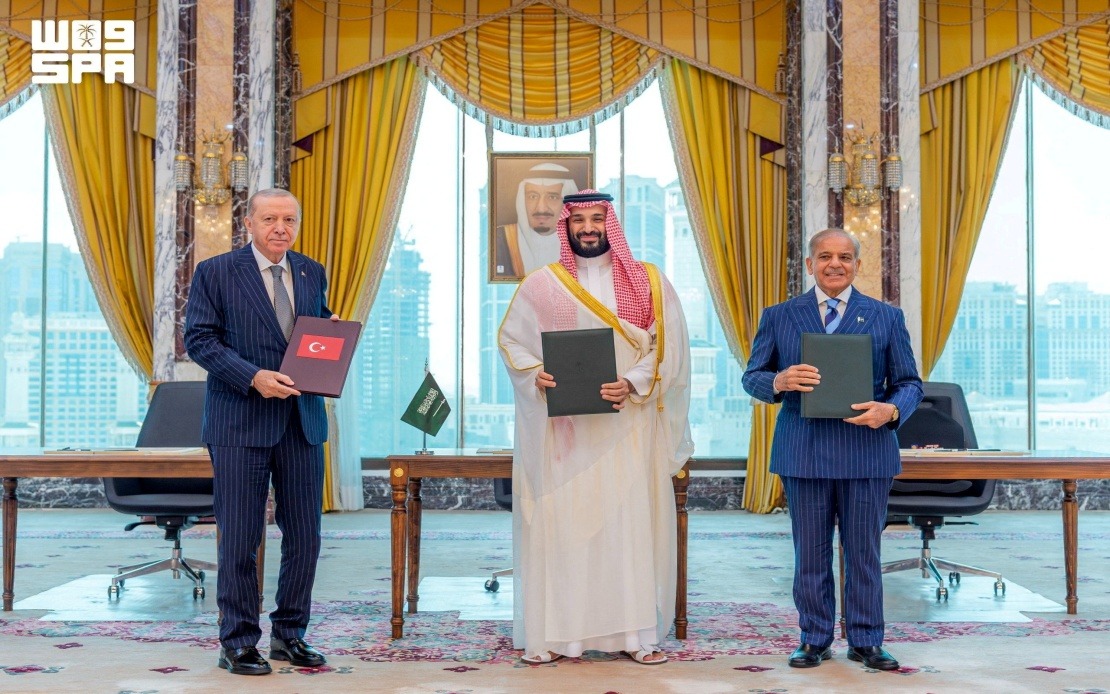
Pakistan, Saudi Arabia and Türkiye have formalized a significant security arrangement, with their leaders signing a comprehensive defence agreement on Friday during a high-level summit held at Al Safa Palace in Makkah. The trilateral accord, inked by Saudi Crown Prince Mohammed bin Salman bin Abdulaziz Al Saud, Pakistan Prime Minister Shehbaz Sharif and Turkish President Recep Tayyip Erdogan, represents a substantial deepening of military and strategic cooperation among three major powers in the Islamic world.
Central to the Joint Defence Agreement is a binding commitment that positions the three nations as collective security partners. Under the pact's framework, an armed attack against any single signatory will be construed as an assault on all three, establishing a mutual deterrence mechanism that fundamentally reshapes their bilateral relationships into a cohesive strategic alliance. This collective defence clause mirrors established security frameworks used elsewhere globally, signifying the seriousness with which these governments view their long-term partnership.
The agreement encompasses far more than symbolic gestures. According to the official joint statement released following the summit, the pact explicitly provides for comprehensive enhancement across all dimensions of defence collaboration. This language indicates intentions to deepen intelligence sharing, coordinate military training exercises, harmonize defence procurement strategies, and potentially establish joint command structures or rapid-response mechanisms. Such practical cooperation would represent a significant upgrade from the traditional bilateral defence relationships that have characterised ties among the three nations historically.
Pakistan brings substantial military credibility to this arrangement as one of only nine nations globally possessing nuclear weapons. Its armed forces represent one of South Asia's largest standing militaries, with sophisticated capabilities across land, sea and air domains. The country's historical alignment with both Türkiye and Saudi Arabia across defence matters provides institutional foundations upon which this new trilateral structure can build, though the formalization into a binding collective defence agreement marks a qualitative escalation in institutional commitment.
Türkiye's participation reflects its strategic position as the only NATO member within the broader Islamic world, bridging Western security architectures with Middle Eastern and South Asian geopolitical interests. Ankara has pursued increasingly independent foreign policy trajectories in recent years, and this trilateral arrangement allows it to strengthen relationships with major Muslim-majority powers while maintaining NATO commitments. The agreement also serves Turkish interests in regional stability, particularly concerning threats emanating from Syria, Iraq and Kurdish separatist movements that might affect its borders and allies.
Saudi Arabia's role as custodian of Islam's two holiest cities and its position as the region's leading economic power add significant weight to the pact. The kingdom has been progressively expanding its defence capabilities and security partnerships as part of its Vision 2030 strategic modernization programme. By anchoring itself within this trilateral framework, Riyadh reinforces its regional leadership while gaining assurances of military support from nuclear-armed Pakistan and NATO-aligned Türkiye.
The agreement builds upon existing bilateral foundations. Pakistan and Saudi Arabia signed their own defence pact in September of the previous year, establishing mutual obligation to provide military assistance in response to external aggression. The new trilateral arrangement essentially expands that bilateral commitment into a broader security ecosystem, potentially allowing for more sophisticated joint operations and integrated defence planning.
Saudi Arabia's Deputy Public Diplomacy Minister Rayed Krimly emphasized through a social media statement that the pact enables participating nations to establish joint defence capabilities, strengthen strategic deterrence posture, enhance collective military readiness, and develop integrated defence systems addressing shared security threats. Notably, official statements have stressed that the agreement poses no threat to any other regional state and does not represent a provocative escalation of existing tensions. Such clarifications suggest sensitivity to international reactions, particularly from other regional actors who might view the alignment as threatening their own security interests.
For Malaysia and Southeast Asia, this development carries several implications. The agreement demonstrates how major Muslim-majority nations are constructing security arrangements aligned with shared religious and civilizational interests. It also illustrates evolving patterns in global geopolitics where traditional Cold War alliance structures are being supplemented by issue-specific and identity-based coalitions. Southeast Asian nations, particularly those pursuing strategic autonomy and non-alignment, will likely observe how this trilateral arrangement operates and whether it develops mechanisms for wider engagement with other Islamic states or becomes an exclusive partnership.
The timing of the agreement merits attention. Amid renewed great power competition between the United States and China, Russia's invasion of Ukraine, and persistent regional instability across the Middle East, major powers are consolidating relationships with strategic partners. This trilateral defence pact reflects broader regional recalibration where nations seek to anchor their security within partnerships offering tangible protection guarantees rather than relying solely on traditional power arrangements.
The implications extend beyond military dimensions. Such defence cooperation typically catalyzes broader economic, technological, and diplomatic integration. Enhanced military ties often lead to defence industrial cooperation, joint research and development initiatives, and expanded trade in security-related sectors. For Pakistan, particularly facing economic challenges and security threats from militant groups, the assurance of Saudi financial backing and Turkish military expertise offers significant strategic advantages. Similarly, Saudi Arabia and Türkiye gain access to Pakistan's military experience and institutional knowledge developed through decades of counter-insurgency operations.
This agreement also signals to the international community that despite varying relationships with different global powers—Pakistan's historical alignment with China, Saudi Arabia's complex ties with the United States, and Türkiye's NATO membership—these three nations have identified sufficient convergence in interests to establish binding security commitments. Such moves typically indicate confidence in long-term stability and reflect assessments that cooperation serves each nation's strategic interests better than competition or isolation.

