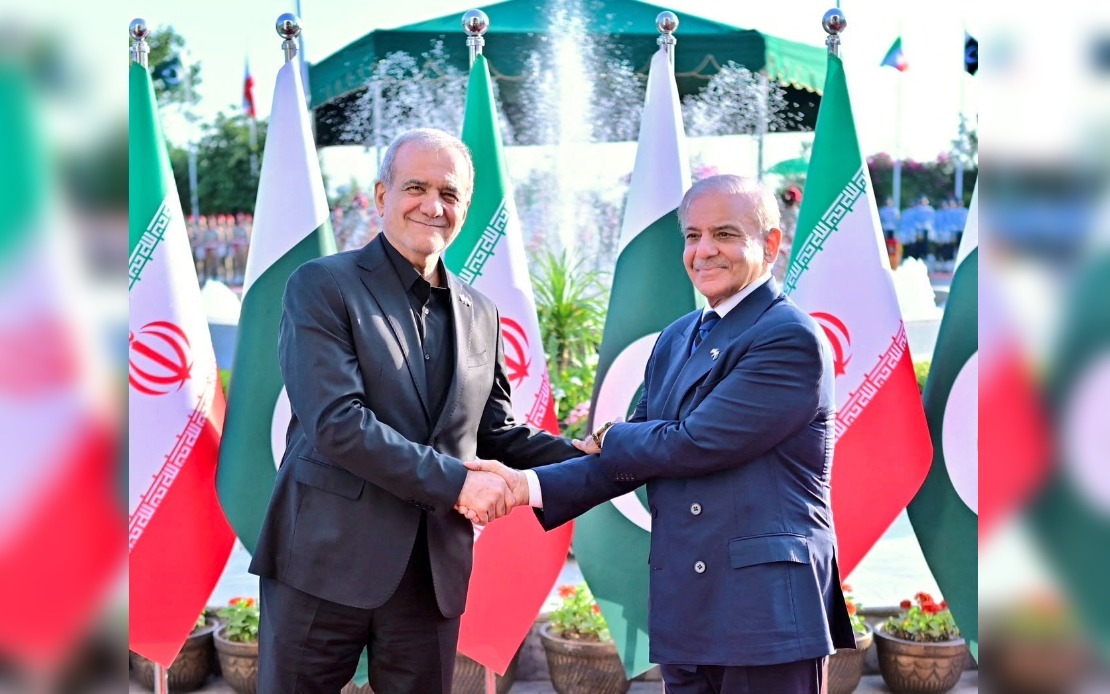
Pakistan's Prime Minister Shehbaz Sharif has thrown his nation's diplomatic weight behind Iran's ballistic missile programme, insisting that Tehran's defensive arsenal was never intended to be part of the recently brokered understanding with the United States. Speaking during high-level talks with Iranian President Masoud Pezeshkian in Islamabad, Sharif made clear that Pakistan's mediation efforts—which culminated in a memorandum of understanding between Washington and Tehran on June 17—deliberately excluded missiles from the negotiating table, and that Iran should not face unequal treatment regarding such capabilities.
The Pakistani premier's forthright defence of Iran's military ambitions underscores Islamabad's delicate but increasingly assertive role as a regional power broker. Over recent months, Pakistan has positioned itself as a trusted intermediary between Iran and the United States, first facilitating a temporary ceasefire in April before progressing to the broader June agreement. By publicly rejecting what he termed "double standards," Sharif signalled that Pakistan views Iran's security concerns as legitimate and worthy of protection, even as global powers debate the appropriate boundaries of Tehran's military development. The statement also reflected Sharif's gratitude for Iran's confidence in Pakistani mediation, a confidence he suggested should be reciprocated through continued support for Iran's strategic interests.
The issue of ballistic missiles has long represented one of the most contentious elements in international relations involving Iran. While the June memorandum of understanding between Tehran and Washington addresses various security matters and de-escalation measures, the missile question remains philosophically unresolved in broader geopolitical discourse. Sharif's position—that the topic was never raised during negotiations and that Iran showed no inclination to discuss it—appeared designed to insulate Iran from future pressure to limit or eliminate such weapons systems. This framing provides diplomatic cover for Tehran while reinforcing the narrative that any demand for missile restrictions would constitute an unfair imposition of external constraints on a sovereign nation's defence capabilities.
The context of recent military escalation gives particular weight to Iran's defensive posture. Earlier in 2024, Israel and the United States launched strikes against Iranian targets on February 28, triggering widespread concern in Tehran about its vulnerability to external attack. Against this backdrop, Iran's leadership regards ballistic missiles not as instruments of aggression but as essential deterrents against further assaults. President Pezeshkian articulated this perspective starkly during the joint news conference, warning that without such defensive capabilities, Iran would face the same devastating fate as Gaza—a direct reference to the humanitarian catastrophe resulting from Israeli military operations. His remarks underscored the fundamental asymmetry Iran perceives in international security arrangements, where Western and allied nations maintain sophisticated arsenals while Iran faces constant pressure to constrain its own military development.
Interestingly, Pakistan's position now enjoys implicit support from an unexpected quarter. US President Donald Trump, typically regarded as skeptical of Iranian interests, recently conceded in Paris that it would be inequitable for Iran to lack ballistic missiles if other nations possessed them. Trump's statement on June 17—made as the memorandum was being finalised—essentially acknowledged that the principle of strategic parity should apply to Iran just as it does to other nations. This convergence between Pakistan's rhetoric and Trump's pragmatic assessment suggests that, at least among certain power circles, the notion of ballistic missile possession as an inalienable right is gaining traction, albeit framed in terms of fairness rather than Iranian might.
Pakistan's diplomatic posture reveals the complex calculations facing nations in the immediate vicinity of regional conflicts. As a Muslim-majority nation sharing land borders with Iran, Pakistan has strong incentives to maintain stable relations with its western neighbour while simultaneously managing its relationship with the United States and Western powers. By explicitly defending Iran's missile capabilities, Sharif demonstrated that Pakistan is willing to stake its credibility on supporting outcomes that benefit Iran, at least on this particular issue. The involvement of senior military and civilian officials—Deputy Prime Minister and Foreign Minister Ishaq Dar and Field Marshal Syed Asim Munir, Chief of Army Staff—in brokering the agreement underscored the whole-of-government commitment Pakistan has invested in these negotiations.
The grand ceremonial reception accorded to President Pezeshkian further illustrated the importance both nations attach to their deepening relationship. The arrival of the Iranian president was marked by six Pakistani Air Force fighter jets providing aerial escort, a 21-gun salute, and personal greetings from both Prime Minister Sharif and President Asif Ali Zardari. Such pageantry typically serves multiple audiences: it reassures Iran that Pakistan values the relationship highly, signals to the broader region that Pakistan-Iran ties are strengthening, and projects to the international community that Pakistan occupies a position of diplomatic consequence in regional affairs. The timing of this high-profile visit, shortly after the US-Iran memorandum, suggested that Pezeshkian sought to reinforce with Islamabad the stability of the nascent agreement while consulting with Pakistan about implementation challenges.
Sharif also acknowledged a darker reality lurking beneath the diplomatic achievements. He alluded to "spoilers all over the world" determined to undermine the peace arrangement, a reference that carries particular weight in the Middle Eastern context. Israel, in Sharif's implicit framing, represents the primary obstacle to sustainable regional peace, with its ongoing military operations in Lebanon and Gaza creating dynamics that could easily destabilise the fragile US-Iran understanding. This perspective, though controversial in Western circles, reflects a widely held view across much of the Muslim world and among nations like Pakistan that occupy complicated positions between Western strategic interests and regional Muslim majority constituencies. By naming spoilers without directly attacking any particular nation, Sharif sought to build consensus around the view that external parties should not be allowed to sabotage nascent peace arrangements.
For Southeast Asian observers, Pakistan's role in regional diplomacy carries implications beyond South Asia proper. As an extended member of the Muslim world and a nation with significant military and nuclear capabilities, Pakistan's diplomatic initiatives influence broader patterns of engagement between Islamic states and Western powers. Malaysia and other Southeast Asian nations with substantial Muslim populations look to Pakistan's experience in negotiating with the United States while maintaining principled stances on issues like Palestinian rights and Iranian sovereignty. Pakistan's willingness to publicly defend Iran's missile capabilities, despite potential American objections, suggests that regional nations need not choose between engagement with Western powers and advocacy for causes their populations support.
The implications for regional security architecture in South Asia and beyond merit careful consideration. Pakistan's positioning as a trusted mediator between Iran and the US, combined with its explicit support for Iran's defensive capabilities, could influence how other regional actors calibrate their own strategic choices. India, Pakistan's rival, might view with concern any strengthening of Pakistan-Iran ties, particularly if it translates into enhanced security cooperation. Conversely, Pakistan's mediation efforts could set precedents for how regional disputes are resolved through patient diplomacy rather than military confrontation, a development that would benefit all nations in South and West Asia seeking greater stability and development opportunities.
Moving forward, the sustainability of the US-Iran understanding will depend partly on whether parties like Pakistan can successfully convince sceptics—both within Iran and among US allies—that the agreement serves mutual interests without requiring either side to abandon core security concerns. Pakistan's unequivocal defence of Iran's missile programme appears designed to reassure Tehran that the agreement does not represent a capitulation of its strategic sovereignty. Whether this diplomatic framework can withstand the inevitable pressures and crises that accompany any major regional realignment remains to be seen, but Pakistan's active advocacy suggests Islamabad intends to remain deeply invested in seeing this arrangement succeed.