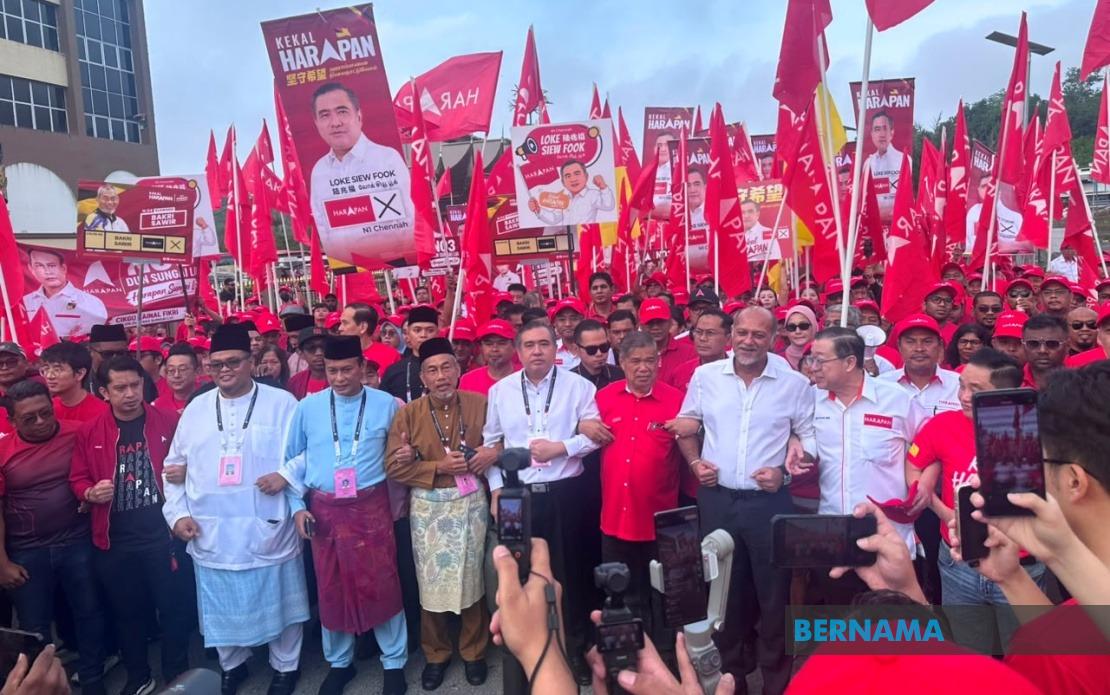
Pakatan Harapan made a calculated show of organisational muscle on Wednesday as its candidates formally submitted nomination papers for the forthcoming Negeri Sembilan state election. The appearance of multiple senior party figures across different nomination centres throughout the morning underscored the coalition's determination to project unity and momentum ahead of the August 1 polling date. The coordinated deployment of Transport Minister Anthony Loke, Communications Minister Fahmi Fadzil, and state Menteri Besar Aminuddin Harun conveyed a message that the contest for the 36 available seats remains a priority for national party leadership.
In the Jelebu district, DAP secretary-general Anthony Loke personally filed his nomination to contest the Chennah state seat, arriving at the Dewan Besar Kuala Klawang nomination centre early in the morning. His appearance was bolstered by the presence of DAP chairman Gobind Singh Deo, former Penang Chief Minister Lim Guan Eng serving as party adviser, and Amanah president Mohamad Sabu. The combination of national-level figures accompanying Loke's candidacy reflected confidence in a seat that represents part of the coalition's traditional support base in the state.
The nomination activity in Jempol district illustrated how PH has distributed its senior membership across multiple constituencies to maximise campaign visibility. Deputy Communications Minister Teo Nie Ching, who also holds the position of Wanita DAP chief, escorted candidate Teo Kok Seong through the filing process for the Bahau seat. Teo Kok Seong brings the advantage of incumbency, having held the seat since the 14th General Election, a factor that typically strengthens PH's prospects in retaining the constituency despite anticipated competitive pressures from other coalitions.
Minister Fahmi Fadzil's presence at the Jempol nomination centre extended to shepherding four candidates across related seats in the district. Beyond Teo Kok Seong's Bahau candidacy, the Communications Minister supported Yaacob Mahmood (Serting), Muhammad Zahin Zinal Abidin (Palong), and Manivanan Gowin (Jeram Padang). Of these four, only Teo carries incumbent status; the others represent fresh entries into electoral politics under the PH banner, a pattern that suggests the coalition is blending experienced representatives with new candidates in its broader strategy for the state.
The Port Dickson nomination centre saw Menteri Besar Aminuddin Harun file his own candidacy for the Linggi seat while simultaneously showcasing the breadth of his party's support network. Alongside him were DAP deputy secretary-general Hannah Yeoh, PKR secretary-general Fuziah Salleh, and Datuk Farhan Fauzi, who serves as the Prime Minister's political secretary. This clustering of national figures around Aminuddin's personal nomination highlighted his significance to PH's state-level operations and suggested confidence in his electoral position. Three additional incumbent representatives—Chuah Yew Boon Lye (Chuah), Choo Ken Hwa (Lukut), and G Rajassekaran (Sri Tanjung)—also filed through the same centre, creating visible momentum for PH in that particular region.
Entrepreneur and Cooperatives Development Minister Steven Sim supervised the nomination filing of six PH candidates at the Wisma Majlis Bandaraya Seremban centre, attracting the attendance of Selangor State Legislative Assembly Speaker Lau Weng San, Bukit Gelugor MP Ramkarpal Singh, and PKR vice-president R. Ramanan. This deployment of federal and state-level figures demonstrated how PH has calibrated support across constituencies, ensuring that each nomination centre witnessed sufficient seniority and firepower to signal competitiveness without concentrating resources in any single area.
The electoral context shapes the significance of this unified turn-out. Pakatan Harapan currently holds 17 of Negeri Sembilan's 36 state seats following the 2023 election, while Barisan Nasional controls 14 and Perikatan Nasional holds five. Maintaining or improving upon this outcome requires systematic campaign intensity, and the nomination day orchestration represented an early signal of that commitment. The coalition faces pressure from multiple directions: Barisan Nasional remains formidable in peninsular state politics despite recent electoral setbacks, and Perikatan Nasional continues attempting to expand its footprint in states where it lacks dominant positions.
The staggered timing of senior figures' appearances across five distinct nomination centres reveals PH's recognition that Negeri Sembilan comprises geographically dispersed constituencies requiring individualised attention. Rather than concentrating all leadership in a single location for media purposes, the coalition distributed its senior membership strategically, ensuring that candidates in each area received visible endorsement. This approach also mitigates risks associated with any single nomination centre becoming a focal point for rival campaign narratives or logistical complications.
The nomination process itself follows the dissolution of the Negeri Sembilan State Legislative Assembly on June 5, after receiving consent from Yang Dipertuan Besar Tuanku Muhriz. Early voting has been scheduled for July 28, with the main election day set for August 1. This compressed timeframe between dissolution and polling concentrates campaign activity, intensifying competition and limiting opportunities for candidates to build grassroots support networks. Consequently, the nomination day appearances by national figures assume heightened importance as they establish early campaign markers and attempt to generate momentum during a crowded political calendar.
For Malaysian observers, the Negeri Sembilan contest carries implications extending beyond the state level. As a federal coalition component, Pakatan Harapan's performance in state elections influences perceptions of its national standing and internal stability. Coalition management across DAP, PKR, and Amanah becomes tested through state-level contests, where local issues, incumbent performance, and demographic shifts create distinct electoral dynamics from national polls. The presence of multiple party leaders in Negeri Sembilan on nomination day suggests confidence in managing these complex relationships while sustaining electoral competitiveness.
The strategic deployment of specific personalities also hints at internal coalition calculations regarding leadership trajectory and positioning. Loke's personal candidacy for a state seat while holding a federal cabinet portfolio signals DAP's continued emphasis on maintaining state assembly presence even among nationally prominent figures. Similarly, Fahmi's supervision of multiple candidates reflects PKR's efforts to strengthen its footprint in constituencies where previous performance proved marginal. These micro-level decisions, visible through nomination day choreography, accumulate into broader narratives about which parties within the coalition perceive Negeri Sembilan as strategically important for their own organisational development.
The August 1 polling outcome will provide crucial data regarding whether this nomination day unity translates into electoral performance. Negeri Sembilan remains competitive territory where none of the three major political coalitions commands overwhelming dominance. PH's current 17-seat position reflects a plurality rather than a governing mandate proportionate to the state's 36-seat assembly, creating both opportunities and vulnerabilities. The coordination visible during nomination filing represents an attempt to convert organisational discipline into ballot-box gains, though success ultimately depends upon local factors, incumbent reputation, and voter sentiment that exist beyond the reach of national leaders' appearances at filing centres.

