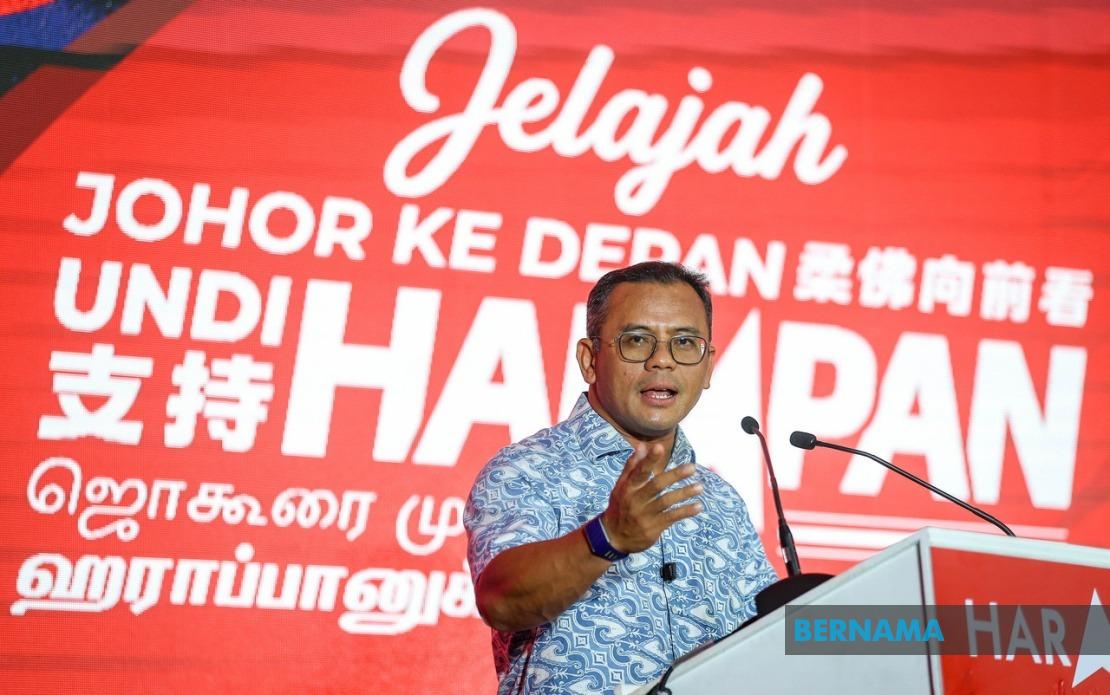
Pakatan Harapan is framing its challenge in the forthcoming Johor state election as a constructive alternative focused on balanced growth, not political disruption. Speaking in Batu Pahat, PKR vice-president and Selangor Menteri Besar Datuk Seri Amirudin Shari emphasised that the coalition's entry into the July 11 election reflects a commitment to sustainable development that benefits the entire state rather than concentrated pockets of prosperity.
The regional disparity narrative sits at the heart of PH's electoral pitch. Johor, despite being one of Malaysia's economic powerhouses, has witnessed uneven development that favours Johor Bahru at the expense of northern, eastern, and western districts. This imbalance has created stark income gaps—most notably between the prosperous state capital and towns such as Segamat—that PH argues require corrective governance. The coalition's campaign message suggests that proper administration can unlock opportunities across the state's geographic breadth, transforming Johor from a single-city economy into a genuinely multi-regional growth engine.
Data presented by Amirudin highlights a curious paradox: investment inflows do not automatically translate into job creation at proportional scales. Johor attracted RM101 billion in investments during the preceding year, yet the employment generation lagged significantly behind comparable figures from other states. Selangor, for comparison, drew RM83 billion in investment capital while simultaneously creating 60,000 new positions. Johor's job creation sat substantially lower, estimated between 30,000 and 40,000 roles, suggesting that existing investment structures may not be optimised for labour-intensive or high-productivity ventures.
This employment gap carries particular implications for Johor's younger demographic. The coalition's framing emphasises that poor job quality and availability have forced thousands of Johor residents into daily cross-border commutes to Singapore, effectively exporting their labour and intellectual capital to a neighbouring economy. Such outward migration of talent represents a form of economic leakage that drains Johor of human resources that could drive local entrepreneurship, innovation, and multiplier effects within the state economy.
PH's proposed remedy centres on strategic alignment of investment with federal-level support mechanisms. The Johor-Singapore Special Economic Zone (JS-SEZ) emerges as a flagship initiative through which a state government led by the coalition would channel capital towards high-value manufacturing, services, and technology sectors capable of generating meaningful employment for tertiary-educated workers. By anchoring such development to formal federal cooperation frameworks, PH suggests it can attract more sophisticated investment streams than those currently flowing into the state.
The coalition's governance philosophy, as articulated by Amirudin and supported by the presence of Amanah deputy president Datuk Seri Dr Mujahid Yusof, emphasises transparency and inclusive leadership. The promise of an open governance approach reflects PH's broader messaging that state administration should operate through broad consultation and stakeholder engagement rather than concentrated decision-making. For Johor's business community, this signals potential for greater input into policy formation and investment climate decisions.
The branding of Johor as the "Jewel of the South" encapsulates PH's aspirational vision. Rather than positioning Johor primarily as Singapore's industrial hinterland or a transit corridor for regional commerce, the coalition invokes imagery of intrinsic value and regional leadership. This reframing attempts to shift the narrative from Johor as an ancillary economic space to one of fundamental importance to Malaysia's competitive positioning in Southeast Asia.
PH is contesting all 56 seats in this election cycle, representing a comprehensive commitment to state-level competition. The timeline—with early voting scheduled for July 7 and general voting on July 11—provides a compressed campaign window during which parties must crystallise their messages. For PH, the challenge involves convincing voters that its approach to balanced regional development offers tangible improvements over incumbent administration across diverse constituencies ranging from urban Johor Bahru to rural agricultural regions.
The underlying economic argument reflects broader Southeast Asian challenges. Many regional economies exhibit acute geographic concentration of wealth and opportunity in capital cities or principal commercial zones, creating internal disparities that breed political discontent and inefficient resource allocation. Malaysia's own experience across multiple states suggests that deliberate policy intervention—including infrastructure investment, decentralised industrial zones, and targeted skills development—can redistribute economic activity more evenly. Johor's scale and existing economic strength position it as a natural testing ground for such approaches.
Context matters for Malaysian observers assessing PH's viability as a governing alternative. The coalition's Selangor administration has operated long enough to permit evaluation of its administrative track record, making claims about investment attraction and job creation subject to empirical comparison. Amirudin's dual role as both state chief executive and national election strategist means his Selangor performance directly informs voter perceptions of PH's capacity to deliver on Johor commitments.
The cross-border dimension adds significance to PH's employment narrative. Singapore's continued magnetism for Malaysian talent represents a structural economic issue extending beyond Johor, yet the state's geographic proximity makes this leakage particularly acute. PH's pitch implicitly argues that improved domestic opportunities can reverse this brain drain, though the coalition's actual policy toolkits for creating high-value employment—education system reforms, research and development incentives, venture capital frameworks—extend beyond state government authority in Malaysia's federal system.
Economically, PH's platform reflects recognition that mere investment volume matters less than investment quality and local multiplier effects. This sophistication in economic messaging suggests the coalition believes voters increasingly understand that prosperity depends not just on absolute capital inflows but on how effectively those inflows translate into sustainable employment, skills development, and business ecosystem maturation. Whether this message resonates sufficiently to overcome incumbent advantages and voter familiarity will become evident as Johor heads toward polling day.

