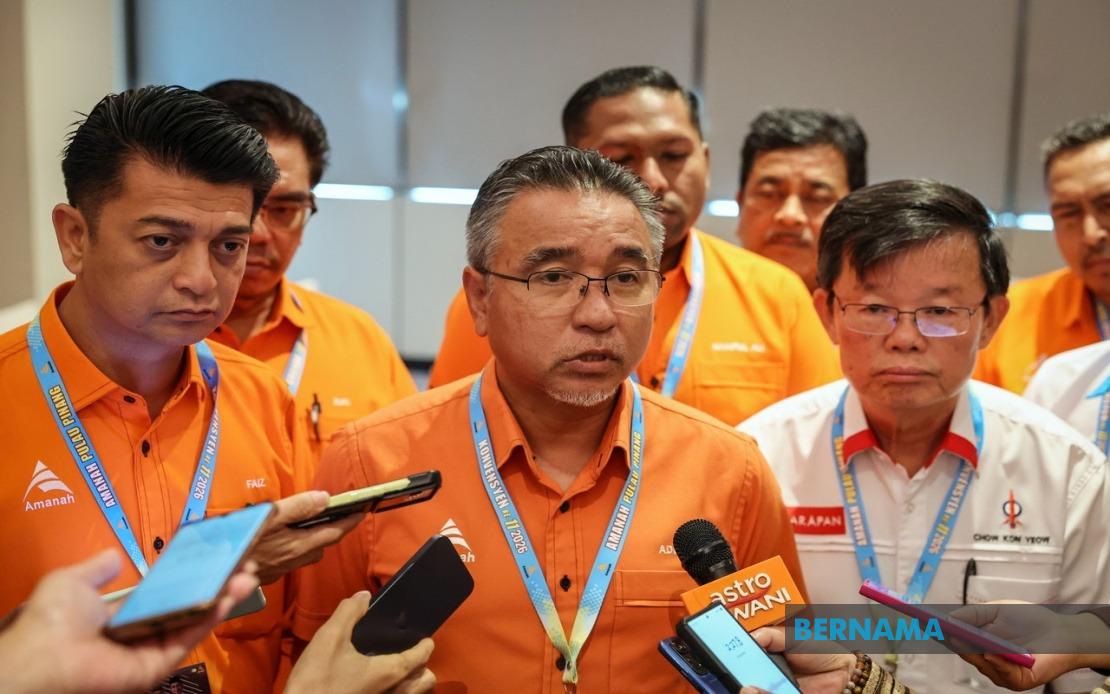
Pakatan Harapan has reaffirmed its commitment to pursuing a political agenda anchored in values, integrity, and effective governance, even as the coalition grapples with disappointing electoral outcomes that have prompted soul-searching within its ranks. Speaking at the Penang Amanah Convention in Bukit Mertajam on Friday, Amanah vice-president Adly Zahari emphasised that this principled approach will remain at the heart of the coalition's political strategy, notwithstanding emerging pressure to recalibrate messaging and electoral tactics across the country.
Adly's remarks came in the context of questions surrounding PH's performance in the recently concluded Negeri Sembilan state election, where the coalition suffered a significant reversal. Barisan Nasional emerged as the dominant force in the contest, securing 18 of the 36 available seats and positioning itself to form government in the state. PH managed to capture 11 seats, a disappointing showing that underscores growing headwinds facing the federal ruling coalition as it heads toward potential early national elections. Perikatan Nasional, meanwhile, capitalised on the divided opposition to claim seven seats, suggesting that the political landscape remains fractured and unpredictable.
The Amanah leader acknowledged, however, that the coalition recognises the need to undertake critical self-examination and strategic refinement. He indicated that PH would conduct detailed post-mortem analyses of its recent electoral setbacks, with a particular focus on identifying gaps in communication and messaging that may have hampered its ability to mobilise voters. This introspection reflects a broader recognition within PH that the coalition's policy achievements and developmental initiatives have not translated effectively into political capital during election campaigns.
Central to PH's assessment is the realisation that Malaysian voters, particularly those in states like Negeri Sembilan, prioritise tangible improvements in their material circumstances over abstract appeals to principles or past pledges. Adly specifically highlighted the issues that dominate kitchen-table conversations across Malaysian households: the mounting cost of living, macroeconomic conditions, educational opportunities, and the quality of government service delivery. These bread-and-butter concerns, he suggested, constitute the ultimate benchmark against which voters judge political actors, regardless of ideological positioning or anti-corruption rhetoric.
This diagnosis points to a deeper communications challenge confronting PH. While the coalition has invested considerable effort in touting its governance record, economic policies, and social welfare initiatives, these messages appear to be failing to resonate with sufficient sections of the electorate. Adly's acknowledgement that PH must improve how it conveys its achievements suggests that the coalition views the problem not as a fundamental policy deficit but rather as a packaging and articulation challenge. The implication is that PH believes its actual record is stronger than voter perception of it, a common refrain among incumbent governments facing electoral headwinds.
Penang Chief Minister Chow Kon Yeow, who chairs the PH coalition machinery in the state, indicated that the coalition would reconvene on August 8 to undertake a more comprehensive assessment of its performance across multiple recent elections. The review will encompass not only the Negeri Sembilan contest but also the outcome of the Johor state election, another recent disappointment that has prompted soul-searching within PH ranks. The aim of this larger strategic review is explicitly framed as preparation for a potential early general election, suggesting that coalition leaders view improved electoral strategy as urgently necessary.
Chow's pronouncements reveal a significant emphasis on refocusing the electorate's attention onto government performance metrics and service quality. He stressed the importance of highlighting the coalition's track record in job creation, economic opportunity generation, and delivery of government services to ordinary Malaysians. This strategic pivot reflects an implicit acknowledgement that PH's earlier messaging around institutional reform, rule of law, and anti-corruption—themes that animated the 2018 election campaign—have lost some salience among voters concerned primarily with economic hardship and government efficiency.
For Malaysian observers, this moment reveals important tensions within the PH coalition between maintaining its foundational commitment to principles and values-based governance on one hand, and the electoral necessity of emphasising material deliverables and economic performance on the other. The coalition's leadership appears to be attempting to thread this needle: maintaining rhetorical commitment to integrity and principled governance while substantially reorienting campaign messaging toward economic and service delivery narratives that may prove more electorally effective.
The Negeri Sembilan outcome also carries broader implications for the political trajectory of the entire Southeast Asian region. Malaysia's experience with coalition governments and multi-party competition offers lessons about the sustainability of reform-oriented governance when confronted with economic challenges and voter dissatisfaction. As PH attempts to rebuild political momentum ahead of potential early elections, its success or failure in communicating the relationship between good governance and improved living standards will carry significance beyond Malaysia's borders for other democratic systems in the region wrestling with similar tensions.
The August 8 strategy meeting will be closely watched not only by PH members but by rival coalitions seeking to capitalise on what they perceive as vulnerability in federal government messaging and electoral positioning. Barisan Nasional's success in Negeri Sembilan suggests that traditional networks and localist appeals retain considerable electoral potency, while Perikatan Nasional's gains indicate that voters remain willing to consider alternative political options when existing coalitions appear to underdeliver on core concerns.

