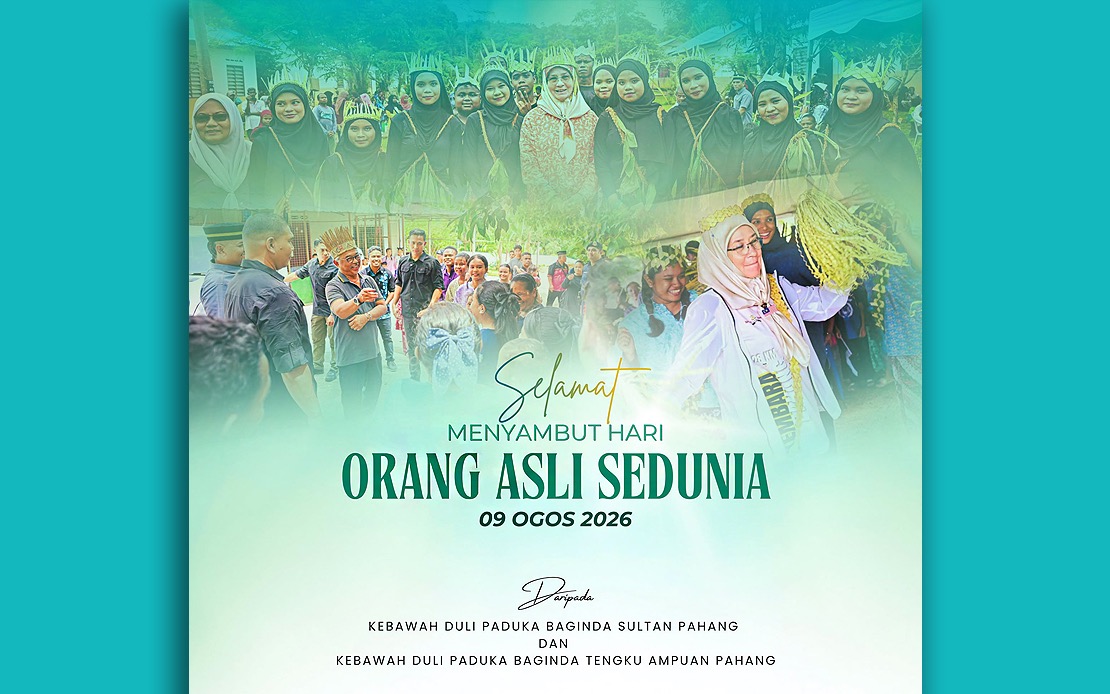
The Sultan of Pahang, Al-Sultan Abdullah Ri'ayatuddin Al-Mustafa Billah Shah, and Tengku Ampuan Pahang Tunku Azizah Aminah Maimunah Iskandariah have publicly recognised the Orang Asli community's foundational contributions to Pahang's identity, marking their appreciation through a formal statement released on the royal household's official channels. The recognition comes as Malaysia observes the International Day of the World's Indigenous Peoples, drawing attention to the cultural custodians who have long shaped the state's social fabric and traditions.
In their acknowledgement, the royal couple stressed the integral role that Orang Asli communities play in preserving and transmitting customs, practices and historical narratives that form the bedrock of Pahang's distinctive cultural landscape. Rather than treating indigenous heritage as a museum piece, Their Royal Highnesses framed it as a living, evolving legacy that requires continuous celebration and protection, reflecting a growing recognition across Malaysia that indigenous knowledge systems hold contemporary value.
The statement from the Pahang palace goes beyond symbolic gestures by articulating a vision for substantive improvement in the Orang Asli community's material circumstances. The royal couple explicitly called for expanded opportunities across multiple dimensions—education, economic participation, technical skills training and broader human capital development—suggesting that cultural preservation alone cannot address the persistent socioeconomic disparities affecting many indigenous Malaysians.
Education emerges as a particular focal point in their message, underscoring a reality that afflicts Orang Asli communities across Peninsular Malaysia: school enrolment rates remain significantly below national averages, and completion rates for secondary and tertiary education lag considerably. By highlighting education, the Sultan and Tengku Ampuan are advocating for pathways that would enable younger generations of Orang Asli to access white-collar employment and professional opportunities, potentially breaking cycles of economic marginalization.
The emphasis on economic development signals awareness that traditional livelihood patterns—which historically centred on forest-based activities and subsistence agriculture—face mounting pressures from land conversion, environmental degradation and changing market dynamics. The royal household's call for economic opportunity may encompass entrepreneurship schemes, cooperative frameworks or value-added production of traditional goods that could generate sustainable income while honouring indigenous economic practices.
Crucially, the statement maintains that cultural preservation cannot be sacrificed in the pursuit of modern advancement. This reflects a delicate balance that indigenous communities throughout Southeast Asia navigate: the need to participate fully in contemporary economies and societies while maintaining distinct identities and traditional knowledge systems that differentiate them from broader populations. By insisting that heritage and customs remain central to any development agenda, the royal couple implicitly critique approaches that would assimilate Orang Asli populations into mainstream structures at the expense of cultural distinctiveness.
The timing of this statement during the 2026 International Day of the World's Indigenous Peoples carries symbolic weight, positioning Pahang within a global conversation about indigenous rights, land sovereignty and cultural recognition. For Malaysian policymakers, the royal endorsement provides momentum for initiatives that might otherwise struggle for political priority in states where Orang Asli populations constitute small minorities relative to Malay or Chinese populations.
The call for unity, respect and cooperation that closes the royal statement extends beyond relations within the Orang Asli community itself, implying a broader appeal for multi-ethnic harmony in Pahang. Given that the state encompasses diverse populations—Malays, Chinese, Indians and smaller indigenous groups—the Sultan and Tengku Ampuan's emphasis on intergroup cooperation suggests that indigenous advancement and cultural celebration need not come at the expense of other communities' interests, potentially defusing tensions that occasionally arise around land rights and resource access.
For observers across Southeast Asia, Pahang's royal intervention demonstrates how traditional monarchical institutions can champion minority rights and cultural preservation in contexts where democratic majoritarian pressures might otherwise sideline indigenous concerns. The statement carries implicit criticism of governance approaches that treat Orang Asli affairs as peripheral rather than central to national and state identity.
The specific mention of quality-of-life improvement addresses an uncomfortable reality: many Orang Asli settlements lack adequate infrastructure, reliable electricity, clean water systems and healthcare services that most urban Malaysians consider basic utilities. Without concrete investment in these fundamentals, rhetorical commitments to cultural preservation ring hollow to communities managing immediate material challenges.
Looking forward, the royal couple's statement may catalyse concrete policy initiatives within Pahang's government, though converting palace recognition into budgetary allocations and programme implementation remains a persistent challenge in Malaysian governance. Implementation gaps between royal appeals and bureaucratic action have historically plagued indigenous-focused initiatives, requiring sustained monitoring and advocacy from community organisations and civil society groups.
The statement also implicitly acknowledges that Orang Asli heritage constitutes a shared resource belonging to all Pahangites, not merely a parochial concern of indigenous communities themselves. Framing indigenous culture as part of the state's collective patrimony may help normalise investment in preservation and development efforts that might otherwise be dismissed as special pleading or preferential treatment.

