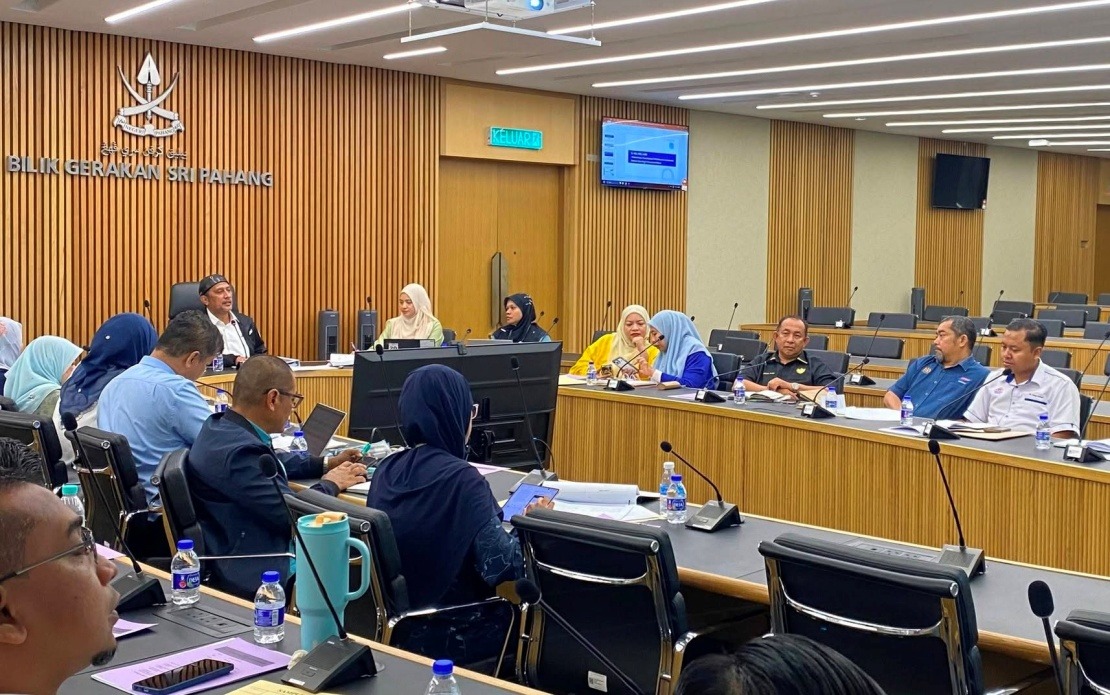
The Pahang state government will formally engage the Department of Orang Asli Development (JAKOA) and the Pahang Land and Mines Office (PTG) to examine workable remedies for an unresolved land dispute centring on the Orang Asli community occupying Kampung Sungai Cot in Maran. The intervention comes as authorities seek to untangle competing claims to the same parcel, one predating formal approval by over three decades and the other sanctioned through official government channels in 2015.
Syed Ibrahim Syed Ahmad, who chairs Pahang's Islamic Religious Affairs, Rural Development and Orang Asli Affairs Committee, emphasised that any resolution will prioritise legal standing and consensual dialogue among affected stakeholders. His statement represented an attempt to reset public perception around the dispute, pushing back against external characterisations of what the state government views as a more nuanced administrative matter than commonly portrayed. The commitment to "prudent" handling signals official recognition that indigenous land claims carry both legal complexity and political sensitivity in contemporary Malaysia.
The genesis of the overlap reveals a common administrative challenge in Malaysia's land management. Twelve Orang Asli individuals had been cultivating the contested land based on a documented claim submitted to JAKOA, establishing their occupancy and use through practice if not formal title. However, the same territory received corporate approval following a November 4, 2015 decision by the 32nd State Executive Council (MMK), effectively granting rights to an outside company without apparent coordination with indigenous claimants already working the land. This temporal disjunction—customary occupation versus bureaucratic authorization—now defines the core dispute.
JAKOA's preliminary engagement with affected Orang Asli representatives has narrowed the active dispute. Of the original dozen individuals, only six have sustained formal claims through the department, suggesting that some claimants have either abandoned pursuit or resolved matters outside the current framework. These remaining claimants contend the land represents ancestral territory, a designation carrying profound cultural and historical weight within Orang Asli communities. Nevertheless, government authorities have been unable to substantiate these ancestral claims through official documentation and recorded evidence, placing claimants in the difficult position of asserting customary rights against institutional mechanisms that demand archival proof.
Pahang's broader Orang Asli landscape provides important context for understanding both the significance and prevalence of such disputes. The state administers 264 Orang Asli villages housing more than 90,000 registered indigenous residents, making it home to one of Malaysia's largest concentrated Orang Asli populations. Of these communities, 30 villages have achieved formal gazettement under Section 6 and Section 7 of the Orang Asli Act 1954 alongside complementary provisions in the National Land Code, establishing legal recognition of their territorial presence. An additional 16 villages have received state-government-approved land ownership grants under Section 76 of the National Land Code, representing the government's most direct recognition of Orang Asli proprietary interests.
The scale of pending formalization efforts underscores both progress and remaining backlog. Pahang is currently processing 75 gazettement applications on behalf of Orang Asli communities, with administrative momentum building through successive stages. Thirty-one applications have advanced to the point where they await consideration by the MMK, potentially moving them toward approval within forthcoming months. A further 44 applications remain entangled in overlap-resolution procedures, illustrating how competing claims—whether involving non-indigenous entities, state land reserves, or other claimants—complicate the path to indigenous land security. Beyond these, 143 additional applications sit at initial measurement stages conducted by JAKOA, a preliminary phase necessary before technical boundaries can be formally established.
The Kampung Sungai Cot case exemplifies tensions intrinsic to Malaysia's land administration during periods of competing resource allocation. Government agencies operating within distinct mandates—economic development through corporate licensing versus indigenous welfare through land security—may issue approvals without systematic cross-referencing or conflict screening. The resulting overlaps frustrate both commercial entities holding legitimate state authorization and Orang Asli communities whose customary presence precedes but lacks parallel bureaucratic formalization. Resolution frameworks must therefore navigate competing legitimacies rather than simple right-versus-wrong scenarios.
For Orang Asli communities across Southeast Asia, Malaysia's experience carries instructive dimensions. Indigenous land security remains fundamentally dependent on state recognition mechanisms, creating structural vulnerability when communities rely on occupancy and oral history rather than documented title. Pahang's gazettement initiatives and ownership grants represent incremental progress, yet the 44 applications caught in overlap resolution reveal how easily administrative processes become stalled when interests diverge. The Maran dispute suggests that mere policy commitments toward Orang Asli land rights require sustained institutional capacity, cross-agency coordination, and transparent dispute-resolution procedures to translate into tangible security.
The consultative approach Syed Ibrahim championed indicates official preference for negotiated settlement over administrative decree or litigation, a stance reflecting both practical wisdom and diplomatic sensitivity. Bringing JAKOA, PTG, and the Land and District Office into coordinated review creates multiple points of institutional leverage and technical expertise. JAKOA brings specialized understanding of Orang Asli tenure customs and claims procedures; PTG contributes state-level land records and registry authority; the District Office provides local administrative insight and enforcement mechanisms. Genuine coordination among these entities offers the best prospect for solutions acceptable to claimants while respecting prior government approvals.
The outcome in Maran will resonate beyond the immediate 12 claimants, signalling to other Orang Asli communities whether Pahang can credibly resolve overlapping claims when they arise. Successful mediation reinforces confidence in the gazettement pipeline and ownership-grant initiatives, whereas protracted deadlock would reinforce skepticism about institutional commitment to indigenous land security. Malaysian policymakers monitoring this case will assess whether existing frameworks—the Orang Asli Act 1954, the National Land Code provisions, and state-level administrative structures—possess sufficient flexibility and political backing to navigate the complexity characteristic of land disputes involving marginalized communities and established corporate interests.

