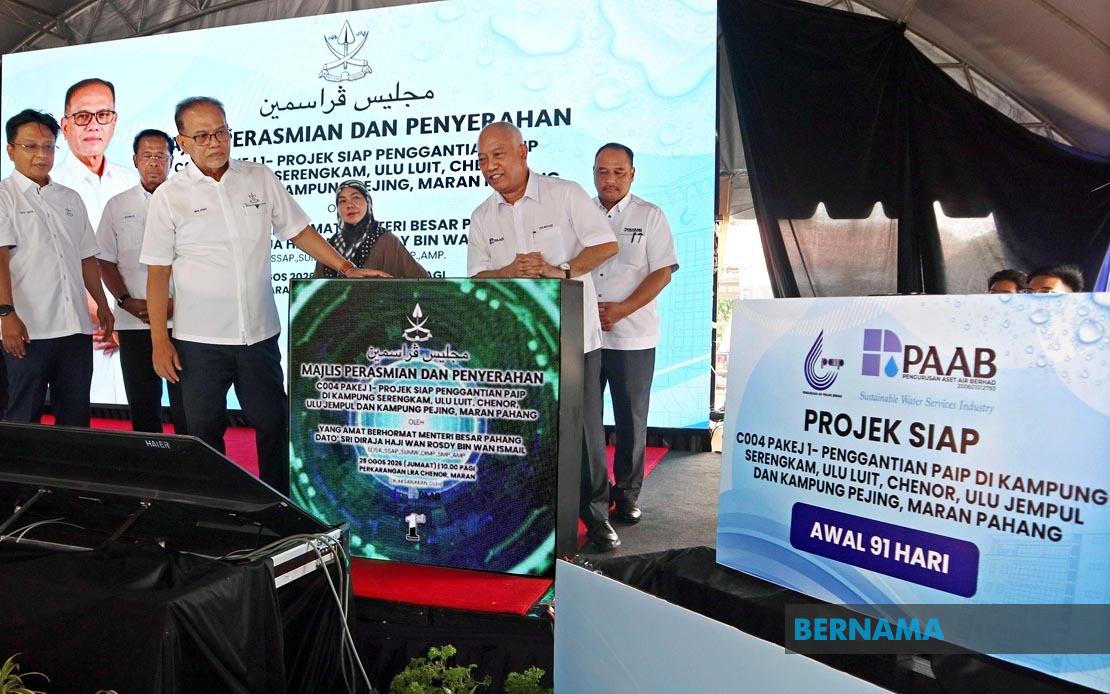
Pahang is embarking on a methodical examination of comprehensive remedies to address the recurring problem of shallow waters in Sungai Pahang, with particular focus on troubled sections such as Kampung Pesagi in Maran district. The state administration recognises that this environmental challenge demands a structured, evidence-based approach rather than ad-hoc interventions, reflecting a broader shift towards data-driven governance in addressing infrastructure and natural resource challenges across Malaysian states.
Menteri Besar Datuk Seri Wan Rosdy Wan Ismail underscored that before committing to specific interventions, the Pahang government is consolidating detailed assessments from all relevant agencies regarding the river's current condition and underlying causes of the shallowing phenomenon. This deliberate pace, while potentially testing the patience of affected residents, signals an understanding that ill-conceived solutions could prove costly and ultimately ineffective in tackling what may be a multifaceted environmental problem.
The Menteri Besar articulated a three-tiered temporal framework guiding the government's approach, distinguishing between short-term stabilisation measures, medium-term corrective strategies, and long-term structural solutions. This graduated methodology reflects international best practices in river management, where immediate relief must be balanced against sustainable interventions that address root causes rather than merely treating symptoms that plague communities dependent on the waterway.
Before proceeding, Wan Rosdy indicated that district-level authorities will compile comprehensive reports destined for scrutiny at the state executive council meeting, where elected representatives will evaluate proposed methodologies and refine implementation strategies. This consultative process, though bureaucratic in appearance, essentially functions as a quality-control mechanism ensuring that public resources directed toward river remediation align with evidence and expert guidance rather than political expediency.
The shallow Sungai Pahang represents a significant concern precisely because it directly undermines economic viability and daily functioning for residents inhabiting areas proximate to the waterway. Agriculture, small-scale commerce, and traditional livelihoods tied to riverside settlements face genuine operational constraints when water depths become inadequate, making this ostensibly technical problem fundamentally a livelihood issue for vulnerable populations. The government's stated commitment to basing interventions on comprehensive study reflects an acknowledgment that hasty action could inadvertently worsen conditions or prove wasteful of limited state resources.
Simultaneously, the Pahang administration has been implementing parallel infrastructure modernisation initiatives aimed at bolstering the state's foundational systems. The pipe replacement programme targeting water supply deficiencies has achieved resolution rates surpassing ninety percent across four districts, with Maran district positioned to shortly join this achievement bracket. These concurrent efforts—addressing both surface water challenges and buried infrastructure—demonstrate a multidimensional approach to resolving resource distribution problems that persistently constrain development across the East Coast.
Beyond water provisioning, Pahang is pursuing energy infrastructure augmentation through a Tenaga Nasional Berhad initiative involving construction of a substantial 500-kilovolt transmission substation in Kampung Awah. This approximately RM350 million undertaking, targeted for completion by 2030, aims to establish robust electrical transmission capacity supporting anticipated industrial expansion and investor attraction throughout the state. Such investment in skeletal infrastructure—power, water, transportation networks—constitutes the prerequisite foundation upon which sustained economic growth depends.
The transmission network extension carries strategic significance for the broader East Coast region, linking pivotal nodal points throughout Pahang and neighbouring territories into an integrated electrical distribution system engineered for reliability and future scalability. This interconnectedness proves essential for supporting industrial clusters, manufacturing facilities, and commercial enterprises increasingly concentrated across the peninsula's eastern corridor. A resilient, modern energy infrastructure simultaneously attracts multinational investors evaluating site options and enables existing enterprises to operate without supply constraints that plague less-developed regions.
Wan Rosdy characterised infrastructure development and sustained investment project implementation as foundational to economic advancement, employment generation, and improvement in population welfare—a formulation emphasising the causal linkage between physical capital accumulation and human prosperity. This perspective, orthodox in development economics, nevertheless requires acknowledgment that infrastructure alone proves insufficient; complementary policies addressing skills development, business regulation, and market access remain equally indispensable.
The Sungai Pahang shallowing crisis exemplifies persistent challenges confronting Malaysian state governments tasked with balancing immediate constituent demands against judicious stewardship of public finances and environmental systems. For Pahang specifically, this challenge intersects with broader imperatives to modernise infrastructure, attract external investment, and position the state competitively within an increasingly integrated regional economy. Solutions emerging from the promised comprehensive study will reveal whether governance capacity and political will exist to implement difficult measures, including potentially costly interventions or restrictions on riverside activities, necessary for durable remediation.
The state's dual focus on Sungai Pahang remediation and energy infrastructure expansion reflects understanding that economic competitiveness depends simultaneously on natural resource sustainability and modern productive capacity. Should Pahang successfully navigate both challenges, the outcomes could establish templates applicable across Malaysia's less-developed eastern territories, where similar impediments constrain development trajectories and resident livelihoods.

