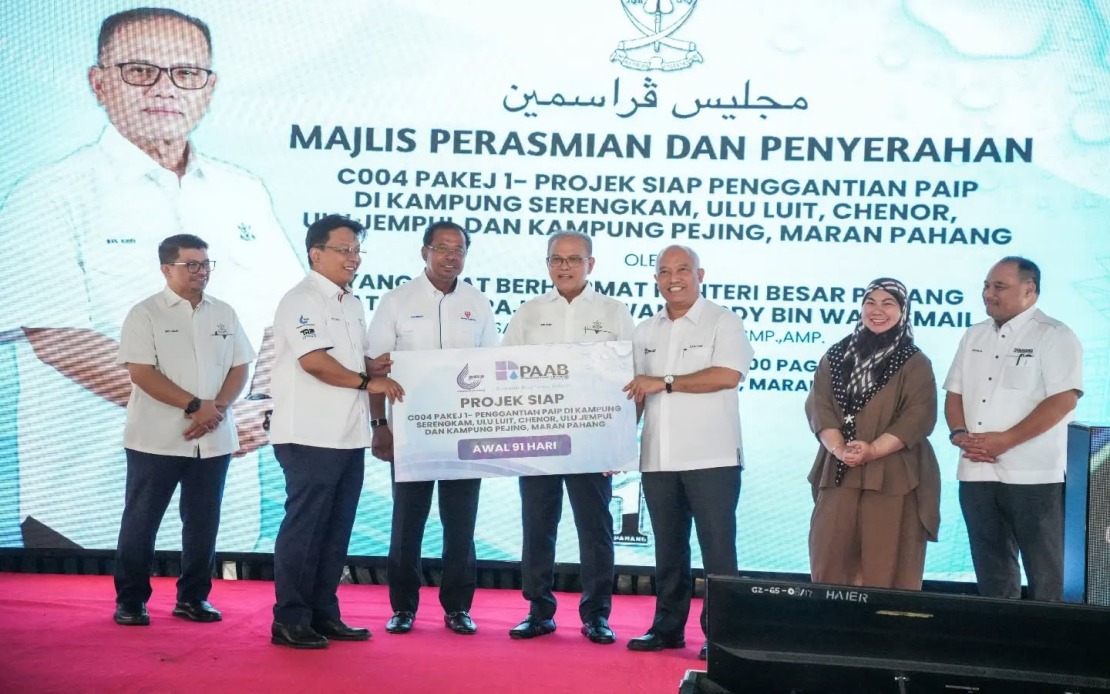
Pengurusan Aset Air Berhad (PAAB) has resolved a long-standing water crisis in Maran by completing a RM11.19 million pipeline replacement initiative that addresses chronic supply failures affecting the Chenor sub-district and surrounding communities. The project, which wrapped up three months ahead of schedule, replaced 29.6 kilometres of deteriorated piping across multiple residential areas including Kampung Serengkam, Ulu Luit, Pejing, Ulu Jempul and Chenor, with nearly 10,000 residents now enjoying improved water access.
The infrastructure overhaul represents a watershed moment for a district that has endured recurrent water shortages for nearly two decades, a situation that had become increasingly untenable as population pressure and seasonal variations compounded supply challenges. By systematically removing ageing pipes prone to rupture, PAAB has tackled a fundamental constraint that had persistently undermined water quality and distribution reliability. The initiative directly addresses the phenomenon of non-revenue water losses, where significant quantities of treated water escape through leaking infrastructure before reaching households—a persistent inefficiency in Southeast Asian water systems that inflates operational costs whilst leaving consumers frustrated.
The project delivers tangible improvements across multiple dimensions of service delivery. Residents previously accustomed to irregular supply now benefit from stabilised water pressure, particularly during peak-demand periods when seasonal droughts traditionally forced rationing or when festive occasions generated consumption spikes. The elimination of frequent pipe bursts removes not only the physical disruptions that characterised daily life but also the cascading water quality degradation that accompanies ruptures, where external contaminants infiltrate damaged sections of network. These operational improvements directly contribute to enhanced public health outcomes and economic productivity within the district.
Pahang Menteri Besar Datuk Seri Wan Rosdy Wan Ismail officiated the project handover ceremony at the Chenor Water Treatment Plant, alongside Deputy Energy Transition and Water Transformation Minister Datuk Seri Abdul Rahman Mohamad and Deputy Economy Minister Datuk Mohd Shahar Abdullah. The formal handover underscores the political significance attributed to water infrastructure in Pahang, where reliable supply remains a cornerstone of regional development priorities. The gathering of senior federal and state officials reflects acknowledgment that water security directly enables broader socioeconomic advancement, from agricultural productivity to industrial investment and residential settlement patterns.
Beyond the completed Maran initiative, PAAB has articulated an ambitious three-year development roadmap targeting multiple districts across Pahang. The Jengka Utama Water Treatment Plant will undergo electrical system upgrades designed to resolve persistent disruptions affecting the Felda Jengka settlement, whilst a separate RM35.7 million undertaking will replace 76.2 kilometres of deteriorated piping in Jerantut and Lipis, addressing supply challenges around Pulau Tawar and Kuala Tahan. An additional RM13 million allocation will modernise 11 kilometres of piping within Felda Keratong to enhance water distribution efficiency across Rompin, collectively demonstrating strategic investment in underserved communities.
The scale of PAAB's financial commitment reveals the magnitude of Pahang's water infrastructure deficit. As of July, PAAB had earmarked RM1.17 billion for water supply projects throughout the state, with RM69.79 million allocated to completed initiatives, RM66.94 million committed to active construction, and RM981.04 million designated for planning and design phases. This substantial portfolio underscores the longstanding underinvestment in water systems across rural Pahang, where ageing networks inherited from earlier development phases struggle with modern demand patterns. The multi-year funding trajectory demonstrates recognition that water security requires sustained capital deployment rather than episodic interventions.
PAIB signed the Pahang State Water Supply Services Restructuring Agreement in 2020, formally anchoring the partnership between federal asset management frameworks and state-level implementation capacity. This contractual arrangement reflects broader restructuring within Malaysia's water sector, where the 2006 Water Services Industry Act established institutional mechanisms to coordinate investment, technical standards and operational efficiency across fragmented regional authorities. PAAB, established as a wholly owned entity under the Minister of Finance Incorporated and regulated by the Ministry of Energy Transition and Water Transformation (PETRA), functions as an intermediary institution channelling federal resources and technical expertise toward state-specific water challenges.
The Maran project exemplifies the practical benefits of this institutional architecture. Rather than relying solely on state government budgets—often constrained by competing infrastructure priorities—PAAB mobilises federal capital and technical resources for regional water security improvements. This model enables acceleration of critical upgrades whilst distributing financial burdens across national revenue streams rather than concentrating them on state fiscal capacity. For Malaysians navigating water insecurity in rural districts, PAAB's interventions translate abstracted policy frameworks into tangible service improvements.
The broader context of water infrastructure challenges across Southeast Asia illuminates the significance of the Maran completion. Throughout the region, rapid urbanisation and climate variability have exposed vulnerabilities in aging water networks designed for smaller, less dynamic populations. Malaysia's experience with recurring supply disruptions in both urban and rural settings reflects a pan-regional phenomenon where asset maintenance and expansion struggle to keep pace with demand growth and environmental pressures. Successful project completions like Maran provide instructive models for peer economies wrestling with similar infrastructure modernisation imperatives.
Looking forward, PAAB's integrated approach to Pahang's water future prioritises not merely fixing immediate crises but systematising infrastructure planning and investment. The planned three-year roadmap represents transition from reactive maintenance toward proactive network modernisation, incorporating strategic assessments of long-term demand, climate resilience and operational efficiency. This orientation aligns with federal government aspirations to transform Malaysia's water sector into a more resilient, efficient and sustainable system, translating national policy directives into concrete district-level outcomes.
The implications for Malaysian households in underserved regions are substantial. Water supply reliability directly influences residential quality of life, health outcomes, property valuations and business investment decisions. For Maran residents who endured nearly two decades of disruptions, the completed infrastructure upgrade represents not merely convenience but fundamental improvement in living standards. The project demonstrates that chronic service failures afflicting specific communities can be addressed through sustained federal-state collaboration and adequate capital mobilisation, offering hope for other Malaysian regions confronting similar water security challenges.

