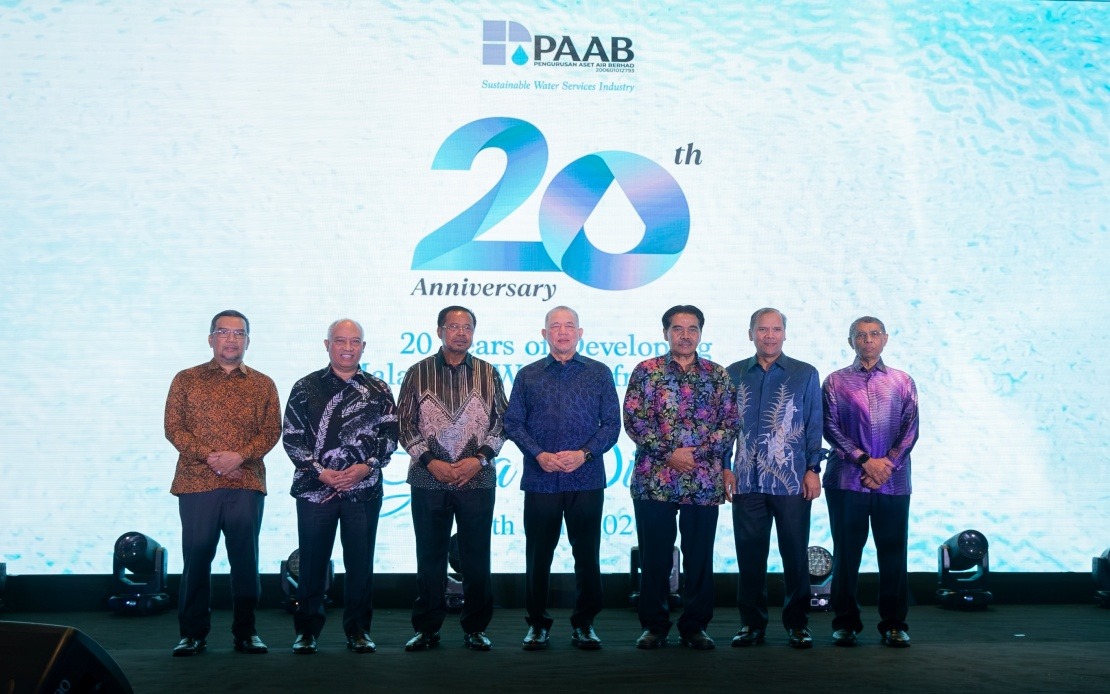
Pengurusan Aset Air Berhad (PAAB), the state-owned water asset management company, is marking twenty years of pivotal work in reshaping Malaysia's water services landscape. Established on May 5, 2006, as a wholly owned entity of the Minister of Finance Incorporated, PAAB has emerged as a central engine for modernising the nation's water infrastructure and safeguarding supply security. The milestone, celebrated at a formal dinner in Kuala Lumpur, underscores the organisation's evolving role in supporting economic development and public welfare across a rapidly industrialising Southeast Asian nation.
The scale of PAAB's financial commitment to sector transformation is substantial. Over its two decades of operation, the company has financed the assumption of water industry debt totalling RM23.04 billion whilst simultaneously investing RM23.84 billion in physical infrastructure development. Combined, these figures represent RM46.88 billion in total financing and capital deployment—a sum that positions PAAB as one of the country's most significant drivers of public infrastructure advancement. The breadth of this investment reflects the government's strategic prioritisation of water security as foundational to both quality of life and economic competitiveness.
Progress under the National Water Services Industry Restructuring Plan, signed by ten states as of December 2025, demonstrates tangible advances in service delivery capacity. PAAB's portfolio encompasses the completion of 21 modern water treatment plants collectively capable of processing 2,085 million litres daily—an expansion that substantially increases the nation's ability to meet rising demand from households, commercial users, and industrial operations. Complementing these facilities are 42 storage reservoirs with combined capacity of 783 million litres, which buffer supply fluctuations and enhance resilience. Infrastructure upgrades have extended to 3,263 kilometres of pipeline replacements and new installations nationwide, reducing physical losses and expanding reach into underserved areas. These projects represent the foundational work required to support Malaysia's ambitions as a regional investment hub attracting data centres, manufacturing facilities, and technology companies that depend on reliable water and energy infrastructure.
Deputy Prime Minister Datuk Seri Fadillah Yusof, who holds the portfolio of Energy Transition and Water Transformation Minister, used the anniversary occasion to highlight the urgency of addressing non-revenue water losses—water that enters the distribution system but is lost through leakage or theft before reaching paying customers. Malaysia's non-revenue water stands at approximately 40 per cent of total supply, an inefficiency that represents both financial loss and missed opportunity in a nation facing growing water stress. Fadillah's messaging stressed that the timeline for resolving this challenge cannot extend indefinitely into a 2050 planning horizon; rather, immediate and coordinated intervention across all tiers of government is required to prevent supply disruptions that could undermine public confidence and economic stability.
The deputy prime minister's remarks reflected mounting pressure on Malaysia's water sector as the country competes aggressively for foreign direct investment in high-value industries. Data centres and other technology-intensive operations demand uninterrupted water supply for cooling systems and operations, making water security a critical competitive factor alongside electricity. Should Malaysia's water sector fail to demonstrate reliability, investors may direct capital to competitor nations with more stable infrastructure. The apparent friction between long-term restructuring timelines and the immediate imperatives of economic attraction suggests tension within government strategy that will require resolution through faster execution and more aggressive investment.
PAAB's operational mandate is structured through the National Water Services Industry Restructuring Plan, which pursues full cost recovery across the sector by 2050 through four sequential phases. The Migration phase (2008–2020) focused on establishing foundational restructuring mechanisms. The current Stabilisation phase (2021–2030) concentrates on building operational capacity and financial stability. Two subsequent phases—Consolidation (2031–2040) and Full Cost Recovery (2041–2050)—are designed to progressively shift the sector toward commercial sustainability and reduced reliance on government subsidies. This phased approach acknowledges the sector's complexity and the need for gradual transition, though as Fadillah indicated, the timeline may require acceleration.
Capital expenditure patterns reveal the staging of PAAB's investment programme. Of the RM23.84 billion committed through December 2025, RM8.33 billion has been deployed to completed projects now transferred to operating companies, representing work genuinely finished and delivering water to consumers. An additional RM1.84 billion is bound up in projects currently under construction, where physical progress is observable but completion remains pending. The largest portion—RM13.67 billion—remains committed to projects still in design and planning stages, indicating that a substantial pipeline of future development exists but has not yet moved to active execution. This composition suggests capacity constraints in project delivery, a concern relevant to Malaysia's broader infrastructure development challenges.
PAAB chairman Datuk Seri Jaseni Maidinsa framed the organisation's success not primarily through financial metrics or asset counts, but through the ultimate measure of impact: whether ordinary Malaysians experience more stable, cleaner, and higher-quality water supply in their daily lives. This framing resonates with public sector legitimacy, where infrastructure investment is ultimately justified by service outcomes rather than balance sheet entries. For Malaysian households, particularly those in areas prone to supply restrictions or water quality issues, improved infrastructure translates to reduced disruption, better health outcomes, and greater economic opportunity through uninterrupted access to reliable utilities.
The attendance of senior officials including National Water Services Commission (SPAN) leadership alongside PAAB management underscores the complex institutional architecture surrounding Malaysia's water sector. SPAN regulates and oversees national water policy, whilst PAAB functions as financier and asset custodian, with actual service delivery handled by various state and private operators. This multi-institutional approach permits specialisation but also introduces coordination challenges, particularly when urgent issues like non-revenue water losses require rapid, simultaneous action across multiple jurisdictions and agencies. The deputy prime minister's emphasis on coordinated action reflects recognition that siloed institutional operations have historically slowed progress on systemic challenges.
For Malaysian businesses and consumers, PAAB's two-decade track record holds both encouraging and cautionary implications. The substantial investment in treatment capacity and pipeline infrastructure demonstrates genuine commitment to sector modernisation and represents real progress in service potential. However, the persistence of 40 per cent non-revenue water losses, despite twenty years and billions in investment, suggests that capital deployment alone does not resolve operational inefficiencies rooted in maintenance practices, governance, or loss-detection capabilities. Future progress will depend not only on continued investment in new assets but on simultaneous improvement in how existing infrastructure is operated and managed across Malaysia's fragmented water sector.
Looking forward, PAAB's role will be tested by competing pressures. The acceleration of data centre development and other water-intensive investments will drive demand growth, requiring faster-paced infrastructure expansion than current timelines suggest possible. Simultaneously, rising awareness of water stress in Southeast Asia, driven by climate variability and population growth, increases the stakes for demonstrating sector efficiency and sustainability. For regional observers, Malaysia's experience with structured water sector restructuring—combining public asset finance through PAAB with regulated operator frameworks and phased cost recovery—offers a potential template, though execution challenges visible in Malaysia's non-revenue water figures suggest that institutional and operational reforms must accompany financial investment. The next phase of PAAB's evolution will determine whether the restructuring plan delivers sustainable, efficient water services worthy of the billions invested.

