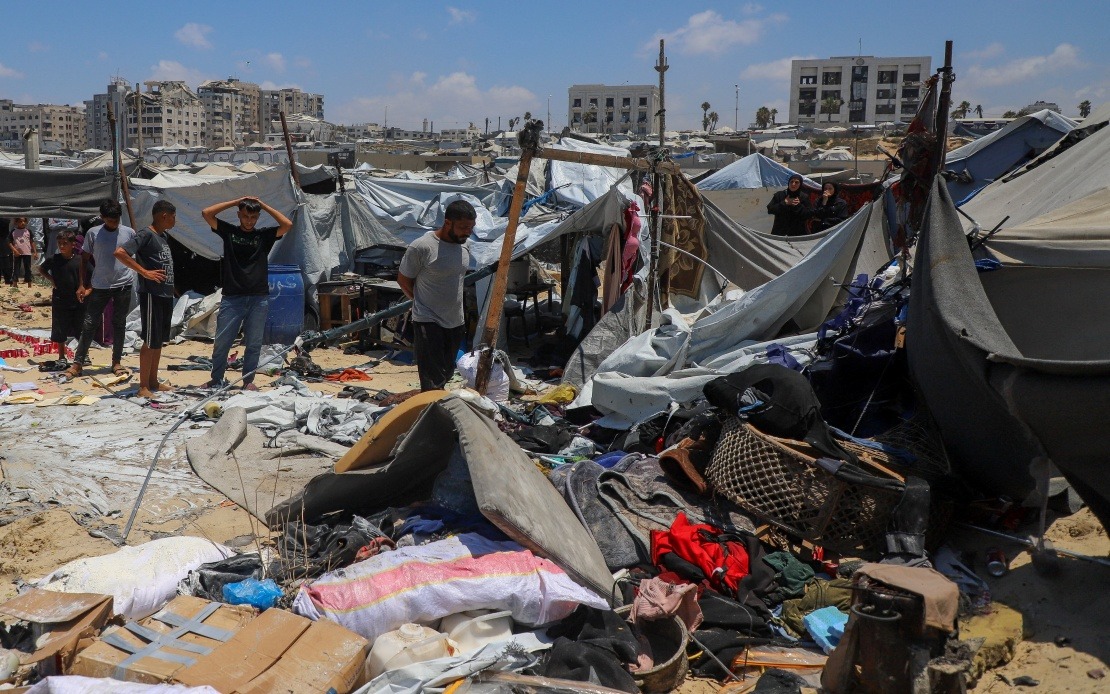
The Israeli military has destroyed more than 90 per cent of the Gaza Strip and currently maintains control over roughly 80 per cent of the conflict-ravaged region, according to findings released by the Palestinian Government Communication Centre operating under the Prime Minister's Office. The assessment, issued on Monday and drawing on accounts from local sources and Palestinian officials on the ground, paints a stark picture of the scale of infrastructure damage and territorial occupation following months of intensive military operations across the densely populated enclave.
During the week spanning June 29 to July 6, Israeli military operations intensified markedly throughout Khan Younis, Rafah, and Gaza City, resulting in the deaths of eight Palestinians according to local medical authorities. The escalation involved not only direct combat operations but also what Palestinian officials characterise as systematic destruction of civilian infrastructure. The Palestinian report documents a pattern of shelling targeting residential neighbourhoods followed by the demolition of homes, an approach that has displaced additional Palestinian families already displaced by earlier phases of the conflict.
For Malaysian observers and policymakers concerned with regional stability and humanitarian issues, the scale of documented destruction carries significant implications. The destruction level reported—exceeding 90 per cent—suggests a comprehensive transformation of the physical environment across Gaza, affecting water systems, electricity infrastructure, medical facilities, educational institutions, and housing. Such extensive damage typically requires decades to repair and creates long-term humanitarian challenges that reverberate through regional and international communities.
Beyond Gaza itself, the Palestinian report highlights concurrent military operations throughout the occupied West Bank. Israeli occupation forces have undertaken widespread raids across multiple Palestinian cities and towns including Ramallah, Nablus, Hebron, Bethlehem, Jenin, Qalqilya, Tulkarem, and occupied Jerusalem. These operations have involved home invasions, mass arrests of Palestinians, restrictions on movement through checkpoints and roadblocks, and intensive security sweeps that Palestinian authorities contend disrupt normal civilian life and economic activity across the territory.
The report also documents activities by Israeli settler militias, which Palestinian officials allege have pursued a coordinated campaign targeting Palestinian communities and property. Documented incidents include arson attacks on commercial establishments, with a cafeteria in the village of al-Lubban ash-Sharqiya targeted for burning. Palestinian shepherds operating near Bethlehem faced physical assault, and settlers reportedly attempted livestock theft. These incidents, according to the Palestinian account, represent a broader pattern of settler aggression that Palestinian authorities argue operates with insufficient constraints from Israeli military authorities.
A particularly significant dimension of the documented disruptions concerns the agricultural sector across the occupied West Bank. The Palestinian Ministry of Agriculture released a weekly briefing documenting what it characterises as a substantial escalation in Israeli actions deliberately targeting farming operations and agricultural infrastructure. The scope of this damage extends across multiple governorates, with the Salfit, Jenin, and Nablus regions experiencing the heaviest documented impact.
Statistically, the agricultural destruction recorded during the reporting period involved 2,559 olive trees either uprooted, burned, or otherwise damaged across affected areas. These operations impacted at least 125 individual farmers whose livelihoods depend directly on these agricultural resources. The Palestinian Ministry of Agriculture assessed the documented direct economic losses from this week's agricultural destruction alone at approximately US$11.78 million, a figure that represents only the immediate financial impact without accounting for longer-term productivity losses or the psychological and social impacts on farming communities.
Olive cultivation holds particular cultural and economic significance throughout Palestinian territories, with olive farming representing not merely an economic activity but a cultural practice deeply embedded in Palestinian identity and heritage. The targeting of olive groves thus carries implications extending beyond immediate economic loss to encompass questions of cultural preservation and community continuity during periods of armed conflict.
For Southeast Asian nations maintaining positions on Middle Eastern conflicts, these Palestinian accounts represent one dimension of an increasingly complex humanitarian situation requiring careful international attention. The scale of destruction and displacement documented creates substantial refugee and humanitarian assistance pressures affecting neighbouring countries and international organisations. Malaysia, as a nation with significant humanitarian commitments and active diplomatic engagement across multiple Middle Eastern issues, remains attentive to documentation of civilian impact and infrastructure destruction in conflict zones.
The Palestinian government's systematic documentation of military operations, civilian casualties, infrastructure damage, and economic losses serves multiple functions within Palestinian political discourse and international advocacy efforts. These weekly situation reports provide official Palestinian perspectives on military operations and their civilian impacts, contributing to competing narratives about conflict dynamics that circulate through international media and diplomatic channels.
The reported destruction levels and occupation control percentages, if verified by independent international observers, would represent a fundamental transformation of Gaza's physical and political landscape. Such comprehensive destruction raises substantial questions about reconstruction possibilities, civilian access to essential services, and the long-term viability of normal economic and social life within the territory. These considerations extend beyond immediate humanitarian concerns to encompass questions about sustainable peace, conflict resolution, and the preconditions for eventual political settlement in the Israeli-Palestinian context.

