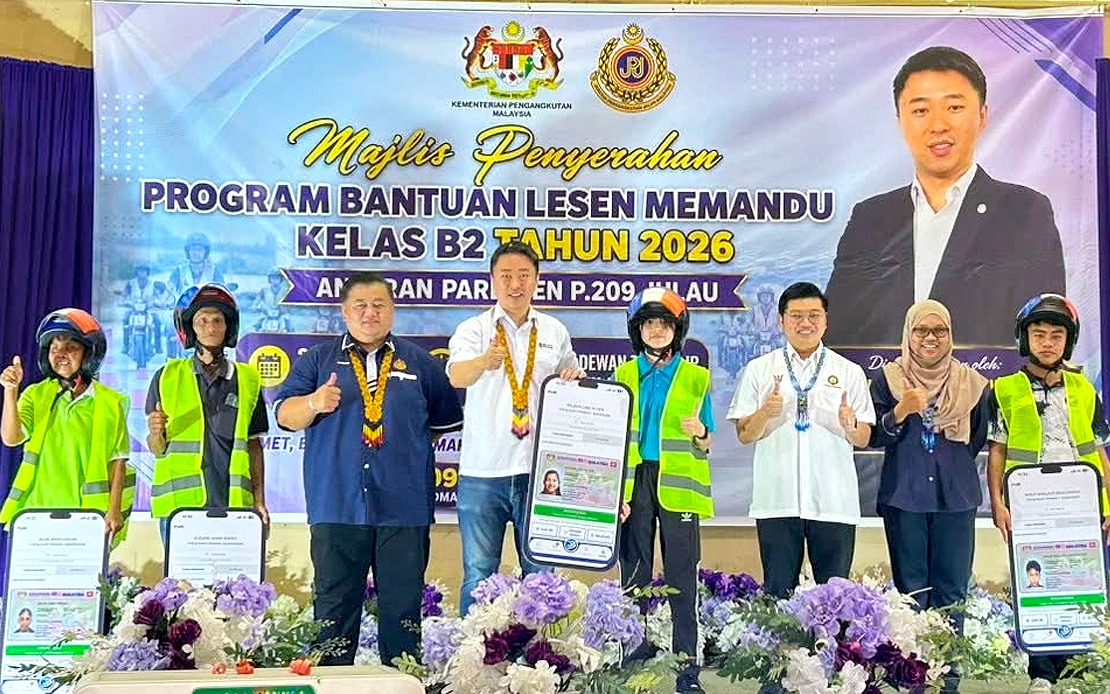
Over 885 residents from remote villages across Sarawak's Julau parliamentary constituency have successfully obtained Class B2 Probationary Driving Licences through a government assistance initiative, marking a watershed moment for rural mobility and economic relief in one of Malaysia's most geographically challenging regions. The Driving Licence Assistance Programme concluded its 2026 intake at the Julau Closed Stadium in Sarikei on June 28, with Datuk Larry Sng Wei Shien, the Julau MP and Malaysian Timber Industry Board chairman, formally closing the scheme. The achievement carries particular significance for smallholder farmers, rural workers, and isolated communities where motorcycles serve as lifelines for accessing markets, services, and employment rather than luxury consumer items.
The subsidy component represents far more than a symbolic gesture to these participants. Many beneficiaries operate agricultural ventures—orchards, oil palm smallholdings, bird's nest operations—where daily transport costs directly subtract from already-thin profit margins. Bajik Undum, a 57-year-old farmer from Rumah Ajau in Ulu Kuntau, exemplified this reality. Previously unable to purchase fuel at government-supported rates due to lacking a valid riding credential, she had absorbed the full market price for petrol consumed during journeys to her orchard and for transporting produce to sales points. The financial burden on elderly rural dwellers, particularly women navigating economies that often marginalise their agricultural contributions, becomes acute when commodity prices fluctuate and transport costs remain non-negotiable expenses.
For Kudang Jenggi, the 64-year-old male participant recognised as the programme's eldest beneficiary, the licence represented liberation from the anxiety of traffic enforcement encounters. As a caretaker managing bird's nest houses in Bayong, Sarikei—work requiring regular travel and presence across multiple locations—he previously operated in a state of constant vulnerability to roadside inspections. Malaysian traffic law enforcement, while necessary for public safety, inevitably carries disproportionate consequences for unlicensed rural riders whose occupations demand mobility. Kudang's relief at no longer requiring evasive tactics during routine work journeys reflects a broader challenge facing motorised transport access in peripheral communities where formal licensing infrastructure has historically lagged demand.
Daniel Padong's experience illuminates the cascading economic pressures that drove demand for this programme. His oil palm smallholding requires daily motorcycle commutes, a necessity rather than convenience in areas where public transportation remains minimal. The documented surge in petrol prices elevated his baseline transport expenditure substantially, compressing margins that small-scale agriculturalists can afford to lose. Access to subsidised fuel through proper licensing transforms his daily operating costs and provides tangible relief from price volatility—a concern that resonates across Malaysia's agrarian sector as global petroleum markets remain sensitive to geopolitical shocks.
The Sarawak Road Transport Department's engagement in delivering this initiative, under director Norizan Jili's administration, demonstrates institutional recognition that rural licensing gaps reflect infrastructure and access limitations rather than deliberate non-compliance. Licensing programmes tailored to rural constituencies acknowledge geographical, economic, and educational barriers that prevent universal compliance with formal requirements. Programmes like the Driving Licence Assistance initiative represent pragmatic policy-making that seeks to incorporate marginalised populations into regulated frameworks whilst simultaneously delivering tangible welfare benefits through fuel subsidies.
The gender dimension merits scrutiny given that Bajik emerged as the oldest female participant. Rural women in Malaysia often occupy precarious economic positions—managing household income, agricultural plots, and transport logistics with minimal institutional support. Her previous inability to access subsidised fuel whilst maintaining an essential economic role illustrates how administrative barriers compound gender-based economic disadvantage. Programmes that deliberately reach female participants in subsistence-oriented communities provide not only licensing compliance but recognition of women's productive roles and economic contributions.
The 885-participant cohort's magnitude suggests substantial pent-up demand across Julau's sprawling rural geography. Parliamentary constituencies encompassing extensive hinterland territories inevitably contain populations whose motorcycle ownership precedes formal licensing—a reality that responsive governments address through amnesty and assistance schemes rather than punitive enforcement. The programme's design acknowledged this reality by creating access pathways rather than erecting barriers, thereby converting a potential enforcement challenge into a positive public engagement outcome.
Malaysia's subsidised fuel mechanism, whilst politically controversial in urban discourse, functions as a survival tool for rural micro-entrepreneurs and agricultural workers. The subsidy's targeting remains imperfect, but its withdrawal would impose measurable hardship on precisely those populations—smallholder farmers, rural workers, remote communities—whose economic alternatives remain most constrained. Expanding access to subsidised fuel through licensing programmes represents sensible targeting that aligns welfare benefits with documented rural need.
The programme's conclusion raises questions about sustainability and reach. Julau represents one parliamentary constituency; similar licensing deficits almost certainly exist across Sarawak's interior and peninsular Malaysia's rural peripheries. Scaling this model would require sustained institutional commitment and resource allocation to licensing delivery infrastructure in areas where transport difficulties complicate access to centralised licensing facilities. The temporary closure of this 2026 intake cycle leaves uncertain whether future cohorts will receive comparable support or whether this represents a finite intervention.
For Malaysian policymakers observing rural development challenges, the Julau experience offers instructive lessons about meeting populations where they exist rather than requiring adaptation to formal systems. Rural motorcycle riders represent economically productive populations whose incorporation into regulatory frameworks simultaneously improves safety compliance whilst removing barriers to subsidy access. The apparent simplicity of this intervention—delivering licences and confirming fuel subsidy eligibility—masks the substantial logistical and bureaucratic work required to reach 885 geographically dispersed participants. Success here suggests replicable models for other regulatory domains where rural-urban access gaps undermine policy effectiveness.

