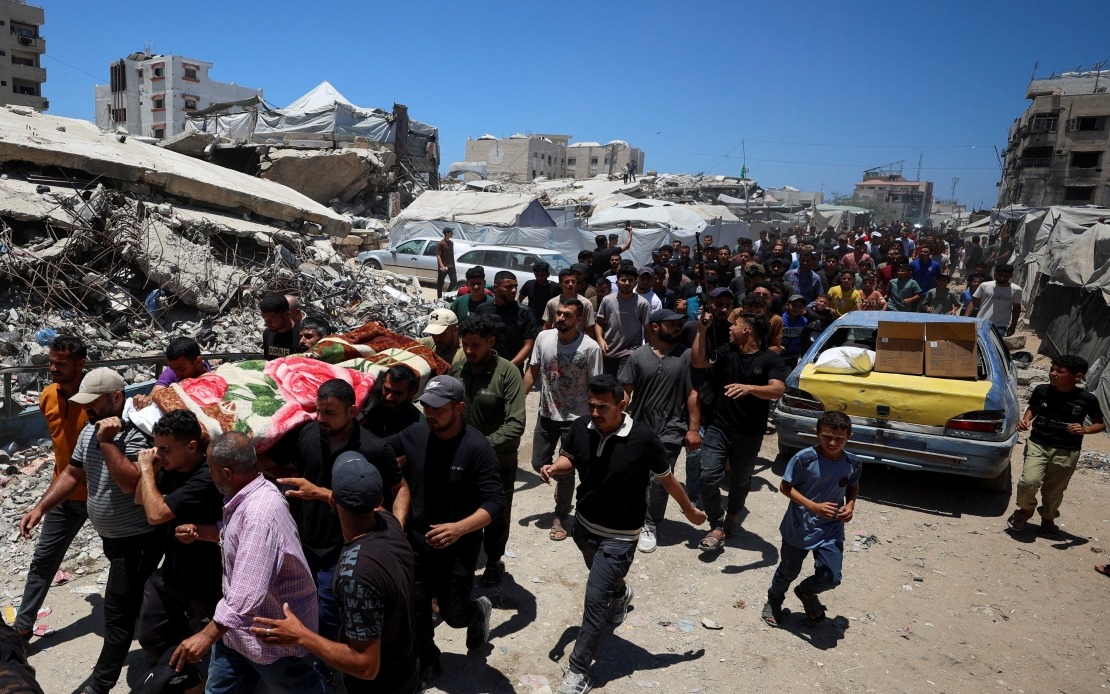
The humanitarian catastrophe unfolding in Gaza has reached devastating proportions, with Palestinian officials reporting that military operations have claimed 1,021 lives following the implementation of a ceasefire agreement. The cumulative death toll since the conflict's outbreak in October 2023 now stands at 73,032, according to the latest situation report released by the Palestinian Prime Minister's Office on Tuesday. These figures underscore the scale of devastation that continues to grip the enclave despite international efforts to halt hostilities, raising critical questions about the durability and enforcement of the ceasefire arrangements.
The destruction wrought upon Gaza's civilian infrastructure has created an unprecedented humanitarian emergency that extends far beyond casualty figures. The Palestinian Government Communication Centre indicates that Israeli military operations have destroyed or severely damaged 76.6 per cent of the territory's housing stock, forcing approximately one million Palestinians to inhabit makeshift tent settlements. This displacement crisis reflects the systematic dismantling of urban infrastructure, leaving residents without adequate shelter as winter approaches and conditions grow increasingly precarious for vulnerable populations including children, the elderly, and those with chronic medical conditions.
Access to basic necessities remains critically compromised across the enclave. The persistent shortage of clean water has compelled the vast majority of Gaza's population to depend entirely on limited humanitarian supplies delivered through increasingly restricted channels. This scarcity creates cascading public health risks, as waterborne diseases flourish in overcrowded refugee camps and informal settlements. The obstruction of humanitarian aid delivery—attributed to ongoing Israeli restrictions—exacerbates nutritional deficiencies and medical emergencies that overwhelm already-stretched healthcare facilities struggling to function without adequate pharmaceuticals, medical equipment, or electricity.
The ceasefire has proven ineffective in preventing continued military engagement and civilian harm. Recent strikes targeting populated areas including Nuseirat, Al-Mawasi, Khan Younis, and Gaza City have inflicted fresh casualties despite the supposed cessation of major hostilities. International humanitarian organizations provide alarming documentation of the impact on Gaza's youngest residents: UNICEF data confirms that 265 Palestinian children have been killed and more than 400 wounded since the ceasefire's announcement. These figures represent not merely statistical losses but the systematic undermining of an entire generation's prospects for normal development and education.
Security Council testimony from Oxfam representatives has illuminated the mechanics of the humanitarian blockade, revealing how Israeli restrictions actively obstruct not only aid delivery but the fundamental movement of people and supplies necessary for survival. This impediment to humanitarian access violates established international principles governing the conduct of armed conflict and the protection of civilian populations. The restriction framework prevents medical personnel from reaching patients, inhibits the distribution of food supplies to vulnerable communities, and forestalls the restoration of essential services including sanitation and water purification infrastructure.
Beyond Gaza's borders, Palestinian territories in the West Bank face escalating violence and displacement pressures. The United Nations High Commissioner for Human Rights has documented a marked acceleration in forced displacement affecting Palestinians across the occupied West Bank, including East Jerusalem, driven by a combination of settler attacks, systematic home demolitions, movement restrictions, and forced evictions. This multifaceted pressure campaign mirrors historical patterns of displacement and territorial consolidation that have characterized Israeli settlement expansion for decades.
Agricultural destruction constitutes another dimension of the humanitarian catastrophe that receives less international attention but carries profound long-term implications for Palestinian food security and economic recovery. The Palestinian Ministry of Agriculture has documented the destruction of 7,258 trees, including 1,270 olive trees, along with estimated economic losses exceeding US$5.17 million. Settler and occupation forces have targeted agricultural resources as part of broader efforts to render Palestinian agricultural lands economically unviable, forcing rural populations toward dependence on external aid. Concurrent arson attacks on mosques in Jiljilya and Mazra' al-Nubani illustrate the deliberate targeting of Palestinian cultural and religious infrastructure.
Refugee camps in the northern West Bank have become flashpoints for renewed displacement and humanitarian deterioration. Military operations concentrated in Jenin, Tulkarem, and Nour Shams refugee camps during 2025 have displaced over 33,000 Palestinians, compounding displacement crises that trace back years. These operations have destroyed homes, severed supply lines, and created security environments so dangerous that normal civilian activities have become impossible. Families flee with minimal possessions, joining the estimated one million internally displaced Palestinians already struggling to survive in temporary shelters.
Detention facilities operated by Israeli authorities have become focal points for serious human rights concerns. Prison authorities have raised urgent alarms regarding deteriorating conditions, severe overcrowding, and the unchecked spread of infectious diseases among detainees. These conditions violate established international humanitarian law standards governing treatment of prisoners and create epidemiological hazards that endanger both detainee populations and broader public health security. The absence of adequate medical care, sanitation, and separation of disease vectors compounds the deliberate deprivation characterizing these institutions.
Meanwhile, Palestinian institutions persist in attempting to maintain educational continuity amid extraordinary adversity. The Palestinian government has successfully prepared for this year's General Secondary Education Examination, involving approximately 91,000 students across Palestinian territories. Notably, roughly 37,000 Gaza-based students are sitting for examinations electronically for the third consecutive year, demonstrating institutional resilience in delivering educational services despite infrastructural collapse and security chaos. This commitment to educational continuity represents both a practical necessity and a symbolic assertion of Palestinian normalcy and future orientation despite present devastation.
For Malaysian and Southeast Asian observers, Gaza's humanitarian collapse presents a case study in the human costs of prolonged armed conflict and the inadequacy of ceasefire agreements lacking enforcement mechanisms or genuine political resolution frameworks. The persistence of violence despite formal ceasefire arrangements suggests that technical agreements addressing immediate hostilities cannot address underlying territorial and political disputes. Regional powers monitoring the situation should recognize that humanitarian crises of this magnitude create regional instability, radicalization, and mass displacement pressures that inevitably extend beyond conflict zones' immediate boundaries, ultimately affecting regional security architectures and international relations.
The trajectory established since October 2023 indicates that absent comprehensive political solutions addressing Palestinian sovereignty, territorial integrity, and refugees' right of return, humanitarian conditions will continue deteriorating regardless of tactical ceasefire agreements. International institutions and regional actors must recognize that documentation and condemnation, while necessary, prove insufficient without enforceable mechanisms ensuring protection of civilian populations and genuine humanitarian access. Southeast Asian nations and the broader Global South possess collective leverage to demand binding international oversight, accountability mechanisms, and good-faith negotiations addressing the foundational political disputes that perpetuate this catastrophe.