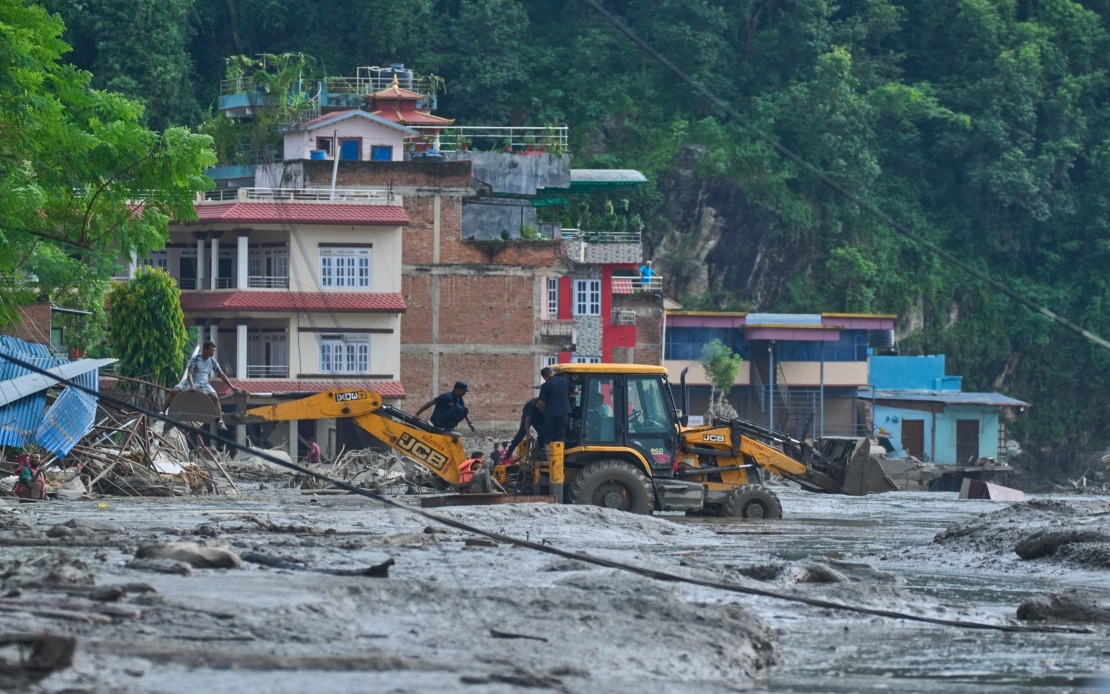
The Nepal-China border region has been struck by a humanitarian catastrophe, with flash floods and cascading mudslides claiming at least 160 lives and leaving more than 680 people unaccounted for, according to authorities on both sides of the frontier. The disaster, which intensified on Wednesday, has triggered the largest cross-border search and rescue operation in the region in recent years, involving military personnel, police forces, and emergency responders equipped with advanced technology.
Nepalese rescue teams have so far pulled 157 bodies from the debris and waters, while successfully extracting 54 survivors from the worst-affected zones. The scale of disappearances underscores the violence and speed of the natural disaster—entire groups of trekkers, workers, and locals were swept away in moments by torrents of water and cascading earth. Meanwhile, Chinese state media reported three confirmed fatalities and 265 persons missing in the southern Tibet region, with the mudslide near Gyirong Port, a key international border crossing, causing particular devastation in Xizang Autonomous Region.
The missing persons represent a truly international tragedy. Among those unaccounted for are tourists and travellers from Nepal, India, the United Kingdom, South Africa, Malaysia, Australia, and the Netherlands—a reflection of how the Nepal-China border region has become increasingly popular for trekking and pilgrimage tourism in recent years. The South Korean Foreign Ministry confirmed that eight of its nationals are missing, with a further ten stranded in Nepal following the floods. Authorities are still working to confirm the nationalities of hundreds of additional missing persons, many of whom were engaged in various activities when the disaster struck.
The disaster has exposed the vulnerability of crucial infrastructure serving both nations and the region's tourist industry. Nepalese government figures reveal that at least 19 bridges have been completely swept away, while approximately 40 kilometres of roadway has been rendered impassable. Thirteen hydropower projects, which supply electricity across Nepal and employ thousands of workers, have suffered severe damage or been destroyed entirely. Speaking before parliament, Foreign Minister Sishir Khanal painted a bleak picture of widespread destruction across the Rasuwa, Dhading, and Chitwan districts, emphasizing how roads, government offices, and essential facilities have been obliterated by the force of the floodwaters.
The casualties among security and project personnel underscore how indiscriminately the floods struck. According to the Nepalese Prime Minister's Office, 44 army personnel remain missing, along with 28 police officers, 13 armed police personnel, and 60 civilian employees working on various hydropower initiatives. These workers, many stationed in remote areas near the border, had little warning and limited means of escape as water levels rose dramatically and unstable slopes gave way. The initial tally of missing tourists and travellers stood at 484, comprising 391 foreign nationals and 93 Nepalese citizens—figures that underscore how the region's appeal as a trekking and spiritual destination had drawn large numbers of visitors at the time of the disaster.
The area around Rasuwagadhi and the Langtang trekking region, among Nepal's most celebrated destinations, has become a scene of devastation and uncertainty. Many of the missing were trekkers who had ventured into these mountain valleys, while others were travellers heading toward Mount Kailash and Lake Mansarovar on the Tibetan plateau—sacred sites that draw pilgrims and adventurers from across Asia and beyond. The disruption to this vital route has broader implications for regional tourism and the livelihoods of communities dependent on trekking and hospitality services.
China's response has been swift and commanding. President Xi Jinping issued direct orders for all available rescue resources to be mobilized, emphasizing the need to evacuate residents in danger and ensure rapid medical treatment for the injured. The mudslide near Gyirong Port has severed road access to this major international crossing, while simultaneously cutting communications and electrical power to affected areas—complications that have hindered rescue coordination and left stranded groups isolated. Xinhua News Agency reported that authorities in Xizang have deployed multiple teams to search for survivors, though heavy terrain and ongoing weather hazards continue to impede operations.
Nepal's capital, Kathmandu, has mobilized its medical infrastructure to prepare for the incoming injured. Government hospitals and medical facilities operated by security agencies have been cleared to accommodate flood victims, reflecting recognition that the disaster will strain health services for weeks or months. India has already responded to its neighbour's plight by dispatching ten tonnes of humanitarian assistance, disaster relief supplies, and essential medicines. Indian Prime Minister Narendra Modi spoke directly with Nepalese Prime Minister Balendra Shah to express condolences and pledge India's full support for rescue and reconstruction efforts.
The disaster carries implications extending beyond the immediate border region. Bihar state officials in neighbouring India have been instructed to maintain constant vigilance over embankments and monitor water levels given the potential for downstream flooding. Round-the-clock patrols have been initiated in sensitive districts, reflecting concerns that catastrophic events on the Nepal-China border can trigger cascading impacts across South Asia's interconnected river systems. The Ganges and its tributaries, which receive drainage from the Himalayan foothills affected by these floods, remain of critical concern to regional governments.
The incident also highlights the increasing risks posed by climate variability and extreme weather in the Himalayan region. The combination of intense precipitation, unstable terrain, and concentrated tourism in narrow valleys creates conditions where natural disasters can claim large numbers of lives in minutes. For Malaysia and other nations with citizens caught in the disaster, the event underscores the need for better coordination among countries on cross-border emergency response protocols and improved infrastructure safety standards in high-risk mountainous regions that attract international visitors.

