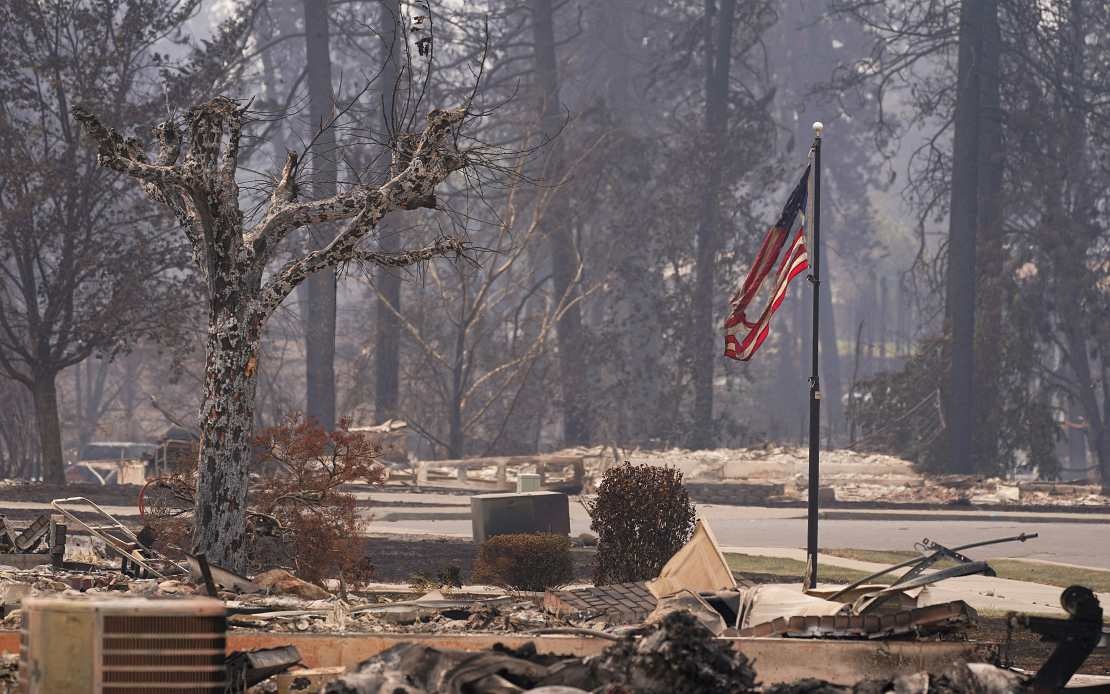
A humanitarian crisis is unfolding in Washington state as an unprecedented wave of wildfires has displaced more than 65,000 residents from their homes. The American Red Cross confirmed the massive evacuation figure on Monday, as multiple blazes continue to spread across the region, transforming entire neighbourhoods into ash and rubble. The scale of the disaster underscores the growing vulnerability of American communities to extreme wildfire events, a phenomenon increasingly familiar to observers across the Pacific Rim, including those in fire-prone regions of Southeast Asia.
Destructive wildfires are not merely natural phenomena in modern times—they frequently intersect with criminal activity. Spokane County Sheriff John Nowels announced at a press conference that law enforcement had arrested Aaron F. Farinacci, a 37-year-old man, on a first-degree arson charge in connection with the Old Trails Fire. Farinacci was taken into custody on Monday afternoon and held on a substantial $1 million bond, suggesting authorities view the alleged offence as sufficiently serious to warrant stringent conditions. The arrest raises uncomfortable questions about how often wildfire catastrophes result from deliberate human action rather than natural causes alone.
The toll on infrastructure has been staggering. Preliminary damage surveys indicate that the advancing flames have already consumed more than 700 homes, concentrated primarily in Spokane County. The American Red Cross, which mobilised resources rapidly following the initial evacuation orders, has been coordinating relief efforts for displaced families who fled with minimal warning. The loss of over 700 residential structures represents not merely physical property destruction but the displacement of entire family units, many of whom now face uncertainty about whether their homes and possessions will survive the continuing threat.
The Spokane Complex Fire, managed by a dedicated incident management team, has burned 8,026 acres across Spokane and Stevens counties since the weekend began. Critically, containment efforts remain at zero percent, meaning firefighters are still in the early, most dangerous phase of combating the blaze. However, meteorological conditions have begun shifting in favour of fire suppression crews. Improving weather patterns have allowed incident management teams to advance defensive lines and create firebreaks more effectively, suggesting that the worst may be passing, though the threat remains far from neutralised.
The situation extends far beyond the Spokane area, with other regions of the state facing even more severe conflagrations. The Sinlahekin fire has grown to a colossal 85,000 acres since being ignited by lightning on July 26, requiring the deployment of more than 820 personnel in a sustained firefighting operation. Like the Spokane Complex Fire, the Sinlahekin blaze remains entirely uncontained. Meanwhile, the Little Giant Fire, which erupted northwest of Leavenworth within the Okanogan-Wenatchee National Forest, has consumed 51,298 acres across federally managed timberland. The sheer acreage affected—tens of thousands of hectares across multiple fires simultaneously—illustrates the unprecedented scale of the current crisis.
Governor Bob Ferguson has provided a cautiously reassuring update regarding the human toll, though the situation remains fluid. Authorities have successfully accounted for nearly all residents who activated emergency assistance protocols, though officials continue attempting to establish contact with 14 individuals to confirm their wellbeing. The governor clarified that these 14 people are not classified as missing persons but rather as individuals with whom authorities simply wish to verify safety status given the evacuation's chaotic nature. Most significantly, no deaths have been confirmed as of the latest official statement, a mercy that has been absent from other major wildfire events.
The Washington state wildfires possess particular relevance for Malaysian and Southeast Asian policymakers and emergency management professionals. While the climatic and geographical contexts differ substantially, the incidents demonstrate how modern communities must grapple with mass evacuation logistics, real-time communication with dispersed populations, and coordination between multiple emergency agencies. The role of the American Red Cross in Washington mirrors the functions performed by humanitarian organisations across Asia during disasters, from typhoons in the Philippines to flooding in Thailand. The comprehensive nature of the response—combining law enforcement, forest service personnel, local authorities, and voluntary organisations—reflects best practices applicable globally.
Moreover, the arson charge against Farinacci introduces a complication that transcends simple natural disaster response. Criminal negligence or deliberate arson as a cause of massive wildfires presents both investigative challenges and prevention difficulties. The $1 million bond and first-degree arson charge suggest prosecutors believe they have substantial evidence. For Southeast Asian countries struggling with forest fires, whether naturally occurring or human-caused, the Washington case illustrates how criminal accountability intersects with disaster management. Improved intelligence gathering, community awareness programmes, and prosecution of arsonists form part of a comprehensive fire prevention strategy.
The geographical concentration of these fires in Washington's interior and eastern regions, far from the moderate coastal climate, reflects how wildfire geography shapes vulnerability. Spokane County and the surrounding interior plateau region experience hotter, drier summers than western Washington's maritime climate. This variation within a single state mirrors how Southeast Asia experiences vastly different climatic and fire regimes depending on local conditions—the annual burning in Sumatra and Kalimantan differs fundamentally from rare fire events in wetter regions. Understanding regional fire ecology becomes essential for appropriate resource allocation and fire season preparation.
The incident management infrastructure activated in Washington demonstrates how developed democracies mobilise resources during environmental crises. The InciWeb interagency reporting system provides real-time data on fire extent, personnel deployment, and containment status, enabling coordinated decision-making across multiple jurisdictions. Southeast Asian nations, particularly those prone to transboundary haze pollution from regional fires, might benefit from examining whether comparable information-sharing mechanisms exist domestically and regionally. The transparency of American fire reporting contrasts with opacity that sometimes characterises fire management in other jurisdictions.
As firefighting crews continue their labour against the Spokane Complex Fire, Sinlahekin fire, and Little Giant Fire, the broader implications for climate change and disaster preparedness remain evident. The scale of this evacuation—65,000 people—represents a threshold event that tests the capacity of emergency systems. For Malaysia and the wider region, closely monitoring how Washington responds, recovers, and implements prevention measures offers valuable lessons. The arrest of Farinacci reminds policymakers that while natural causes drive many wildfires, human action remains controllable through vigilance and enforcement. The convergence of environmental stress, weather patterns, infrastructure vulnerability, and occasional criminal conduct creates the conditions for catastrophic wildfire events—a challenge that transcends borders and demands continuous institutional preparation.

