Malaysia's Federal Territories have received over 62,000 national flags since the beginning of August as the country gears up for its 2026 National Day and Malaysia Day (HKHM) celebrations. The widespread distribution across Kuala Lumpur, Putrajaya and Labuan represents a comprehensive effort to blanket public spaces, residential neighbourhoods and major thoroughfares with the Jalur Gemilang, transforming the three territories into a sea of red and blue in the coming weeks.
Minister in the Prime Minister's Department (Federal Territories) Hannah Yeoh unveiled the distribution figures at an event launching the Aspirasi Jalur Gemilang: Mural Kemerdekaan programme in Putrajaya. She framed the flag deployment not merely as ceremonial decoration but as a means of fostering genuine patriotic sentiment among Malaysians of all backgrounds and ages. The initiative reflects a broader governmental strategy to use visual symbols of nationhood to strengthen social cohesion during significant national commemorations.
The flags have been positioned strategically along protocol roads—major arterial routes typically reserved for official motorcades and state occasions—as well as throughout commercial districts, government buildings, and neighbourhoods where ordinary Malaysians live and work. This multi-layered approach ensures that the symbol of national identity appears across diverse spaces, from formal institutional settings to intimate residential areas. The strategy effectively extends the reach of official national messaging beyond ceremonial spaces into everyday lived environments.
Yeoh stressed that proper flag etiquette remains a critical concern, particularly as the responsibility for display falls to diverse organisations and individuals with varying levels of familiarity with protocols. She called on Malaysians to educate themselves through readily available online resources detailing the correct orientation, handling and positioning of the Jalur Gemilang. Her emphasis on accessible guidance appears designed to lower barriers to participation, positioning flag display as an inclusive act rather than an exclusive ritual reserved for those with specialised knowledge.
The Minister's remarks underscored a potential tension between encouraging widespread flag display and maintaining standards of proper presentation. Instances of incorrectly displayed national flags—whether inverted, damaged, or positioned improperly—can inadvertently undermine the intended message of patriotic unity. Yeoh specifically cautioned business owners and institutional managers to ensure their staff understand flag protocols before assigning them responsibility for hanging or maintaining flags in their organisations. This approach delegates quality control to individual leadership rather than relying solely on centralised enforcement.
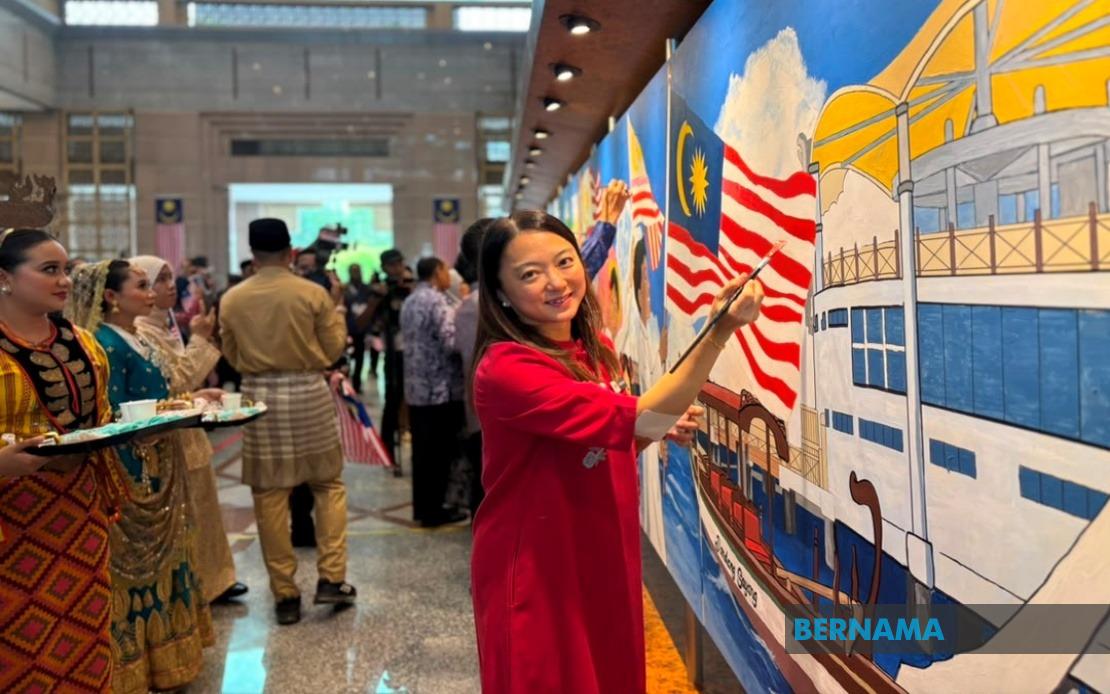
Integrated into the broader HKHM 2026 campaign was the completion of a monumental 25.40-metre Independence Mural at Menara Seri Wilayah, a symbolic centrepiece for the celebrations. The artwork incorporates iconic architectural and geographical landmarks representing each of the three Federal Territories, deliberately weaving together visual elements that distinguish Kuala Lumpur, Putrajaya and Labuan while uniting them under the national flag's imagery. This artistic approach emphasises diversity within unity—a recurring theme in Malaysian national rhetoric.
Yeoh's participation in painting the mural alongside Federal Territories Department personnel served a communicative function beyond the artwork itself. It projected an image of political leadership actively engaged in grassroots expressions of patriotism rather than observing from distance. Such visible participation by government ministers in public ceremonies and creative initiatives helps reinforce messages about national pride whilst generating photographic content for media distribution and social media amplification.
The initiative reflects Malaysia's approach to national observances, which increasingly incorporate creative and participatory elements alongside traditional ceremonial functions. The Jalur Gemilang distribution programme invites voluntary individual and organisational participation in displaying national symbols, creating a distributed expression of patriotism rather than purely top-down mandates. This methodology acknowledges that sustainable national sentiment emerges most powerfully when citizens actively choose to participate rather than merely comply with requirements.
For Malaysian businesses and institutions, the mass distribution of flags presents both opportunity and practical challenge. Commercial establishments and governmental agencies must now navigate the balance between visible patriotic commitment and appropriate presentation standards. The availability of guidance materials and official protocols provides frameworks, yet interpretation and execution remain variable. Organisations failing to display flags correctly risk unintended impressions, whilst those displaying them prominently demonstrate alignment with national messaging during significant commemorative periods.
The timing of the distribution—approximately five months before the 2026 celebrations—allows for gradual acclimation and preparation. Unlike eleventh-hour mobilisation that might appear rushed or superficial, the early rollout suggests sustained commitment to the observances. It also permits institutional planning, staff training, and community awareness-building in advance of the peak celebratory period. This phased approach contrasts with compressed campaigns that attempt to generate patriotic enthusiasm through rapid, intensive efforts.
For the Malaysian population across the Federal Territories, the visible proliferation of national flags throughout public and private spaces creates an immersive environment where national identity becomes practically unavoidable during daily routines. Whether commuting along flagged protocol roads, passing decorated commercial establishments, or observing the national symbol in residential neighbourhoods, citizens encounter repeated visual reinforcement of national belonging. Psychological research on symbol saturation suggests such environmental ubiquity reinforces collective identity through daily exposure.
The inclusion of Labuan alongside Kuala Lumpur and Putrajaya in flag distribution underscores the federal structure's commitment to recognising all three Federal Territories as constitutive components of the nation's administrative and symbolic landscape. Labuan, geographically separated from peninsular Malaysia, sometimes experiences diminished prominence in national campaigns centred on major population centres. Explicit inclusion in HKHM 2026 preparations signals inclusive governance framing.
As Malaysia approaches 2026, the combination of massive flag distribution, official guidance on proper display, creative public artworks, and ministerial participation in grassroots activities creates a multi-dimensional campaign that extends well beyond simple decoration. It represents a deliberate governmental effort to cultivate patriotic sentiment through ubiquitous symbols, accessible participation, and visible leadership commitment during a significant national commemoration.

