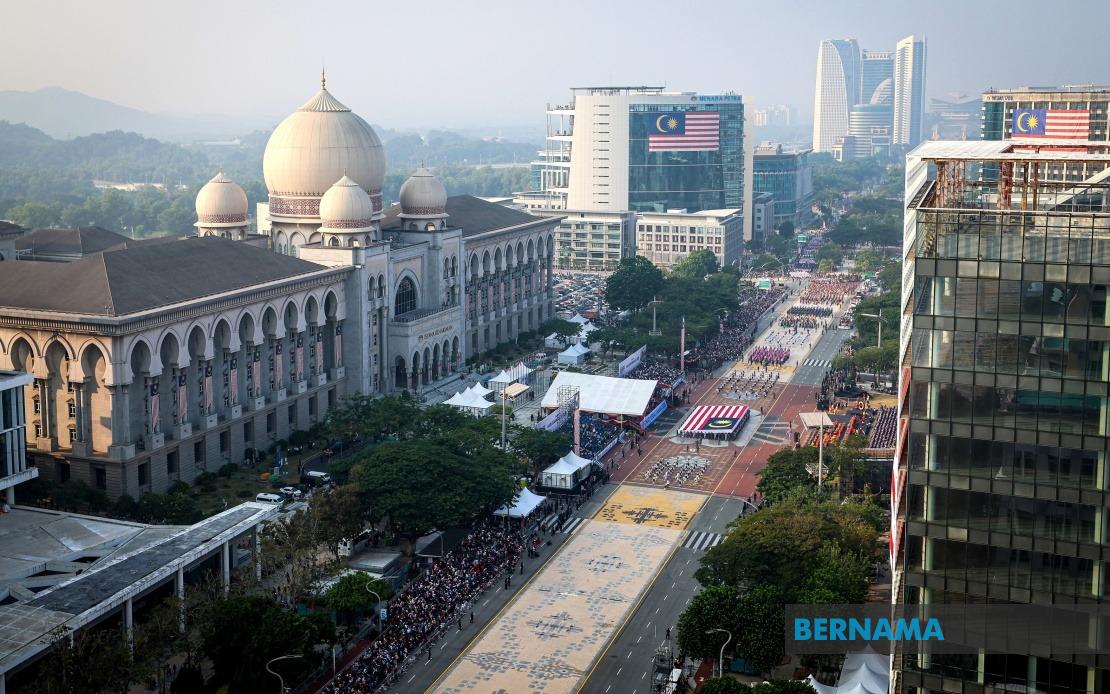
Malaysia's police force is preparing an extensive security operation for the nation's 69th National Day observance scheduled for August 31, 2026, with more than two thousand personnel being positioned throughout Dataran Putrajaya to manage the anticipated influx of celebrants. The Royal Malaysia Police (PDRM) has deployed 2,354 members and officers in a comprehensive arrangement designed to guarantee both public safety and the seamless execution of the festivities, according to authorities who revealed the deployment details following a full-scale rehearsal of the event.
Putrajaya district police chief ACP Aidi Sham Mohamed outlined the scope of the security arrangements, noting that officers will be stationed at strategic points across the venue to oversee both stationary security checkpoints and mobile traffic management operations. The police strategy reflects standard protocols for large-scale national events, with personnel distributed to address potential congestion points and maintain order throughout the celebration grounds. This layered approach seeks to balance accessible public engagement with robust crowd control and emergency response capabilities.
Communications Minister Datuk Seri Fahmi Fadzil confirmed that this year's observance will proceed according to traditional formats, maintaining continuity with how Malaysia marks this significant annual milestone. The 69th National Day celebration carries the theme "Malaysia MADANI: Kesejahteraan Dinikmati," emphasising prosperity and wellbeing as central messaging elements. Organisers are projecting attendance exceeding 80,000 members of the public, representing a substantial gathering that necessitates proportionate security infrastructure and logistical planning.
Authorities have issued detailed guidance for attendees, emphasizing the importance of arriving early to allow adequate time for security processing and venue entry. ACP Aidi Sham advised visitors to familiarise themselves with all regulatory requirements in advance, including designated vehicle parking zones and traffic flow protocols. His public messaging stressed individual responsibility in maintaining orderly conduct, urging families to prioritise their own safety management alongside compliance with official directives.
Parental supervision emerged as a particular focus in official communications, with police specifically urging guardians to maintain close watch over children and personal belongings throughout the event duration. This guidance reflects standard crowd management concerns for large public gatherings, where the combination of excitement, congestion, and unfamiliar environments creates elevated risks for vulnerable attendees. The emphasis on parental awareness represents a proactive approach to reducing preventable incidents during the celebration.
A strict weapons prohibition forms a core element of the security framework, with authorities unambiguously warning against bringing any dangerous implements to Dataran Putrajaya. This prohibition encompasses conventional weapons and any items designed or capable of causing injury, reflecting contemporary security protocols standard across comparable public events globally. The clear messaging aims to establish unequivocal expectations before attendance, deterring potential violations through explicit communication of regulations.
Vehicle management constitutes a significant operational component of the security deployment, with police emphasising the criticality of observing parking restrictions and maintaining traffic flow along designated routes. Unauthorized parking represents a persistent challenge at major public events, as attendees seeking convenience often create bottlenecks and emergency access impediments. The police directive attempts to mitigate these problems through advance education and visible enforcement presence at vulnerable locations.
The rehearsal attended by the Communications Minister provided authorities with operational experience in deploying the full complement of personnel, testing coordination mechanisms and identifying any procedural refinements needed before the actual event. Such practice exercises serve multiple functions: validating resource allocation assumptions, training personnel in their assigned roles, and revealing unforeseen logistical challenges that can be addressed before the main celebration. The involvement of ministerial representation underscores the political significance government attaches to the event's successful execution.
For Malaysian residents planning attendance, the scale of police presence and the explicit guidance provided create both reassurance and obligation—security arrangements function optimally when public cooperation complements official efforts. The 80,000-plus projected attendance will transform Dataran Putrajaya into a temporary hub of national cultural expression, making individual adherence to safety protocols collectively consequential. Visitors should interpret the detailed advisories not as burdensome restrictions but as frameworks enabling safe participation in shared national commemoration.
The deployment reflects broader patterns in how Southeast Asian nations manage large public gatherings, balancing celebratory accessibility with security imperatives in an era of heightened risk awareness. Malaysia's approach, emphasizing advance communication, visible uniformed presence, and clear consequence frameworks, aligns with international best practices for crowd management at high-attendance events. The police operation signals government commitment to facilitating meaningful public participation in National Day while maintaining the institutional order necessary for peaceful collective observance.

