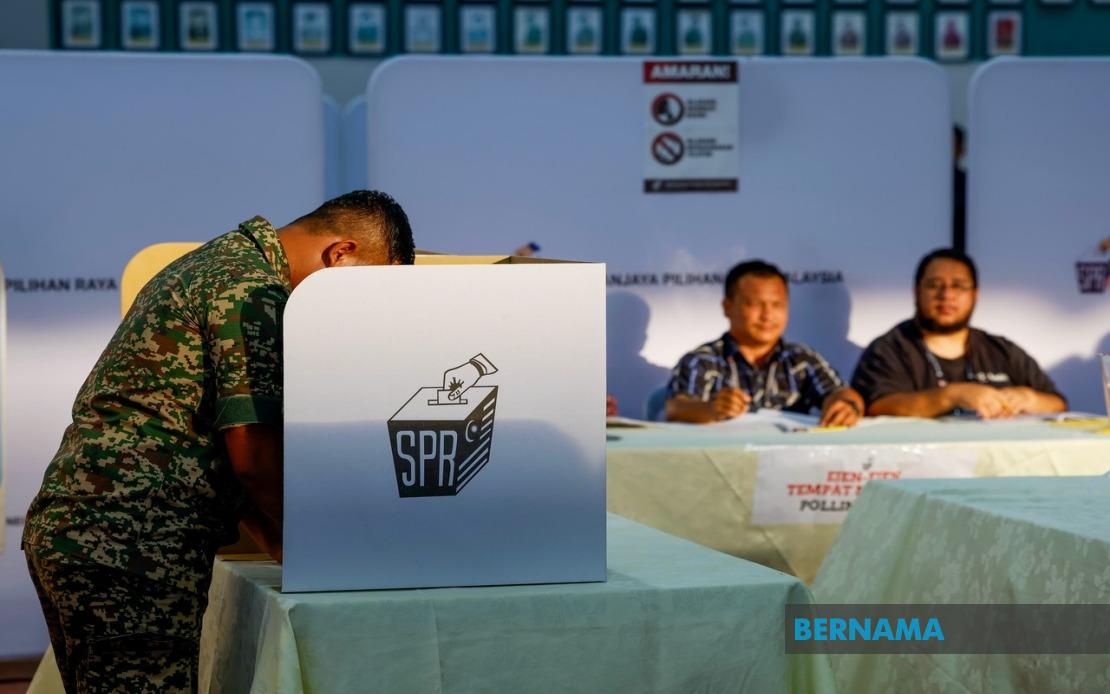
The 16th Negeri Sembilan state election proceeded smoothly on July 28 as early voting got underway, with preliminary figures showing solid participation rates among designated voters in the morning hours. The Election Commission reported that 14.31 per cent of early voters had cast their ballots by 9am, reflecting the initial engagement of security personnel and their families with the electoral process ahead of general polling later that day.
The early voting cohort comprised two distinct groups: 1,431 military personnel exercising their voting rights, alongside 925 police officers. Significantly, both groups were permitted to bring their spouses to participate in the same early voting window, recognising the practical constraints faced by security sector families during standard election periods. This arrangement reflects the EC's ongoing effort to maximise participation across all demographic categories while maintaining the integrity of the electoral process.
To facilitate this early voting phase, the EC established 38 polling centres that opened uniformly at 8am across Negeri Sembilan. These centres were strategically distributed to accommodate 22,389 registered early voters overall, providing accessible voting locations for military and police personnel stationed in various parts of the state. The simultaneous opening ensured equitable access and prevented bottlenecks that might discourage participation during the morning rush.
The voting schedule reflected operational considerations unique to each centre. Rather than imposing a uniform closing time, the EC allowed staggered closures beginning at noon and extending until 5pm, varying according to each centre's location and the number of registered voters assigned to it. This flexibility acknowledged the different circumstances at various polling stations while ensuring that all early voters had adequate opportunity to fulfil their civic obligation within a clearly defined timeframe.
The broader electoral contest saw 103 candidates competing across 36 state assembly seats, indicating a moderately contested election landscape. This candidate-to-seat ratio suggested that certain constituencies would feature two-way contests, whilst others might see three-way or multi-candidate battles, potentially affecting voting patterns and outcomes. The distribution of candidates across constituencies would significantly influence both campaign intensity and voter choice dynamics in different parts of the state.
General polling was scheduled for the same day, July 28, with 889,490 registered voters eligible to cast ballots during the standard voting period. This substantially larger electorate compared to early voters underscored the significance of the main polling day in determining the eventual composition of the Negeri Sembilan state assembly. The timing of general voting on the same day as early voting ensured a consolidated election process rather than splitting participation across multiple days.
For Malaysian electoral observers, the Negeri Sembilan election represented an important mid-term test of political sentiment in one of the country's more closely contested states. The state's political landscape had experienced considerable shifts in recent years, and this election provided voters with an opportunity to affirm or reassess their preferred representatives. The participation patterns among early voters, typically comprising disciplined institutional voters with relatively high turnout propensity, often foreshadowed broader engagement levels across the general electorate.
The early voting mechanism itself has become an increasingly important feature of Malaysian elections, serving to distribute voter load across multiple days whilst providing special provision for security sector employees whose duties might otherwise prevent standard polling day participation. By July 2023, when this Negeri Sembilan election took place, the EC had refined procedures for managing early voting based on experience from previous elections, though logistical challenges and organisational demands remained considerable.
From a regional perspective, Negeri Sembilan's electoral performance carries implications beyond its state boundaries. As a state bordering the Selangor federal territory and lying within the Klang Valley economic corridor, political developments in Negeri Sembilan influence broader Selangor metropolitan dynamics. The state's political colour and the composition of its state assembly can affect collaborative efforts on regional development, transport planning, and environmental management that span multiple jurisdictions.
The election also tested public confidence in electoral procedures during a period when Malaysian democracy was navigating complex transitions. Smooth execution of the early voting phase, reflected in the reported participation figure and the coordinated opening of 38 centres, demonstrated the EC's operational capacity to manage logistically challenging electoral events across dispersed locations. Such procedural competence underpins public confidence in electoral integrity, a crucial foundation for democratic legitimacy in any system.

