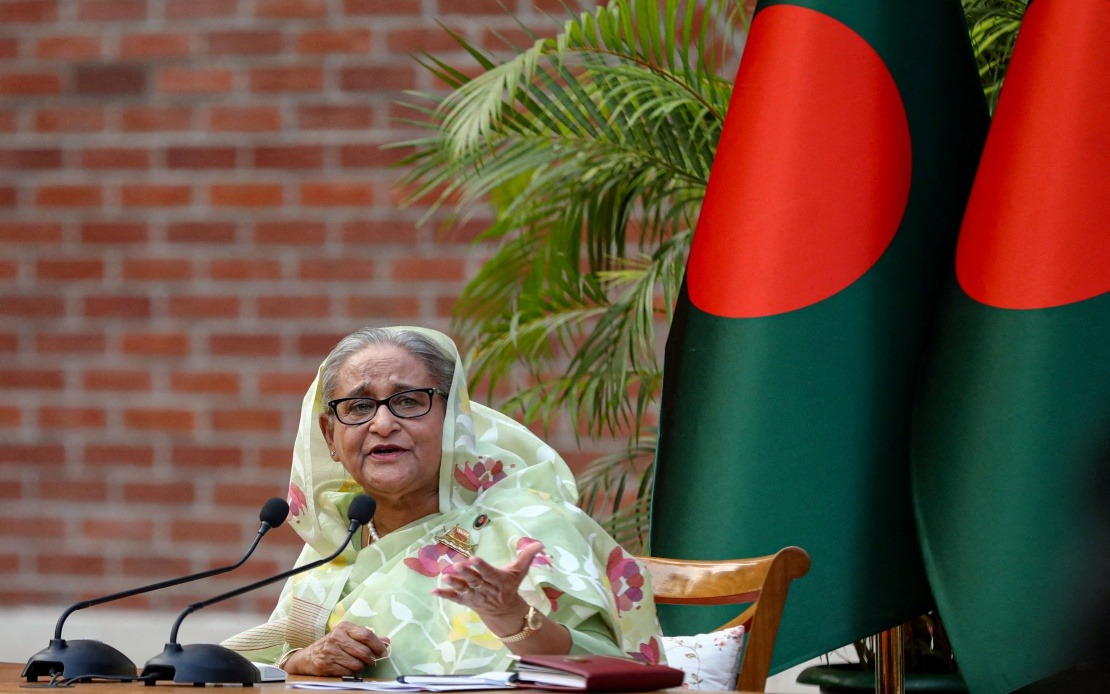
Sheikh Hasina, the 78-year-old former Prime Minister of Bangladesh who fled the country in August 2024 amid violent anti-government unrest, has publicly committed to returning to face justice despite the existential threat posed by her death sentence. In remarks to Kyodo News, Hasina stated her resolve to appear before the courts, acknowledging the grave personal consequences she may encounter including imprisonment or execution. Her declaration comes more than a year after she abandoned her position and sought refuge in India as mass protests engulfed Dhaka, fundamentally reshaping the nation's political landscape.
Hasina's conviction emerged from Bangladesh's war crimes tribunal in November 2025, which held her responsible for crimes against humanity linked to a brutal crackdown on student-led demonstrations. The unrest originated from a court decision in June 2024 that restored a 30 percent employment quota for descendants of those who fought in Bangladesh's 1971 independence war. What began as focused student grievances over educational opportunity rapidly metastasised into a sweeping movement against Hasina's government, drawing diverse segments of society into the streets and ultimately destabilising her administration after more than 15 years in power.
The human toll of the turmoil proved devastating. According to United Nations assessments, approximately 1,400 people lost their lives during the unrest, with the majority shot by security forces operating under the government's authority. Hasina has consistently maintained that she issued no orders for lethal force and suggests instead that opposition figures orchestrated the protests as a deliberate strategy to undermine her hold on power. She has proposed that independent international forensic experts examine the circumstances of individual deaths, arguing that such an investigation would exonerate her from direct responsibility for the bloodshed.
Human Rights Watch has expressed serious reservations about the legitimacy of the tribunal proceedings, noting that Hasina was tried and convicted in her absence without opportunity for meaningful defence. The rights organisation simultaneously acknowledged the validity of investigating alleged abuses perpetrated during her tenure, establishing the tension that characterises Bangladesh's current justice processes. This ambiguity reflects broader concerns across Southeast Asia about balancing accountability with procedural fairness when leaders flee their countries.
New Delhi has confirmed receipt of Bangladesh's extradition request but has not yet acted decisively on the matter. India's Ministry of External Affairs stated that the request is under examination within the context of applicable legal and judicial frameworks, suggesting a cautious diplomatic approach. Hasina's location in India, where she retains historical connections and political allies, complicates straightforward enforcement of Bangladesh's demands. The situation illustrates the complex dynamics that arise when regional neighbours must navigate competing interests of justice, diplomacy, and their own strategic relationships.
Tarique Rahman, who became Prime Minister following elections in February 2026 that brought the Bangladesh Nationalist Party to power, signalled his government's determination to prosecute Hasina. Through his information adviser Zahed Ur Rahman, he indicated that authorities would pursue Hasina's return and guarantee her the opportunity to mount a legal defence. This commitment suggests that the new administration views accountability for the 2024 violence as essential to its political legitimacy and national healing.
Hashina's political trajectory spans multiple decades and several electoral cycles. She served as Prime Minister across five separate tenures, beginning in June 1996 and extending through her most recent period from January 2009 until August 2024. Her Awami League party, which she has led and which dominated Bangladesh politics during much of her tenure, has been wholly banned since May 2025. This prohibition represents an extraordinary step that effectively excludes her political faction from electoral competition and removes institutional platforms for her supporters.
During her governance, Bangladesh experienced an incident that reverberated far beyond national borders and took on particular significance for Japan and other development partners. In July 2016, Islamist militants stormed the Holey Artisan Bakery in Dhaka, resulting in the deaths of 20 hostages alongside two police officers. The victims included nine Italian nationals, seven Japanese, two Bangladeshis, one Indian, and one American of Bangladeshi origin. Seven of the militants responsible were initially sentenced to death in 2019, though these sentences were later commuted to life imprisonment. The Japanese victims had been engaged in work related to a rapid railway development project supported by the Japan International Cooperation Agency, underscoring how Bangladesh's internal instability can directly impact international development cooperation and foreign investment.
Hashina's vision for Bangladesh's future emphasises reconciliation without amnesty. She has articulated a framework where the nation requires healing but where those accountable for crimes must undergo legitimate judicial processes rather than escaping consequences. This formulation appeals to international audiences and those seeking both stability and accountability, though it raises complex questions about how she would reconcile such principles with her own situation. She has stressed that Bangladesh's stability matters not merely domestically but regionally and globally, particularly for Japan, China, and other development partners who have invested substantially in the country's infrastructure and economic trajectory.
The interim government established by Muhammad Yunus, the Nobel Peace Prize laureate and former microfinance pioneer, represented a transition period following Hasina's departure. Yunus served as chief adviser after student protest leaders nominated him for the role, embodying hopes for reset and reform. The subsequent election victory of the Bangladesh Nationalist Party and Rahman's ascendancy to the premiership indicate that voters rejected a continuation of Awami League dominance. These political shifts establish new power structures within which Hasina's promised return must be situated.
For regional observers and policymakers across Southeast Asia, the Bangladesh situation presents instructive lessons about the intersection of mass protest, security force response, political transitions, and international justice expectations. Malaysia and other neighbouring states watch closely as Bangladesh grapples with questions about how to establish legitimate authority following contested violence. Hasina's pledge to return and face courts, though rhetorically compelling, depends ultimately upon her willingness to abandon the safety of Indian refuge and upon India's willingness to facilitate her departure. The coming months will test whether her commitment translates into concrete action or remains a symbolic assertion designed to maintain her political relevance.
Looking forward, Hasina has framed the next decade as a potential period of Bangladesh's recovery and renewal, contingent upon restoration of democratic processes and popular sovereignty in governance. This vision presupposes both her own political redemption and a reconfiguration of Bangladesh's political structures to accommodate her return. Whether the current government of Tarique Rahman and the broader Bangladeshi society will accept such a restoration remains uncertain, but the international dimensions of this conflict—involving India, justice norms, and development partnerships—ensure that Bangladesh's internal struggle will continue resonating across South and Southeast Asia.

