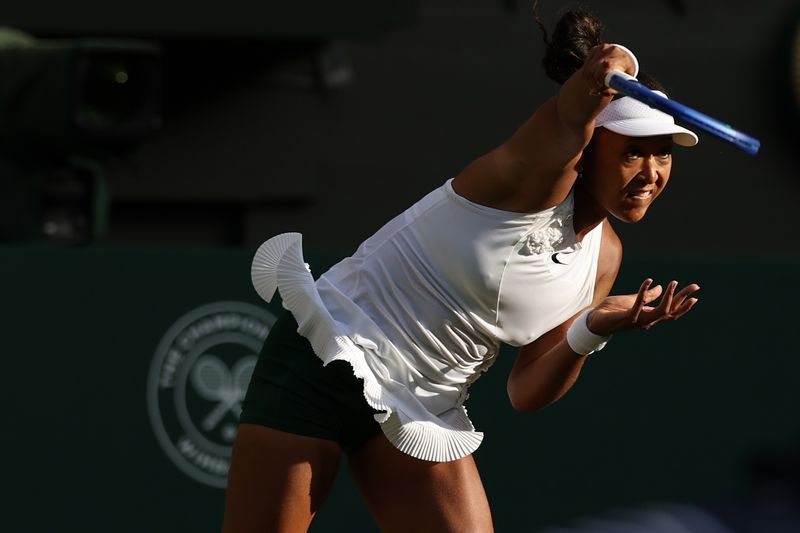
Naomi Osaka capped a striking return to elite competition by dismantling world number one Aryna Sabalenka 6-2 7-6(2) at Wimbledon, reaching the quarter-finals for the first time and delivering the kind of commanding tennis that earned her four Grand Slam titles. The 14th-seeded Japanese player arrived at Centre Court in a striking kimono-inspired walk-on outfit paying homage to the protagonist of Quentin Tarantino's Kill Bill, and departed having completed an emphatic statement of intent by thoroughly outplaying the favoured Sabalenka across two sets.
Osaka's victory represents far more than a single match victory; it signals a shifting landscape in women's tennis at this year's championship. The elimination of the tournament's top three seeds has now become mathematical certainty, following earlier defeats for defending champion Iga Swiatek and 2022 winner Elena Rybakina. Coupled with Barbora Krejcikova's loss to fellow Czech Karolina Muchova in the fourth round, the stage is set for an unprecedented occurrence—a ninth consecutive first-time Wimbledon champion in the women's draw.
The absence of the conventional favourites carries particular significance for Malaysian and Southeast Asian tennis followers who have watched these top-ranked players dominate recent seasons. Such wholesale upheaval at grass-court level demonstrates how form fluctuates across different surfaces and how the pressure of defending elite rankings can expose vulnerabilities that competitors further down the seeding list may not carry.
Osaka herself acknowledged the magnitude of her performance, particularly given her journey back from maternity leave and her recent struggles against Sabalenka. The three consecutive losses to the Belarusian power-hitter had rankled, but the Japanese champion used that frustration as fuel. She exhibited remarkable composure and precision, combining the explosive groundstroke play that defined her earlier championship years with the maturity that comes from extended time away from professional competition.
Meanwhile, on the men's side, Novak Djokovic progressed through a gruelling encounter against qualifier Roman Safiullin, though the 39-year-old Serbian champion appeared thoroughly dissatisfied with his performance. The 7-6(6) 6-3 3-6 6-3 scoreline advanced him through but, by his own admission, lacked the fluidity and enjoyment he typically demands from his tennis. Djokovic's reflective post-match comments—suggesting he had neither felt comfortable on court nor experienced satisfaction—revealed a competitor acutely aware of his own exacting standards, even whilst securing victory.
Despite the laboured nature of his progression, Djokovic reached his 17th Wimbledon quarter-final and etched another historic milestone by claiming his men's record 106th Wimbledon match victory, surpassing Swiss legend Roger Federer's previous benchmark. For a player approaching his 40th year, continuing to rewrite record books at grass-court level underscores a competitive hunger that defies conventional athletic aging patterns.
Djokovic's path forward presents a significant obstacle in the form of Canadian third seed Felix Auger-Aliassime, whom he must negotiate before any prospect of facing defending champion Jannik Sinner in the semi-finals. Auger-Aliassime himself required a gruelling near-four-and-a-half hour marathon against Spain's Alejandro Davidovich Fokina, ultimately prevailing 6-7(4) 7-6(6) 6-3 6-7(2) 6-1 in a match that ended with heated words exchanged at the net—a testament to the emotional and physical toll of extended rallies under Wimbledon's summer conditions.
The tournament has claimed notable casualties among other established contenders. Polish eighth seed Hubert Hurkacz suffered heartbreak when forced to retire during the fifth set of his encounter with German veteran Jan-Lennard Struff, who at 36 years old achieved a first Grand Slam quarter-final appearance—a milestone that underscores how Wimbledon's unique variables can reshape hierarchies established on other surfaces.
Osaka's next opponent will be tenth seed Karolina Muchova, the Czech who dispatched 2024 champion Krejcikova in a tightly contested 7-5 5-7 6-3 affair. This quarter-final matchup promises compelling tennis between two players recently resurgent on the grass surface.
The American presence in the women's draw has strengthened unexpectedly, with five players reaching the round of 16—their most substantial representation at this stage since 2002. Fourth seed Jessica Pegula demonstrated her experience by dispatching 18-year-old Iva Jovic 4-6 6-3 6-1 on Court One, a victory that matched Pegula's best previous Wimbledon performance. Should American fifth seed Coco Gauff overcome Switzerland's Belinda Bencic, the possibility of an all-American clash between Pegula and Gauff would further underscore the strengthening competitive depth of the United States women's tennis programme.
For Malaysian observers of international tennis, Wimbledon's unpredictability this year serves as a reminder that Grand Slam competitions remain susceptible to disruption by players outside the narrow elite seeding positions. Osaka's resurgence illustrates how time spent away from competition, whether for injury recovery or personal circumstances, need not signal permanent decline for world-class athletes who maintain their competitive instincts and physical preparation.

