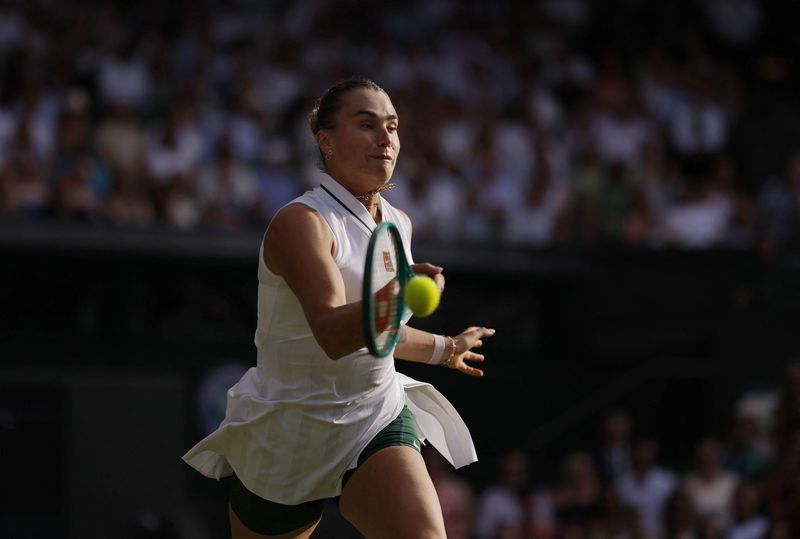
Naomi Osaka delivered a masterclass in composure and precision on Centre Court at Wimbledon on Sunday, dismantling world No. 1 Aryna Sabalenka with a comprehensive 6-2 7-6(2) victory that fundamentally altered the complexion of the women's championship. The 14th-seeded Japanese player's inspired performance, which produced her most significant result since returning to professional tennis following maternity leave, has suddenly opened the tournament door for a wider pool of contenders just as the event reaches its crucial closing stages.
The collision between two elite champions—Osaka and Sabalenka's combined eight Grand Slam titles underscored the match's significance—promised an absorbing Centre Court spectacle. Yet the contest unfolded with stark asymmetry. The early stages proved particularly brutal for Sabalenka, whose formidable power-driven game, usually a devastating asset on grass courts, conspicuously malfunctioned. The opening set lasted barely half an hour as Osaka seized control with immediate breaks of serve, leaving Sabalenka visibly frustrated and desperately seeking answers to her opponent's sharp tactical execution.
Sabalenka's predicament illustrated a fundamental tennis principle: even the world's most dominant players can be neutralised when their primary weapons fail to function. Her typically explosive serving and aggressive baseline game, which had propelled her through three consecutive Grand Slam semi-finals before arriving at Wimbledon, found little traction against Osaka's crisp returns and intelligent court positioning. The 28-year-old champion's mounting frustration manifested in audible outbursts and occasional equipment strikes, yet these emotional releases offered no respite from her tennis troubles.
The second set threatened briefly to provide the drama the crowd craved, as Sabalenka steadied her game and engaged Osaka in lengthier exchanges. However, Osaka's temperament proved unshakeable. In a critical moment, the Japanese player snapped Sabalenka's remarkable streak of 21 consecutive tiebreak victories across Grand Slam tournaments, a record that had seemed almost unbreakable. That breakthrough, sealed through superior positioning and clean stroke execution in the tiebreak, crystallised the fundamental difference between the two competitors on this particular afternoon.
Osaka's victory carries extraordinary significance beyond the fourth-round scoreline. The complete elimination of the tournament's top three seeds—Sabalenka's exit following Saturday's third-round defeats of defending champion Iga Swiatek and second-ranked Elena Rybakina—has created an unprecedented opening in the women's draw. Where the seeding structure had appeared to narrow the championship focus toward predictable contenders, the sudden absence of the favourites now permits emerging players and lower-ranked challengers realistic pathways toward the final rounds.
For Malaysian and Southeast Asian tennis observers, Osaka's resurgence holds particular interest. Her decision to step away from competition during pregnancy, maintain her physical conditioning, and return to tournament play demonstrated resolve and perspective that contrasts sharply with conventional athletic narratives. Her quarter-final berth—a landmark achievement in her gradual rehabilitation as a competitive force—positions her against Czech 10th seed Karolina Muchova, a matchup that remains genuinely open given recent performances.
Osaka's recent form on the professional circuit had been uncertain following her 2024 comeback, yet this Centre Court triumph announced her return with unmistakable authority. Her composed demeanour throughout the contest, particularly during the emotionally charged tiebreak, suggested an athlete whose psychological framework has been fundamentally reshaped by her time away from elite competition. She spoke afterwards of rediscovering joy in tennis itself, an emotional register often absent from contemporary player interviews dominated by technical analysis and tactical discussion.
Both players share a significant career distinction as hardcourt specialists, each possessing four Grand Slam titles accumulated primarily on Australian Open and US Open surfaces. That both have now competed at grassroots' highest level illustrates the increasing versatility required of modern professional champions. However, their distinct trajectories merit examination: Osaka captured all four of her Slam titles before Sabalenka claimed her maiden Grand Slam victory, yet the Belarusian has since established herself as the world's dominant player while Osaka's career experienced complications.
Historically, these competitors had met just once across Grand Slam competition, nearly eight years prior when Osaka prevailed during her maiden US Open triumph. That distant encounter provided psychological ammunition for Osaka's Sunday performance; she remarked on having lost three successive matches against Sabalenka in recent years, suggesting this victory carried weight extending beyond the fourth-round context. The extended absence from competition, rather than diminishing her competitive edge, appears paradoxically to have restored her hunger and focus.
Sabalenka's post-match commentary, delivered within minutes of departing the court, illuminated her emotional state. The world No. 1 acknowledged simply wishing to escape tennis temporarily, a candid admission reflecting the psychological toll of unexpected failure at the tournament's highest stakes. For a player accustomed to advancing deep into championships and consolidating her status as the circuit's most consistent performer, this fourth-round elimination represents a significant setback in her calendar year objectives.
The match's deeper implications extend throughout the broader championship architecture. With the favourites removed, players such as Muchova, alongside remaining seeds and unseeded competitors, now confront significantly enhanced realistic opportunities for advancing toward the championship stage. The unpredictability generated by simultaneous elimination of the top three seeds creates genuine sporting theatre and uncertainty—precisely the elements that elevate tournaments from predictable coronations into compelling competitions.
Osaka's sartorial choices, influenced by Japanese aesthetic traditions evident in her courtside walk-on attire, have attracted considerable attention throughout the fortnight. Yet her Centre Court performance confirmed that genuine influence derives not from visual presentation but from tennis excellence. The quality of her service returns, her positional excellence, and her capacity to remain emotionally centred amid high-pressure situations all contributed to her triumph. These technical and psychological dimensions now position her as a meaningful contender for the tournament rather than a sentimental story of an athlete rediscovering her sport.
As Wimbledon's women's championship enters its second week with dramatically altered competitive conditions, Osaka's stunning upset has injected unpredictability and genuine narrative complexity into the remaining matches. The top seed's elimination, combined with her own quarter-final progression, has restructured the mathematical probabilities underpinning the championship trajectory. What appeared likely to become a coronation for the world's most dominant player has instead transformed into a genuinely open competition where multiple contenders possess realistic Grand Slam aspirations.

