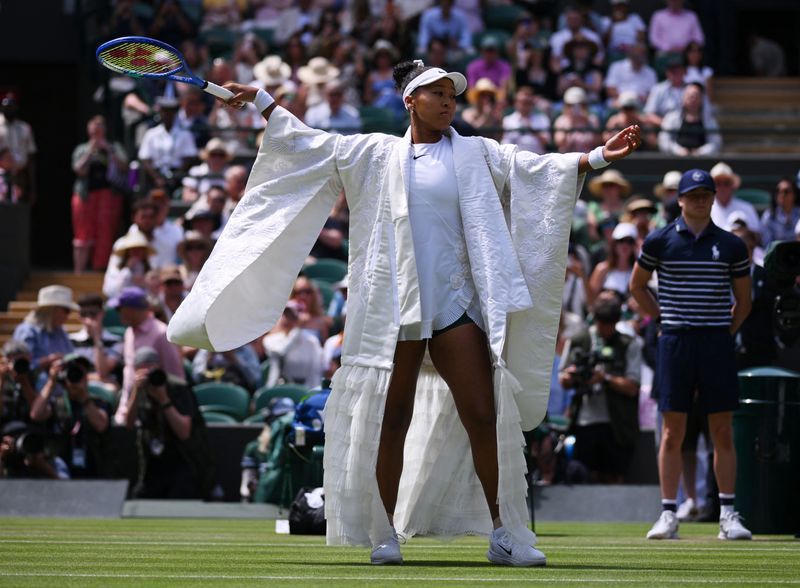
Naomi Osaka's journey through Wimbledon has become a masterclass in balancing sporting excellence with fashion statement-making, and her commanding 6-1 6-3 dismissal of Australian Daria Kasatkina on Friday confirmed she is far more than just a style icon on the All England Club's manicured lawns. The fourth-seeded Japanese champion, returning to top-level competition after health breaks, demonstrated that beneath the carefully curated kimono ensembles and flower-patterned robes lies the steel and tactical acuity that earned her four Grand Slam titles across her career.
Osaka's progression to the last 16 marks her best performance at Wimbledon to date, a significant milestone for a player whose previous campaigns at the tournament had failed to yield deep runs despite her dominance on harder courts. This breakthrough carries particular resonance given the physical and mental struggles that have defined her recent seasons, making her current trajectory both personally meaningful and competitively impressive. The No. 14 seed's comfort on grass courts has visibly improved following tournament appearances in the lead-up to Wimbledon, most notably her run to the Bad Homburg final where she ultimately retired with injury, providing valuable competition and confidence-building moments.
The match itself painted a portrait of a player rediscovering her rhythm and authority. Against the unseeded Kasatkina, Osaka wasted little time establishing dominance, deploying her characteristic blend of power and precision to secure a break in the second game. She consolidated her advantage with a towering forehand that secured a double break, allowing her to navigate the opening set with the kind of efficiency that had characterized her earlier career dominance. The first set fell in just 24 minutes, a statement of intent that suggested Osaka had identified weaknesses in her opponent's approach and was determined to exploit them ruthlessly.
Kasatkina offered resistance in the second set, testing Osaka's composure by forcing the Japanese star to overcome an early deficit and recover from squandering commanding positions. Rather than yielding to frustration, however, Osaka displayed the mental fortitude essential for success at Grand Slams, fighting back from the brink to manufacture two match points. She converted the second opportunity with characteristic style, completing a performance that left no doubt about her competitive hunger and growing confidence on the surface where grass-court specialists have traditionally thrived.
The significance of this victory extends beyond the immediate progression to the last 16. For Malaysian and Southeast Asian observers, Osaka's resurgence carries broader implications for the region's tennis profile. While the subcontinent has produced notable players, sustained representation at the highest levels of Grand Slam competition remains relatively modest. Osaka's journey—marked by setbacks, comebacks, and the determination to reclaim lost ground—resonates with emerging players across Asia who face similar pressures and expectations. Her willingness to address both mental health concerns and physical rehabilitation, rather than continuing under unsustainable conditions, has established her as a countercultural figure in professional tennis.
Osaka's on-court comments reflected a player conscious of her journey and grateful for the opportunity to perform at the highest level. Her reference to having never previously won on Court One highlighted the incremental progress that characterizes even champions' careers at different venues, while her emphasis on taking matches point-by-point demonstrated a philosophical maturity absent from some earlier iterations of her commentary. The response from the Centre Court crowd, which has increasingly embraced her presence despite her relative youth in the sport's pantheon, suggests that her combination of excellence and authenticity resonates with fans beyond traditional tennis constituencies.
Awaiting Osaka in the quarter-final round stands a daunting proposition: either world No. 1 Aryna Sabalenka or former French Open champion Jelena Ostapenko. Both opponents present contrasting challenges that will test different facets of Osaka's game. Sabalenka's overwhelming power and aggressive baseline approach demand precision and patience from opponents, while Ostapenko's unpredictability and creative shot-making require the kind of tactical flexibility that Osaka has consistently demonstrated. The looming matchup will provide further evidence of whether Osaka's Wimbledon run represents a genuine comeback or merely a strong fortnight on a surface that has historically proven secondary to her preferred hard courts.
The broader context surrounding Osaka's Wimbledon campaign cannot be divorced from her highly publicized mental health advocacy and refusal to engage with traditional media constraints that she found psychologically damaging. Her decision to prioritize wellbeing over adherence to conventional professional obligations marked a watershed moment in tennis culture, challenging long-established hierarchies and opening conversations about player autonomy and psychological support. This year's return to Grand Slam competition with clearly renewed energy suggests that her earlier decisions, controversial as they were, have enabled sustainable engagement with the sport rather than burnout-driven retirement.
As Osaka progresses deeper into Wimbledon, her campaign will inevitably inspire discussions about the intersection of personal brand management, fashion influence, and competitive performance in elite women's tennis. The perception that style and substance exist in tension—that dedication to visual presentation somehow compromises athletic commitment—has plagued female athletes across numerous sports. Osaka's convincing victories demonstrate that these categories are not mutually exclusive, that a player can celebrate her identity and cultural heritage through distinctive fashion choices while simultaneously executing the technical and strategic excellence that Grand Slam success demands. Her presence at Wimbledon, therefore, carries significance well beyond tournament standings.

