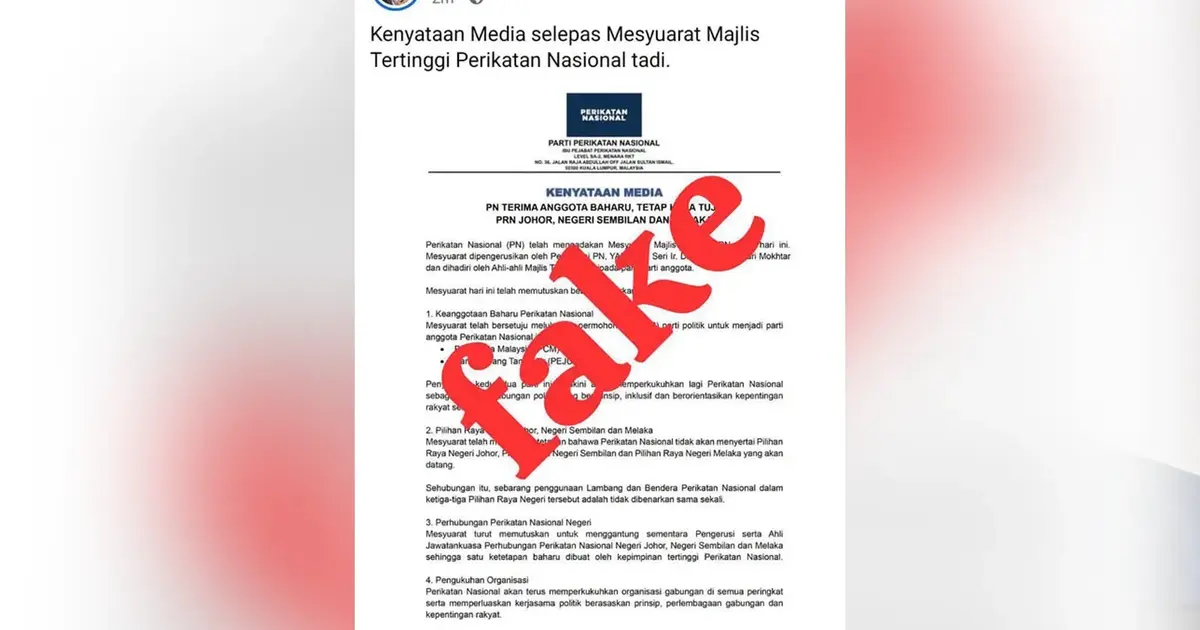
A statement circulating in political circles has alleged that Perikatan Nasional will abstain from three state elections, prompting the opposition coalition to issue a swift denial. PN representatives characterised the claim as entirely false and inaccurate, underscoring their commitment to electoral participation across Malaysia's political landscape.
The emergence of such unsubstantiated allegations reflects the intensifying competition within Malaysia's opposition bloc, where strategic positioning ahead of electoral contests remains a contentious matter. PN, which comprises UMNO, PAS, and several smaller parties, has maintained its focus on strengthening its presence in state-level politics as a pathway to building broader electoral momentum.
State elections represent crucial battlegrounds for political parties seeking to consolidate support and demonstrate governance capabilities. For PN, these contests carry particular significance given the coalition's relatively recent formation and its ongoing efforts to establish itself as a credible alternative to the current federal administration. Withdrawing from any electoral competition would contradict these core objectives and potentially undermine the coalition's long-term strategic interests.
The false statement appears designed to create confusion about PN's electoral intentions and possibly to generate internal discord within the coalition's ranks. In Malaysia's polarised political environment, misinformation campaigns targeting major political actors have become increasingly commonplace, with various interested parties seeking to influence public perception and shape electoral dynamics.
PN's immediate rejection of the claims demonstrates the coalition's determination to maintain clarity regarding its political direction. Coalition leaders have consistently emphasised their intention to contest elections across all available platforms, viewing state assemblies as essential arenas for advancing their political agenda and building grassroots support networks.
The denial carries implications beyond mere political posturing. State elections offer parties opportunities to test their campaign machinery, refine messaging strategies, and evaluate voter sentiment in specific geographic constituencies. For PN, participation in these contests serves as both a practical mechanism for political development and a symbolic assertion of the coalition's viability as a national political force.
Malaysian voters have grown increasingly sophisticated in evaluating political claims and counter-claims, particularly following the country's recent political volatility. The public's exposure to multiple competing narratives has heightened awareness of the distinction between verified electoral positioning and speculative reporting. PN's decisive response to the false statement aligns with voter expectations for clear, factual communication from major political actors.
The timing of such allegations may reflect anxieties within opposition circles about PN's trajectory and potential electoral prospects. As Malaysia moves through its electoral cycle, coalitions and parties face pressure to demonstrate unity and resolve, making allegations that suggest divisions or inconsistency particularly damaging to internal morale and public credibility.
Regionally, PN's electoral strategies carry significance beyond Malaysia's borders, as Southeast Asian political observers monitor how opposition coalitions navigate complex multiparty competition and evolving voter preferences. The coalition's emphasis on comprehensive electoral participation contributes to broader discussions about democratic competition and the accessibility of political institutions across the region.
Moving forward, PN faces the ongoing challenge of translating its electoral commitments into tangible results. Success in state contests would vindicate the coalition's strategic approach and potentially strengthen its negotiating position within Malaysia's broader opposition landscape. Conversely, electoral setbacks could invite renewed scrutiny of PN's cohesion and long-term viability.
The incident underscores a persistent feature of contemporary Malaysian politics: the circulation of unverified claims that attempt to exploit public attention and reshape political narratives. PN's swift and explicit rejection of the false statement demonstrates standard practice among major political organisations seeking to maintain message discipline and public credibility.
As Malaysia's electoral calendar continues to unfold, the stakes for state-level competitions will only intensify. PN's commitment to contesting these elections represents a fundamental aspect of its opposition strategy, and any suggestions to the contrary warrant the kind of direct refutation the coalition has provided. The coalition's ability to maintain its electoral presence while managing internal dynamics and responding to misinformation will significantly influence its prospects for political advancement.