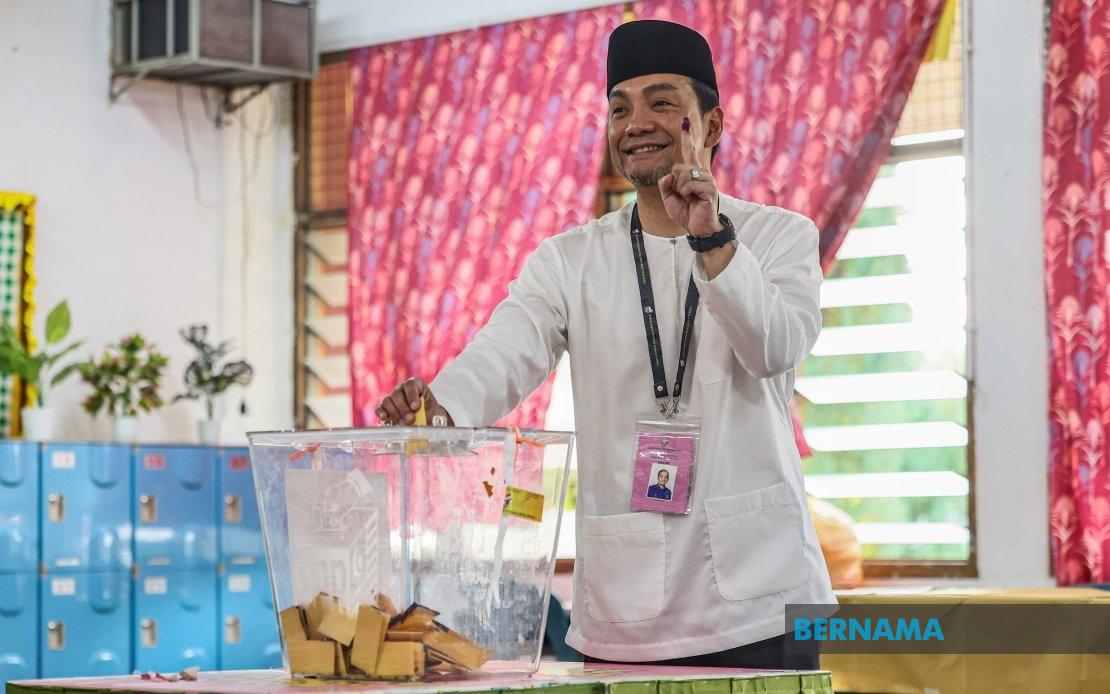
Johor Menteri Besar Datuk Onn Hafiz Ghazi exercised his democratic right on July 11 in the 16th Johor state election, casting his ballot at Sekolah Kebangsaan Simpang Renggam shortly after 8:30 am. The appearance marked a significant moment for the incumbent leader, who is mounting a campaign for a second consecutive term in the position that has dominated Johor's political landscape in recent years.
Before making his way to the polling station, Onn Hafiz, who doubles as chairman of Johor's Barisan Nasional machinery, took the opportunity to connect with constituents gathered at the voting centre. The gesture reflected a common practice among seasoned politicians during election cycles, where personal interaction with voters remains an important tool for bolstering support and maintaining grassroots connections. His presence at the school underscored the significance both he and his party place on this particular electoral contest.
The menteri besar faces a one-on-one electoral duel against Nur Hafiz Roslan, the Pakatan Harapan candidate challenging his incumbency. This straight fight between the two major coalitions captures the broader political polarization that has characterised Malaysian elections in recent years. The contest represents a direct ideological and administrative clash between Barisan Nasional's governance model and Pakatan Harapan's reform platform, with local Johor issues serving as the primary battleground for competing visions.
Following his voting engagement, Onn Hafiz addressed members of the media with an appeal for strong public participation throughout polling day. His call for early voting reflected concern about overall turnout levels, which have become increasingly important in determining election outcomes across Malaysia. The emphasis on orderly and efficient polling procedures suggested a desire to see the process completed smoothly without disruptions or technical difficulties that might undermine confidence in the electoral system.
Simultaneously, the Puteri Wangsa constituency witnessed voting activity from another prominent political figure. Dr Maszlee Malik, representing Pakatan Harapan in this particular state seat contest, arrived at his designated polling station at SJK (C) Tuan Poon in Simpang Renggam to record his vote late in the morning. His candidacy represented a notable return to electoral politics following his previous ministerial tenure in the federal government.
The Puteri Wangsa race itself presented a considerably more fragmented political landscape compared to the menteri besar's contest. Five distinct candidates competed for the seat, transforming the election into a multi-cornered battle rather than a two-horse race. Beyond Maszlee and the Barisan Nasional representative Teow Chia Ling, voters faced choices including Rashifa Aljunied of the Malaysian United Democratic Alliance, Nicholas Paul Vincent representing Parti Bersama Malaysia, and independent candidate Wang Wee Siong. This proliferation of choices reflected the growing diversification of Malaysia's political ecosystem beyond the traditional BN-PH framework.
The presence of MUDA in this electoral contest marked the continued relevance of newer political movements attempting to carve out space in Malaysian politics. Similarly, Parti Bersama Malaysia's participation demonstrated ongoing efforts by smaller political entities to gain traction and construct alternative narratives to the established coalitions. Independent candidates, meanwhile, embodied the longstanding Malaysian tradition of individual aspirants seeking office outside formal party structures, though their success rates typically remain limited.
Johor's 16th state election represents more than merely routine democratic procedures occurring in one of Malaysia's most economically significant states. The southern sultanate has historically served as a bellwether for broader national political trends, making voting patterns here particularly consequential for assessing the health of both Barisan Nasional and Pakatan Harapan support bases. Results here frequently foreshadow outcomes in subsequent federal electoral cycles, giving the contest national implications.
The election itself occurred within a distinctive political moment for Malaysia, characterised by ongoing realignments within the broader political system. The successful positioning of Onn Hafiz as a relatively new political figure with apparent support among Johor voters represented an interesting development within Barisan Nasional's renewal strategy. Conversely, Pakatan Harapan's continued challenge to the traditional ruling coalition reflected the structural changes in Malaysian electoral competition that have persisted since 2018.
For Malaysian voters and political observers, particularly those in Johor and neighbouring states, the election outcome carried significance extending beyond provincial concerns. The result would contribute to understanding whether Barisan Nasional's stabilisation efforts under contemporary leadership were succeeding and whether Pakatan Harapan retained genuine capacity to govern strategically important states. These questions remain central to Malaysia's evolving political trajectory as the nation navigates persistent questions about governance quality, institutional integrity, and democratic representation.

