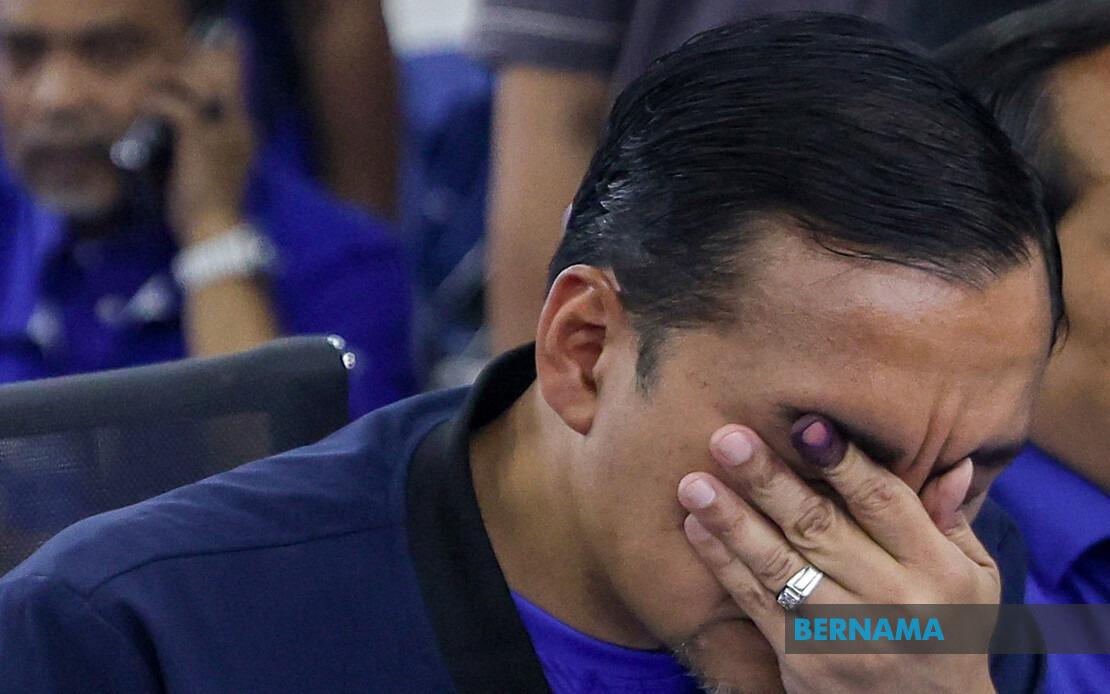
Datuk Onn Hafiz Ghazi has consolidated his political grip on the Machap seat, securing victory for Barisan Nasional in the 16th Johor state election held today. As both the Johor Menteri Besar and state BN chairman, Onn Hafiz's successful defence of his constituency reinforces his position as a central figure in peninsular Malay-Muslim politics and the ruling coalition's leadership in Malaysia's southern state.
The scale of Onn Hafiz's victory marks a significant shift in the electoral dynamics of Machap. Official results released by the Election Commission showed the incumbent garnering 20,382 votes to vanquish Pakatan Harapan's Nur Hafiz Roslan in a direct two-candidate contest. The margin of 15,375 votes represents a substantial amplification of his support base compared to his previous outing at the ballot box.
This enlarged majority comes as a marked contrast to the 2022 state election, when Onn Hafiz retained the seat with a considerably narrower advantage of just 6,543 votes. That earlier victory occurred in a fractious four-way race where he faced opposition from Perikatan Nasional's Azlisham Azahar, MUDA's R. Sangaran, and PEJUANG's Sharuddin Md Salleh. The fragmentation of the non-BN vote across multiple parties had worked in his favour then, but today's result demonstrates that voter consolidation and renewed confidence in his leadership have driven his performance upwards substantially.
The strengthened mandate suggests several important dynamics at play in Johor's electoral landscape. Barisan Nasional appears to have successfully rebuilt its coalition architecture following the fractious period that saw the rise of Perikatan Nasional as a serious alternative. The concentration of opposition support around Pakatan Harapan, rather than its fragmentation across splinter parties, indicates that the two-bloc contestation that defined Malaysian politics nationally may be reasserting itself at state level.
For Onn Hafiz personally, the enlarged victory margin elevates his authority within Barisan Nasional at a time when the coalition continues to navigate internal tensions between its component parties. As Johor Menteri Besar, he has advocated for a more businesslike approach to governance and has sought to project competence on economic and development matters. His expanded support in Machap provides political capital to pursue his agenda within both state government and the broader BN framework.
The implications for the broader Johor election deserve careful consideration. Machap is regarded as a bellwether constituency within the state, and Onn Hafiz's expanded victory margin may foreshadow stronger-than-expected performances for Barisan Nasional across other seats. The coalition has been working to restore its electoral dominance following its near-defeat in the 2022 state polls, and results of this calibre would signal successful repositioning.
Pakatan Harapan's defeat in Machap, particularly by such a substantial margin, underscores the challenges facing the opposition coalition in Johor specifically. The state has traditionally been a BN stronghold, and while Pakatan made significant inroads in 2022, consolidating those gains has proven difficult. The concentration of resources on a high-profile seat such as Machap, where it fielded Nur Hafiz Roslan, yielded no electoral dividend, suggesting that the opposition faces an uphill battle in reversing BN's structural advantages in the state.
The elimination of splinter candidates from the Machap race appears to have benefited Onn Hafiz disproportionately. In 2022, votes scattered across four candidates created an opening for a narrower victory. Today's straight fight against Pakatan Harapan gave voters a clearer binary choice, and the overwhelming preference for the incumbent reflects either genuine approval of his stewardship or voter hesitation toward the opposition alternative, or most likely a combination of both factors.
For Malaysian observers tracking the health of electoral competition at state level, Machap's result offers important lessons about voter behaviour and coalition dynamics. The swing toward Onn Hafiz suggests that even in the post-2022 era, when conventional wisdom held that Malaysian voters were increasingly volatile and unpredictable, traditional ruling-coalition strength in core constituencies remains formidable. Johor's Menteri Besar appears to have successfully immunised his seat against opposition challenge through a combination of incumbency advantage, effective governance messaging, and the coalescence of the Barisan Nasional machinery.
Looking ahead, the significance of today's result will become clearer once the broader pattern of victories and defeats across Johor's constituencies is established. If Onn Hafiz's strengthened position in Machap is replicated across other marginal seats held by Barisan Nasional, the coalition could emerge from these elections with an enhanced majority that provides stability for state governance in coming years. Conversely, should other BN-held seats prove more competitive, the Machap outcome may represent an isolated strong performance rather than a broader pattern of rejuvenation.

