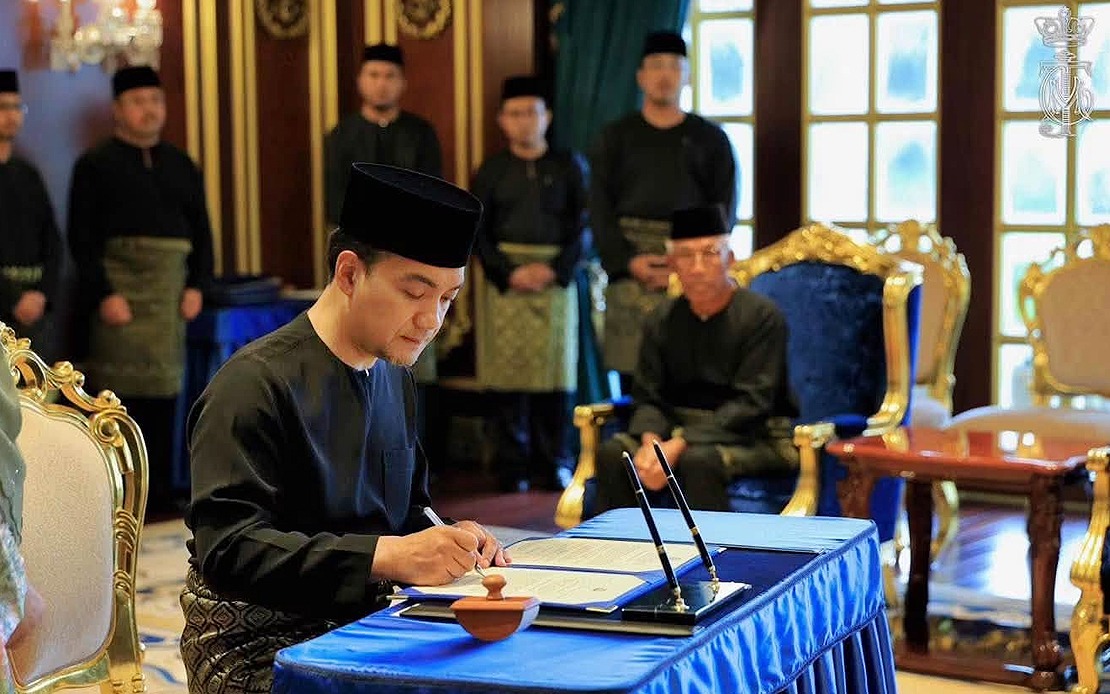
Datuk Onn Hafiz Ghazi took the oath of office as Johor's 19th Menteri Besar for a second term on July 12, cementing his position atop the peninsular state's administration after Barisan Nasional's commanding performance in the most recent state election. The 48-year-old leader, sworn in before the Regent of Johor, Tunku Mahkota Ismail, at Istana Bukit Serene, represents a continuity of both governance and dynastic influence within one of Malaysia's most politically significant states. His reappointment follows an election that strengthened his mandate considerably, positioning him to advance the state's long-term economic and social objectives with renewed electoral backing.
Onn Hafiz's political pedigree extends deep into Malaysia's founding era and Johor's institutional memory. He is the great-grandson of the late Datuk Onn Jaafar, who established UMNO and served as Johor's seventh Menteri Besar, establishing a lineage that shaped nationalist politics during the colonial transition period. More prominently, he descends from the late Tun Hussein Onn, Malaysia's third Prime Minister, whose tenure from 1976 to 1981 proved pivotal in navigating the nation through a critical post-Emergency consolidation phase. This generational legacy positions Onn Hafiz within a narrow elite of political families whose influence spans institutional leadership at both state and federal levels, a connection that carries symbolic weight beyond Johor's borders.
Barisan Nasional's electoral performance in the recent Johor state election delivered a substantially enlarged majority that reshapes the legislative arithmetic in the state assembly. The coalition secured 48 of 56 state seats, an improvement of eight seats compared to the 2022 election, when BN captured 40 seats. This expansion represents not merely a consolidation of the incumbent's position but a potential mandate to pursue more ambitious policy initiatives without the legislative constraints that accompany narrow majorities. For Malaysian political observers, the result underscores the continued strength of traditional coalitional politics in a major state, even as federal dynamics have become more fluid and unpredictable in recent years.
Onn Hafiz has anchored his administration to a development framework formally articulated as "Maju Johor 2030," a long-term blueprint that prioritises economic diversification and investment attraction. During his initial tenure since March 2022, this agenda has provided organisational coherence to state-level policy initiatives, positioning Johor as a growth engine within Southeast Asia's broader economic integration. The expanded electoral mandate now provides increased political capital to pursue flagship projects and negotiate with federal authorities and private investors from a position of strength. The framework's emphasis on economic expansion aligns with regional trends toward positioning Malaysian states as individual economic actors rather than purely administrative subdivisions.
His professional background before entering electoral politics shaped an administrative approach grounded in efficiency metrics and financial discipline. Between 2001 and 2004, he worked as an auditor at PricewaterhouseCoopers, acquiring technical knowledge of corporate governance and risk management. Subsequently, he held various executive positions, including directorships and chief executive roles within the corporate sector between 2005 and 2013, notably with Chin Well Holdings Berhad and KMB Sdn Bhd. This trajectory distinguished him from many political contemporaries who rose through party structures without substantive private-sector experience, potentially informing a managerial rather than ideological approach to state governance. Such backgrounds have become increasingly common among second-generation political leaders across Southeast Asia, reflecting the fusion of technocratic and political career paths.
Born on March 2, 1978, Onn Hafiz completed his early education at the Royal Military College before pursuing tertiary studies in accounting at the University of Hertfordshire in Britain. This educational pathway—combining elite domestic institutional formation with overseas university training—represents a standard trajectory for Malaysian political elites across multiple generations. As a father of four, he presents a family-oriented public image consistent with contemporary political messaging across the region. His career transition from accounting and corporate management to full-time political engagement occurred relatively late compared to politicians who entered legislative bodies in their thirties, suggesting a deliberate professional sequencing before committing to electoral competition.
Onn Hafiz's entry into active electoral politics commenced through party machinery rather than grassroots mobilisation. Between 2012 and 2018, he served on the UMNO Youth executive council and led the Sembrong UMNO Youth division, building organisational credentials within party structures. Concurrently, from 2013 to 2018, he served as political secretary to the defence minister, acquiring exposure to federal-level governance and ministerial operations. This apprenticeship culminated in his election as Layang-Layang assemblyman in the 2018 general election, subsequently leading to his appointment as chairman of the Johor Tourism, Youth and Sports Committee from 2019 to 2022. The pathway demonstrates the calcified nature of advancement within UMNO, where positions within party hierarchies and executive roles precede electoral contestation rather than following it.
His transition to the Menteri Besar position occurred through the 2022 Johor state election, when he contested the Machap state seat successfully and was subsequently appointed to lead the state administration. This appointment followed the collapse of the Hasni Mohammad administration and represented a generational shift toward younger, professionally credentialled leadership within UMNO's Johor contingent. Within UMNO's institutional structure, he currently serves as chairman of the Johor UMNO Liaison Committee and chief of the Simpang Renggam UMNO division since 2023, having previously held the deputy chief position from 2018 to 2023. These positions reinforce his control over party machinery within the state, creating overlapping layers of influence spanning electoral, executive, and party organisational domains.
The renewed mandate carries implications for Southeast Asian regional dynamics beyond Johor's borders. As Malaysia's premier industrial and commercial hub outside the federal territories, Johor's economic trajectory influences broader ASEAN competitiveness and investment flows. Onn Hafiz's stated focus on investment attraction and economic expansion positions the state to compete more aggressively for regional capital flows, particularly within manufacturing, digital economy, and logistics sectors. His professional background in accounting and financial management suggests comfort with quantitative governance frameworks and performance-based accountability mechanisms increasingly demanded by institutional investors.
The second term also provides opportunity to deepen infrastructure projects initiated during his first administration. Johor's geographic proximity to Singapore creates both economic complementarity and competitive tension, requiring sophisticated diplomatic and business acumen to maximise bilateral advantage while protecting local interests. Onn Hafiz's corporate experience and connections within the business community position him to navigate these complex negotiations more effectively than politicians with purely grassroots or party-based backgrounds.
Looking forward, Onn Hafiz's expanded majority and strengthened position within both UMNO and state administration may influence broader calculations about his potential trajectory within national politics. Political succession planning at federal levels frequently draws upon state-level success, and a leader consolidating power in a prosperous major state whilst managing complex economic and administrative challenges accumulates political capital of potential national significance. His age—currently 48—positions him within an intermediate generation between current federal leadership and emerging political cohorts, potentially relevant to longer-term power transitions within UMNO and the broader Malaysian political structure.

