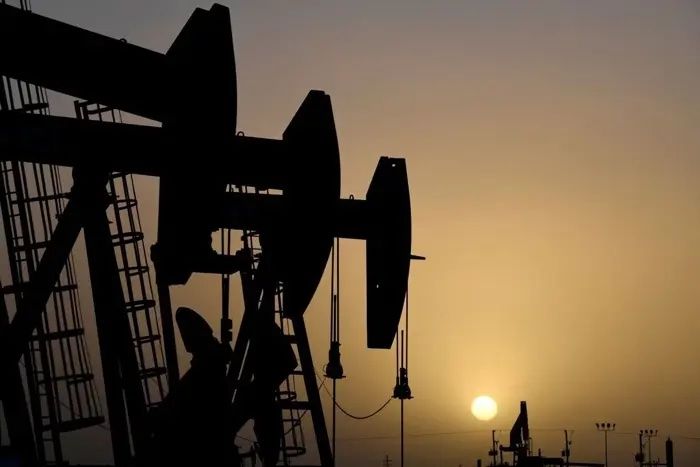
Oil markets surged on Friday as military tensions between the United States and Iran reached a critical juncture, with both nations conducting successive attacks across the Persian Gulf and threats mounting to close vital shipping corridors that channel a substantial portion of the world's crude exports. The spike in crude prices reflects deepening concerns about potential supply disruptions at two strategically crucial chokepoints—the Strait of Hormuz and the Red Sea—as diplomatic efforts deteriorate and military posturing intensifies.
Brent crude futures gained 70 cents per barrel to settle at $84.93, representing a 0.83% increase, while West Texas Intermediate climbed 81 cents to $79.76, a 1.03% rise that reversed losses accumulated during the previous trading session. The momentum reflected broader market anxiety about geopolitical risk in one of the world's most energy-critical regions. More significantly, both benchmark contracts have posted substantial weekly gains of approximately 12%, with Brent tracking towards its third consecutive weekly advance and WTI positioned for a second consecutive weekly climb, signalling sustained trader concern about medium-term supply security.
The escalation marks the first significant military action since a memorandum of understanding had briefly paused direct hostilities between Washington and Tehran. On Wednesday, the U.S. launched two major waves of air strikes concentrated near Iran's southern coast, continuing bombardment into Thursday. The U.S. Central Command confirmed that American forces initiated what it termed "a new wave of strikes" for a sixth consecutive night, explicitly aimed at degrading Iranian military capabilities. These operations occurred at 2 p.m. EDT, or 9:30 p.m. in Tehran time, demonstrating the intensity and coordination of the campaign.
Tehran has responded in kind, deploying missiles and unmanned aircraft targeting U.S. military installations across neighbouring countries, including strikes directed at a recently expanded air base in Jordan. The tit-for-tat exchange has raised legitimate questions about whether either side retains sufficient diplomatic off-ramps to de-escalate without further military action. The cycle of escalation carries particular significance for global energy markets because both nations possess the capability to substantially disrupt crude flows through international waters.
Beyond immediate military operations, Iran's leadership has conveyed instructions to its Houthi allies to prepare for potential closure of the Red Sea shipping corridor, contingent upon whether U.S. forces strike Iranian power infrastructure. According to three sources who briefed Reuters, this conditionality represents a deliberate escalation pathway that transforms infrastructure targeting into a trigger for blockading another major export route. For Malaysia and other Southeast Asian economies heavily dependent on Middle Eastern oil and gas imports, such a development would pose significant energy security challenges and could trigger substantial import cost inflation.
The Red Sea already represents a concerning vulnerability in global supply chains following previous attacks by Houthi forces on commercial shipping. The prospect of coordinated, state-directed closure of this waterway would duplicate supply pressures currently threatening the Strait of Hormuz, through which approximately 21% of the world's petroleum passes. Analysts at KCM Trade characterised the situation as a "dual-risk scenario," with multiple chokepoints simultaneously vulnerable to disruption. Chief market analyst Tim Waterer observed that "the potential threat of the Red Sea becoming another major supply disruption point is further complicating the global oil outlook," describing how geopolitical premiums remain embedded within both major crude benchmarks.
Qatar's defence ministry reported that its armed forces successfully intercepted an Iranian missile attack early Friday morning, with the country's interior ministry subsequently confirming that shrapnel from the interception operations injured a child. The incident underscores how escalating military activity now extends beyond direct Iranian-American exchanges into broader regional security dynamics, potentially drawing additional countries into the conflict and complicating diplomatic resolution efforts.
International energy officials have expressed mounting alarm about the trajectory of tensions. Fatih Birol, the International Energy Agency's Executive Director, stated at a Council on Foreign Relations event in Washington that energy security remains critically threatened. He explicitly warned that further deterioration over the coming weeks would warrant serious concern, implying that current price levels may prove insufficient if supply disruptions materialise. His comments carry significant weight given the IEA's role as the primary international arbiter of global oil market conditions and reserve adequacy.
The technical outlook for crude prices depends substantially on whether current support levels prove sustainable. Analysts at IG indicated that West Texas Intermediate could potentially test mid-$80s price territory if the contract maintains above key support in the mid-$70s range. This analysis suggests limited downside protection unless military tensions unexpectedly ease, though the technical floor appears somewhat fragile and vulnerable to sudden moves lower if risk appetite suddenly returns to markets.
For Malaysian policymakers and businesses, these developments present multifaceted challenges. Import-dependent economies throughout Southeast Asia face mounting energy costs precisely when regional growth momentum has already decelerated. Petrochemical producers and refineries relying on feedstock from Middle Eastern suppliers confront both input cost pressures and supply reliability questions. Additionally, the extended disruption of shipping routes through the Red Sea and the Strait of Hormuz would inevitably increase freight costs for goods transiting between Europe, Asia, and beyond, further pressuring regional competitiveness.
The underlying structural dynamics driving current tensions suggest that diplomatic resolution may prove elusive without significant concessions from either party. The U.S. position reflects longstanding commitments to regional security partnerships and concerns about Iranian military expansion, while Iran's rhetoric emphasises national sovereignty and resistance to external pressure. This ideological gulf complicates conventional negotiation pathways and suggests that energy markets will likely remain influenced by geopolitical considerations for the foreseeable future, even absent dramatic military escalation.

