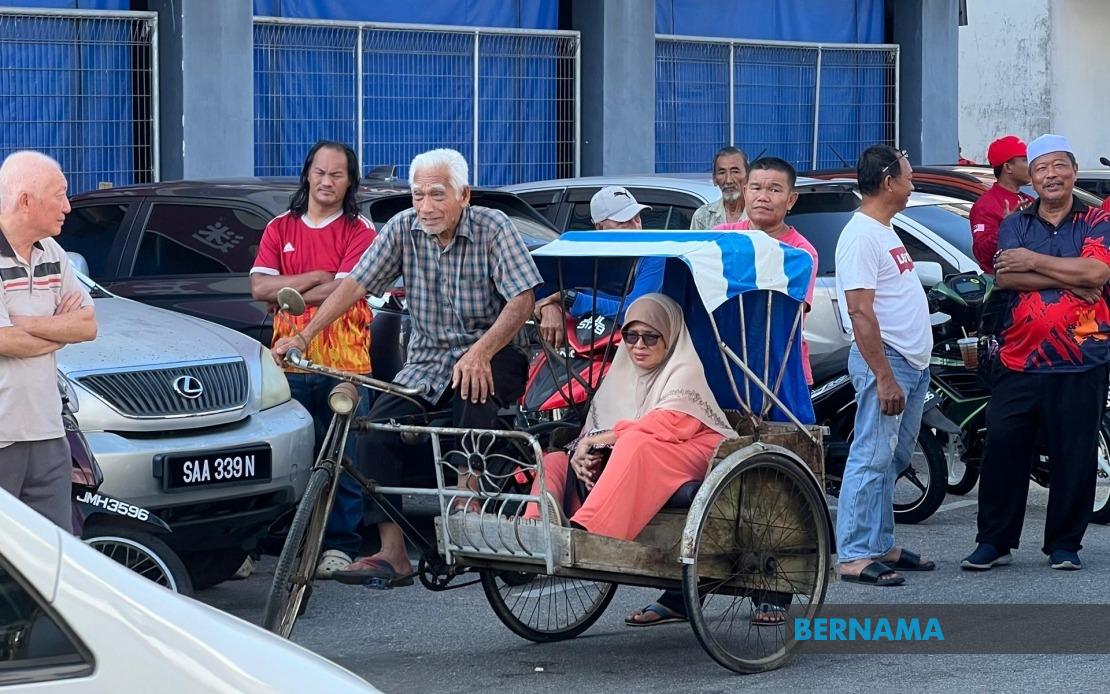
In the sweltering humidity of a Johor afternoon, an 86-year-old man's determination to share a moment with the nation's leader tells a deeper story about grassroots political engagement in Malaysia. Abdul Razak Pelangga, the imam of Masjid Raudhatul Jannah Parit Bugis, pedalled his trishaw nearly a kilometre through Batu Pahat's streets to ferry his wife, Jamilah Samsudin, to a chance encounter with Prime Minister Datuk Seri Anwar Ibrahim. The journey, undertaken despite the oppressive heat and his advanced age, underscores how personal connection and political interest intersect during election campaigns at the community level.
The occasion was part of the PMX Meet-and-Greet Programme for the Senggarang state constituency, a series of informal engagements designed to bring the Prime Minister directly into contact with Johor voters as the state geared up for its 16th election. Anwar's stop at Kedai Kopi Hailam Sri Medan provided exactly the kind of accessible, unscripted political moment that resonates with ordinary Malaysians. The coffee shop setting—intimate, casual, and deeply embedded in local culture—allowed residents to observe and occasionally interact with their national leader in a way that formal rallies or televised addresses cannot replicate. This grassroots approach has become a hallmark of Pakatan Harapan's campaign strategy in state elections, emphasising direct voter engagement over grand spectacles.
Abdul Razak's choice of transport reveals practical wisdom about navigating both the physical and logistical realities of attending such events. Rather than driving or motorcycling, which would have required securing a parking space in crowded circumstances, he opted for the trishaw—a humble vehicle that is both environmentally sensible and deeply rooted in Malaysian street culture. This decision also carries symbolic weight; the trishaw represents a slower, more deliberate form of civic participation, contrasting sharply with the rapid-fire, media-driven nature of modern political campaigns. For a man in his eighties, the physical act of pedalling reflects not mere spectacle-seeking but genuine civic commitment.
The emotional foundation for this journey rested on a memory spanning decades. Abdul Razak recalled that long before Anwar became Prime Minister, the leader had visited his mosque in Parit Bugis to perform prayers. That encounter—a handshake, an exchange of greetings—had left an impression significant enough that Abdul Razak had recounted it to his wife numerous times over the years. When news arrived that Anwar would be passing through Senggarang, the opportunity to bring his wife to see the man from that distant memory became irresistible. For many Malaysians, particularly older citizens, such personal moments with political figures carry weight beyond party affiliation; they represent continuity, recognition, and the sense that leaders remember the communities they serve.
Though Abdul Razak and his wife could not achieve a face-to-face meeting with the Prime Minister owing to the sizeable crowd that had gathered, the experience itself satisfied their objective. Seeing Anwar from a proximate distance, after years of viewing him solely through television screens, created a tangible sense of connection. This distinction—between mediated and direct observation—matters considerably in how citizens experience and relate to political leadership. In an era dominated by digital communication and social media, the physical presence of a leader, even glimpsed from the crowd, carries an authenticity that no broadcast can fully replicate.
Anwar's visit to the coffee shop extended approximately 50 minutes, during which he engaged with local residents, sharing breakfast and conversation. Accompanying him was Datuk Fahmi Fadzil, the Pakatan Harapan Communications Director and Communications Minister, whose presence underscored the significance the coalition placed on this constituency and the broader Johor campaign. The informality of the setting—a neighbourhood coffee shop rather than a convention centre or government building—democratised the encounter, allowing ordinary Johor residents to approach and interact with the Prime Minister without the barriers typically associated with formal state functions.
Beyond the symbolic dimensions of the meeting itself, Abdul Razak's enthusiasm extended to the electoral process itself. Polling day for the Johor state election was scheduled for July 11, which coincided with his 87th birthday. Rather than viewing this as mere coincidence, he framed his participation in the electoral process as a birthday gift to himself and to the nation. Having voted numerous times throughout his long life, he recognised that this particular act carried enhanced significance not solely because of the Anwar factor but because of its alignment with a milestone in his own existence. This perspective reflects how older voters often perceive their continued civic participation as a privilege and responsibility, particularly in elections where they have witnessed and lived through Malaysia's political transformations.
The Johor state election represented a significant political moment for Malaysia beyond the immediate state-level implications. State elections serve as barometers for national political sentiment and provide opportunities for parties to test campaign strategies and messaging before potential general elections. Johor, as Malaysia's second-largest state by population and a traditional stronghold, carried particular strategic importance. The PMX Meet-and-Greet strategy reflected Pakatan Harapan's effort to maintain momentum and connection with voters, particularly in constituencies where the outcome remained competitive or uncertain.
The campaign calendar itself revealed the compressed timeline within which voters and candidates operated. Early voting was scheduled for July 7, providing flexibility for those unable to vote on the main polling day, while the primary election would be held four days later on July 11. This compressed schedule intensified the visibility and frequency of campaign activities, with leaders like Anwar strategically positioned across constituencies to maximise exposure and engagement. For residents of Senggarang and surrounding areas, the breakfast stop represented one of numerous campaign touchpoints they would experience in the weeks leading to the election.
Abdul Razak's trishaw journey also illuminates the socioeconomic dimensions of political participation in Malaysia. Not all voters possess private vehicles or the flexibility to attend campaign events during standard working hours. The casual, accessible nature of a coffee shop gathering accommodated citizens across various economic circumstances, enabling both the wealthy and those of modest means to participate. This accessibility is crucial for democratic health, ensuring that political engagement remains genuinely inclusive rather than inadvertently skewed toward particular demographic segments.
The story of an elderly man pedalling his trishaw through the heat to bring his wife to see a political leader might seem touching but ultimately inconsequential to those focused narrowly on electoral mathematics and policy outcomes. Yet such moments constitute the actual fabric of democratic practice. They represent the countless individual decisions through which citizens choose to engage with their political system, the personal narratives through which they connect abstract ideas about governance to lived experience. Abdul Razak's determination embodied the proposition that politics, at its most meaningful level, remains fundamentally about human connection and the shared civic project of choosing leaders and directions for society.
As Johor voters headed toward the polls, the Anwar breakfast stop in Batu Pahat had already registered in local memory—not through media coverage alone but through the direct experience of residents like Abdul Razak and Jamilah, who had made deliberate choices to be present and witness. Such grassroots engagement, replicated across numerous constituencies and voter interactions, shapes electoral outcomes in ways that formal campaigns and advertising cannot fully capture. The democratic health of Malaysia, ultimately, depends upon maintaining spaces—whether coffee shops or trishaw rides—where citizens and leaders can encounter one another across the distance that modern governance inevitably creates.

